ELT: Extract Load Transform, Explained
Learn Shanika WickramasingheBusinesses today rely on analytics and insights derived from different data types for gaining competitive advantages. These data often come from different sources and in different formats. Without a unified solution, aggregating those data and performing analytics tasks is challenging.
ELT has been invented to solve the complexities associated with processing data from multiple sources while retaining the raw data as it is. This article digs deeper into the ELT processes, use cases, benefits, and challenges. And of course we’ll look at the differences between ETL and ELT.
What is ELT?
Short for ‘Extract, Load, and Transform,’ ELT is one way to integrate data for data analytics. In the ELT process, raw data is loaded directly from its sources to a destination, such as a data lake or a data warehouse, in its original raw data format. Transformation proceeds after that, making data loading faster than in ETL.
In this data integration process, raw data stays in its original format. As there is more raw data today than ever before, ELT been gaining momentum and popularity among cloud-based systems. Indeed, modern data warehouses like Amazon Redshift, Snowflake, and Google BigQuery are designed specifically for transforming large volumes of raw data efficiently.
The differences: ELT vs. ETL
ELT fundamentally differs from extract, transform, and load (ETL) from the data format in the destination data storage.
In ETL, data are transformed into the required format after the data extraction and then loaded into the data lake or warehouse. Thus, data will not be in its original format in destination storage like ELT.
Data loading in ELT is faster and more flexible than loading data in different formats. It does, however, require a powerful data processing engine on the destination server to transform them. Unlike ETL, you do not have to decide on the query and schema before loading them into the data warehouse.
Both ELT and ETL use staging areas or temporary storage spaces:
- ELT staging areas are within the data warehouse.
- ETL staging areas are integrated within the ETL tool itself.
(Read our companion guide to ETL.)
The 3 processes of ELT
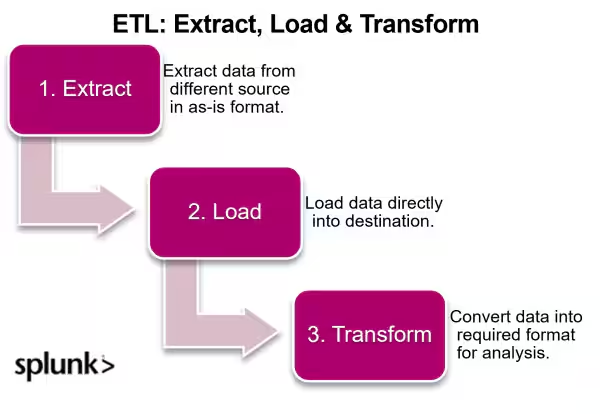
ELT comprises three phases: Extract, Load, and Transformation phases.
Phase 1. Extract
Data from different sources is extracted as it is. Examples include web pages, email repositories, customer relationship management (CRM) systems, Enterprise Resource Planning (ERP) systems, APIs, etc.
Data can be in unstructured, semi-structured, and structured formats such as JSON, XML, or data tables.
Phase 2. Load
Extracted data is loaded directly into the destination, often a staging area within the data warehouse. This is similar to offline data extraction in ETL, where raw data is stored temporarily. After that, the raw data will be loaded into the data warehouse in bulk or incrementally, depending on the underlying infrastructure. This is an automated process.
Phase 3. Transform
The final phase involves converting the data into the required format before it is used for further analysis. Several transformation processes happen during this phase. For example, data normalization processes like removing data duplications, missing values, summarization, aggregation, and mapping processes.
Further transformation steps such as data partitioning, validation, and encryption may be required, depending on the organizational requirement and the underlying technology used for data analytics.
Use cases: when & why to use ELT
Reporting and analysis
ELT facilitates reporting and analysis by preparing and organizing data for efficient querying and analysis. ELT extracts and loads data from various sources into a single data warehouse or data lake, enabling users to access and query data from a centralized location.
ELT leverages the computational power of modern data warehouses such as Amazon Redshift and Google BigQuery, enabling real-time or near-real-time reporting.
Handling a massive amount of data
Handling massive amounts of data is often a challenge. Leveraging ELT processes enables organizations to gain several advantages in such scenarios.
Cloud-based data warehouses used in ELT can handle a massive amount of data and consist of processing power to process it efficiently. Furthermore, their inherent scalability allows for dynamically scaling up and down the resources according to demand.
(Read all about big data analytics.)
Collaborating or merging data with other teams
It is challenging to integrate data when different teams and organizations all use different systems, structures, and processes. Data sources can range from traditional relational databases to NoSQL databases hosted in on-premises data centers or by various cloud providers. Leveraging ETL for collaborating and merging can be time-consuming and complex, as the raw data has to be transformed first.
Instead, ELT allows collaborating organizations to load raw data from each into a single and unified data platform without the risk of losing any data. After merging, organizations can synchronize data to ensure the merged system is updated with the most recent data.
Creating data sandboxes for experimentation
Data sandboxes provide experimental environments for data scientists and analysts using the raw data sets without altering the original data sources. ELT allows users to load data in raw format into a sandbox environment. It enables scientists to understand the underlying information, anomalies, and patterns.
Scientists can then experiment with various data transformation processes, comparing results and refining their approaches. Additionally, they can build machine learning models, iteratively refining them. Across the whole process, there will be no impact on the original data sources.
Data streaming analysis
Organizations use ELT to capture and analyze data in real time. For example, IoT devices and social media platforms produce vast amounts of data continuously, which requires ingesting a continuous stream of data. ELT allows users to load such data quickly into cloud data warehouses or lakes and perform real-time or batch transformation.
For example, real-time processing is critical in financial fraud detection — the real-time nature allows users to take immediate action to avoid fraud.
Top ELT tools
The development of cloud platforms has led to the emergence of many ELT tools with different sets of features. Here are examples of some of the top ELT tools widely used by organizations today.
- Talend data fabric provides a modern solution for data integration, quality, governance, and more. The software also provides data security, ensuring regulatory compliance.
- AWS Glue is a serverless data integration platform that can be used for analytics, machine learning, and application development. It allows integration with more than 70 data sources.
- Matillion simplifies connecting to various data sources. It also creates data pipelines and carries out complex transformations on data.
- Airflow is a Python-based open-source platform allows the creation and monitoring of workflows from data.
- Fivetran has automated the time-consuming parts of ELT processes. It also provides over 300 no-code source connectors and performs real-time data movement with minimal impact on data sources.
- Splunk is a unified data platform for all the data in all the parts of your organization. It can solve almost any problem you’ve got, provided there’s data for it. Learn more about what you can do with Splunk.
Benefits & challenges with ELT
ELT can be useful in a variety of ways. Let’s look at the benefits.
- Flexibility in data storage and transformation. In ELT, data from different sources can be integrated into one platform without first deciding on the data structure. ELT enables futureproofing: organizations can retain data in its original form and use it for future use cases or unforeseen needs.
- Flexibility in choosing transformation tools. In ELT, data transformation is decoupled from the extraction and loading phases. This decoupling allows organizations to choose the transformation method according to the use case without depending on the tools used during the extraction and loading phases.
- Cost efficiency. Data warehouses used in ELT use a pay-as-you-go mode where users only have to pay for what they use. Therefore, organizations can often optimize their costs by leveraging the computational power of these platforms only when needed.
- Optimizes data storage. data warehouses used in ELT provide an optimized storage solution that can scale well and provide advanced features such as automatic data compression.
- Reduces operational costs. ELT helps reduce operational costs (OpEx) in many ways, especially compared to traditional ETL processes. For example, Handline has high performance and large-scale transformations efficiently, reducing data storage costs through compression and allowing faster development and maintenance.
- Helps you comply with regulations. The ELT transformation phase consists of data validation and data quality that can help you meet regulatory compliance standards.
Of course, like anything in technology, there is some inherent complexities to be aware of.
Data transformation can be complex
When data is transformed after loading the data, it can be complex due to the complex structures in raw data. Therefore, this transformation can be slow. Besides, it can be challenging to maintain complex transformation logic with varying data sets.
Impact on other tasks in the warehouse
Since raw data is transformed directly in the data warehouse, it can utilize more computing power. This high resource utilization can impact the other tasks in the data warehouse, creating performance bottlenecks.
Challenges in cost optimization
Even though most ELT data warehouses operate on a pay-as-you-go model, costs can go high if the usage is not monitored accurately.
Migrating from ETL can be challenging
ELT and ETL use different coding and logic. Therefore, organizations transitioning from ETL to ELT must rethink their setup or consider moving to a cloud provider.
Data security concerns
Since ELT data warehouses store raw data, they have the potential to introduce security vulnerabilities. Especially if there is sensitive and confidential information, it is critical to ensure the security and privacy of raw data before it is transformed.
ELT: a more flexible approach to your data
ELT fundamentally differs from ETL by performing the data transformation after directly loading the raw data into data warehouses. As mentioned in this article, ELT has several use cases. Several ELT tools have been developed, and the top ELT tools provide unique features to make the ELT process smoother. Leveraging ELT tools provides many benefits to organizations.
However, as you learned from this article, there are several challenges associated with this process that you need to consider to maximize benefits from your investments.
FAQs about Extract Load Transform
Related Articles

Blacklist & Whitelist: Terms To Avoid

The Double Diamond Design Process