What Is SOC Modernization?
Learn Laiba SiddiquiThe increasing number of cybersecurity threats means that it’s constantly more challenging to monitoring and prevent these threats. These rising attacks indicate that your organization — indeed, your intellectual property — is constantly at risk.
Modernizing your SOC is now mandatory: so you can ensure you’re ready and futureproofed for detecting all sorts of malicious attacks. This article explains:
-
Why modernizing SOCs is important.
-
How to do it right.
-
What challenges does it involve?
The landscape for SOCs
The average cost of cybercrime globally was $4.45 million last year. These attacks dominated in 2023, breaching even the security of the U.S. State Department. Here's the average breach cost of a few industries:
-
The healthcare sector faced an average breach cost of $11 million.
-
The financial sector experienced an average breach cost of $6 million.
-
Pharmaceuticals came in third place, with an average breach cost of $4.82 million.
You can expect a massive rise in these numbers and more advancements in attack technologies in the coming years. That's why every organization needs modernized SOCs — to build resilience.
Security operation centers (SOCs) protect organizations' data by detecting and mitigating harmful threats. And here's how SOC managers manage these security operations centers:
-
They collect data and review alerts to identify risk events and potential incidents.
-
After identifying and reviewing, they design and implement strategies to recover from incidents.
(See how Splunk is powering the SOC of the future.)
Traditional SOCs: Understanding risks & gaps
Before 1995, SOCs were only made available to military and government organizations. Their main focus was to detect incidents — so they could manually recover them.
In contrast, organizations and banks relied on a reactive approach to managing network devices and manually monitoring performance.
General SecOps challenges
In short, traditional SOCs had many loopholes — and those loopholes now riddle SOCs and SecOps globally. Today, nearly 96% of organizations face at least one of these security operations challenges with their staff and systems:
-
Spotting threats quickly and taking action to minimize damage and keep your systems safe.
-
Ensuring comprehensive security measures are in place to protect all aspects.
-
Cutting through the noise of security alert and pinpointing the ones requiring immediate attention.
-
Adhering to evolving data security regulations and industry best practices.
SecOps workflow challenges
Going beyond basic security operations challenges, there are also many workflow challenges that CISOs and security teams face:
-
Continuously monitoring the network to identify and address various types of vulnerabilities.
-
Using disparate security tools (“tool sprawl”) makes understanding the overall security posture difficult and contributes to cross-functional inefficiencies.
-
Security tools and systems don't integrate easily, wasting time and effort.
-
Reliance on manual processes for security tasks slows down the ability to identify and respond to threats.
(Learn about security automation.)
With all this, we can say that most organizations today do not have SOCs that can keep up with today’s pace. So, modernizing the SOC must become a priority.
Importance of SOC modernization
SOC modernization helps organizations stay ahead of breaches and attackers' tactics. Modernized SOCs are prepared for the future because they can:
-
Detect threats seamlessly.
-
Improve and enhance collaboration.
-
Manage cybersecurity risks effectively.
Detect threats
Time is important, especially when it comes to identifying threats. Earlier threat detection reduces the time to exploit vulnerabilities. Continuous monitoring as part of SOC modernization makes it possible to identify threats before they occur.
(Related reading: the TDIR lifecycle: threat detection, investigation & response.)
Improve collaboration
Team collaboration is the backbone of any secure system. SOC modernization empowers teams by improving their communication and problem-solving skills.
Unlike traditional SOC, various security teams collaborate and share information faster. With improved collaboration, teams can reduce the response time.
Handle sophisticated threats
Cybersecurity attacks become more sophisticated every day. To stay ahead, it's important to evolve attack detection tools. To deal with the complexity of attacks, you need tools that identify and prevent them. Modernizing SOCs makes this possible.
Reduce response time
SOC modernization reduces the detection and mitigation period. With automation tools, you can reduce response time. Effective solutions such as AI and ML are examples of modernized SOCs.
(Power your SOC with full visibility and security monitoring from Splunk.)
How to modernize your SOC
Cybersecurity threats are never stopping. For this reason, modernizing your SOC is a must — but where do you begin? Organizations can use these best practices to improve their SecOps workflows and threat detection capabilities.
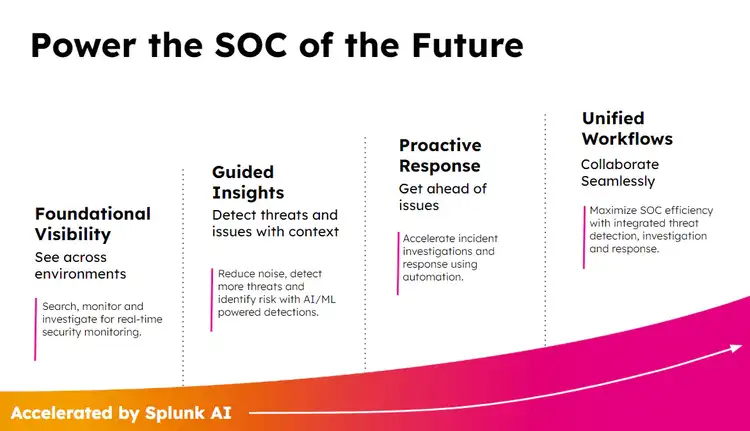
At Splunk, we are powering the SOC of the future with four areas of maturity, all accelerated by Splunk AI:
-
Enable foundational visibility so you can see across environments.
-
Get guided insights thanks to AI and ML-powered detections that provide the context you need exactly when you need it.
-
Get ahead of issues with proactive response that uses automation to accelerate incident investigations and response.
-
Collaborate seamlessly with unified workflows and a single data platform.
Automate SOC workflows
If your security analysts perform repetitive tasks manually, this consume pretty much all of their valuable time and may cause errors. So, a modern SOC automates specific manual tasks such as:
- Log collection, log monitoring and log management
- Event correlation for event analytics
- Incident ticketing and some repetitive incident response activities
Doing so will free up SOC analysts' time to focus on more complex tasks like threat hunting and incident investigation.
Reduce the number of tools used
Many security teams use multiple security tools, making it difficult for analysts to keep track of all the data and slowing down incident response times. For this purpose, modernized SOCs reduce the number of tools used and allow security teams to focus on important tasks.
Implement common work surface
The biggest flaw in traditional SOCs is the lack of visibility across infrastructure, which contributes to inefficient workflows. A common interface or work surface can provide SOC analysts with a single place to view all the data and tools they need to do their jobs.
This improves situational awareness and makes it easier for analysts to collaborate on incidents. That’s why modern SOCs will:
- Implement a common work surface/platform.
- Enable team members to collaborate effectively.
Train SOC personnel
Since threats are continuously evolving — so should your security teams' skills. Timely training will help stay up-to-date on the latest threats and vulnerabilities. So, train your SOC personnel to ensure they help you achieve your goals because every organization has different goals.
Adopt more SOC workflow best practices
Here are some general best practices for SOC modernization:
- Minimize human intervention to improve response time and human errors is essential.
- Automate the reactive functions by integrating EDR tools with SIEM.
- Build a better work environment to prevent SOC members from burnout and fatigue.
- Invest in the latest security tools to compete with the sophistication of cyberattacks.
SOC trends: what does the future hold?
The future of Security Operations Centers looks promising. You will notice improvements in data collection, security tooling, and access. SOCs will benefit from data enrichment through internal and external intelligence sources. And, best of all, a modern SOC will provide a better context for detection and automation.
The focus will shift from a physical SOC room towards an extended team model to include DevOps practices like writing, testing, and deploying detections. As data layers bring Security, IT, and DevOps teams together, cultures and working styles will be blended to increase productivity.
Overall, the future SOC will lower the barrier of entry so that more teams can harness sophisticated detection, orchestration, and automation capabilities.
Related Articles

What Is Detection Engineering? A Complete Guide to Modern Threat Detection

Splunk Open Source: What To Know