Log Monitoring with AI: What Makes Monitoring Intelligent?
Learn Muhammad RazaKey Takeaways
- Log monitoring provides real-time visibility into application and infrastructure events, enabling faster troubleshooting, early detection of security threats, and compliance with regulatory requirements.
- Implementing automated log monitoring with standardized formats, clear retention policies, and real-time alerts streamlines incident response and ensures efficient, actionable logging.
- Adopting a unified log-monitoring platform with integrated indexing, search, and observability features enhances scalability, optimizes system performance, and supports continuous security and compliance.
Log monitoring is the practice of collecting, aggregating, analyzing and processing network log data.
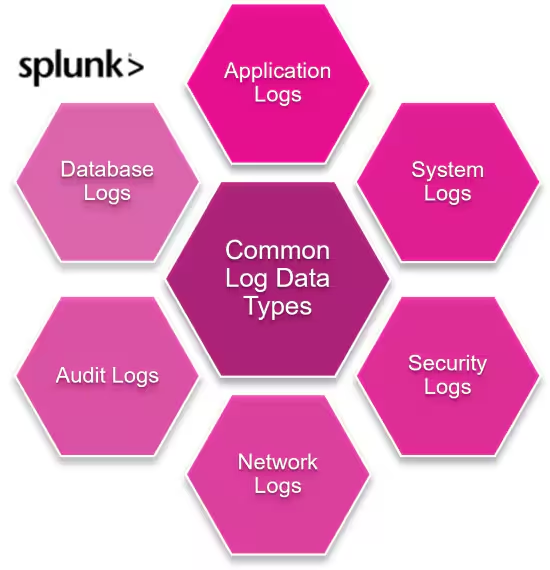
This information is generated from a variety of sources: network nodes, networking devices, applications, devices and third-party services. It may also contain:
- Security incidents and events information
- User traffic and access data
- Transactional logs
- Information about network and application performance
Information streams from heterogeneous sources are continuously monitored in real-time. The idea behind log monitoring initiatives is to identify anomalous incidents and understand insights from log data patterns. These insights can allow the organization to make proactive decisions on network security and performance — by correctly predicting the future state of their networks based on real-time information streams.
Now, with that basic understanding of what log monitoring is, we can now turn to log monitoring in today’s complex environments…and whether AI can be applied here.
(Related reading: log management & log analytics.)
Log monitoring today: Multicloud environments
Of the many downstream effects of the prevalence of cloud computing, one is the significant increase in the volume, variety and velocity of log data generated in the enterprise IT network. Suddenly, even small businesses are practically swimming in log data.
The scale and scope of network log data deluge is often unpredictable — or at least, unplanned. Enterprises deploy hundreds of SaaS apps on average, leading to SaaS sprawl. The network architecture may be software defined and the app workloads are dynamically distributed for load balancing and resource optimization. Compute provisioning is also easy: users can deploy growing instances of infrastructure and platform resources as needed.
Because these resources run in an ephemeral state, aggregating this network log data is critical to resource planning.
Real-time log aggregation
The server instances may be live only to temporarily run self-contained application components. However, the interaction of these application components and the underlying dependencies with external services — each accessing privacy- and security-sensitive user information — must be evaluated in real-time.
This is where real-time log monitoring plays an important role: helping your organization understand how your users, applications and machines interact within the network.
The importance & benefits of log monitoring
This knowledge resulting from real-time log monitoring is important for two key reasons.
Reason 1: Proactive security enforcement
Firstly, log monitoring allows for proactive security controls and policy enforcement.
In contrast, traditional network security solutions rely on fixed parameter measurements as a threshold for security sensitivity. In this world, for instance, these events are possible:
-
An unauthorized network intrusion attempt may be characterized as a false alarm unless the subsequent traffic behavior exceeds the predefined thresholds describing normal traffic parameters.
-
An unauthorized user can periodically extract small volumes of sensitive business information without raising any alarms.
Reason 2: Long-term forecasting
In large-scale, complex and multi-cloud environments, anomaly detection and other use cases of network log analysis become a multi-dimensional multivariate problem. This leads to the second challenge of long-term planning and forecasting.
So here, log monitoring is valuable because of its relationship to resource utilization on the network—but that’s not all. Network log monitoring and analysis can help develop the business case for a variety of needs, including decisions around your:
-
Future investments
-
Digital transformation efforts
Using AI to overcome limitations
To overcome limitations in downstream cybersecurity tasks — such as real-time threat intelligence, intrusion-detection and prevention, capacity planning and forecasting — consider using log monitoring tools with advanced AI capabilities.
(See how Splunk gives you visibility, on-premises and in the cloud.)
Here are best practices for the AI models governing these functions:
- AI models should train on real-time information streams generated in the form of network logs.
- In-house expertise may be required to transform raw preprocessing data into standardized trainable information assets.
- A data lake platform can be a suitable platform choice for real-time data ingestion at scale, allowing for an efficient schema-on-read analysis using third-party AI monitoring tools that rely on large-scale information processing to generate meaningful insights.
(While the latter may be seen as a limitation of log monitoring tools that extensively rely on machine learning functions, it is rarely a constraint for modern enterprise IT environments.)
This is particularly true for multi-cloud environments where an ever-growing deluge of log data is generated in real-time.
Benefits of AI for log monitoring
Any IT admin or security analyst can tell you that information from log data itself may not hold any long-term value — but the ability to understand the evolving state of network performance using real-time insights and pattern recognition using AI monitoring tools is useful in many ways.
- Firstly, real-time data processing is more important than the data storage itself. Engineering and security teams need access to insights and knowledge drawn from data, not the unprocessed raw log data itself.
- Secondly, AI models can be tuned and adapted in real-time. As a result, the changing network behavior, represented by changing log data and information metrics, is never compared against fixed thresholds to determine anomalous behavior.
The thresholds for anomalous behavior also become moving targets — and yet the AI models predicting anomalies adapt to account for changing usage patterns in real-time. This offers two huge benefits:
- Reduces the administrative burden on cybersecurity professionals and engineering teams.
- Provides real-time intelligence for your network monitoring functions.
An important consideration when using third-party data-driven log monitoring technologies is to enforce strict privacy preservation mechanisms. These include anonymization and masking of source to prevent reverse engineering the original source, and therefore, impersonation of the source devices and users.
For security sensitive information logs, consider encryption schemes to ensure data in transit remains secure. To avoid risk of a data breach, deploy IT monitoring and security monitoring tools for your in-house data centers or private cloud networks.
(Related reading: how SIEMs work for security incidents & event management.)
Related Articles

What Is IaC? Infrastructure as Code, Explained

Kubernetes Cost Management: A Practical Model for Controlling Cloud Spend