Digital Transformation in 2026: Strategies, Benefits, & Real-World Examples
Learn Shaun QuartonKey Takeaways
- Digital transformation isn't just about adopting new tech: it's about rethinking how value is delivered. It involves automation, data, AI, and cloud to reshape business operations.
- Strategies must align with business goals. Whether improving customer experience or modernizing infrastructure, the right roadmap varies by organization and industry.
- Real-world success stories show the impact. From logistics automation to virtual healthcare, transformation can drive both innovation and efficiency.
Global digital transformation spending is expected to reach $4 trillion by 2027. It's a staggering figure — and a clear sign of how essential transformation has become for future-proofing your business and delivering the kind of experiences that today's consumers expect.
In this article, we'll explore how businesses are embracing digital transformation, where initiatives are focused, and why it remains a top priority for organizations seeking to stay competitive in an increasingly fast-paced, tech-driven world.
What is digital transformation?
Digital transformation involves utilizing the latest digital technologies to fundamentally reshape how a business operates.
While digital transformation became a mainstream business imperative in the 2010s, the roots go further back, starting with digitization in the 1980s and ‘90s. We’re talking scanning paper documents or using computer software for certain tasks. The term “digital transformation” itself began gaining traction around 2011, when it was used to describe the broader organizational impact of technology shifts.
But true digital transformation goes beyond IT upgrades or modernizing existing workflows. It uses cutting-edge technologies to reimagine those processes entirely, unlocking new forms of value for customers and driving long-term growth.
Digitalization vs. digital transformation: what’s the difference?
While digitalization and digital transformation often overlap, there are key differences. Let’s clarify with an example from customer service:
- Suppose a company moves from phone-based support to email or introduces a chatbot for after-hours queries. These are examples of digitalization: using technology to improve an existing process.
- In contrast, digital transformation involves reimagining the entire approach. Imagine that same company adopting a fully automated, AI-powered support system. This new system delivers 24/7 personalized service across channels like chat, email, and mobile apps. It tailors responses to each user’s history and behavior, learns from every interaction, and proactively addresses known issues, even reaching out before a customer realizes there’s a problem.
Digital transformation fundamentally changes the nature of support, making it more innovative, personal, and always available.
That’s digital transformation: a fundamental shift in how value is delivered through technology.
How digital transformation works
The blueprint for digital transformation varies widely depending on a company’s size, industry, and goals. With emerging technologies and shifting customer expectations, there’s no fixed formula. However, the central aim is modernization — using technology to boost efficiency, speed, flexibility, and the customer experience.
Most digital transformation efforts focus on these key areas:
- Automation: Automated workflows replace manual processes, reducing errors, increasing efficiency, and enabling employees to focus on higher-value tasks.
- Customer experience: Continuously rethinking how value is delivered by simplifying digital journeys, speeding up support, and personalizing experiences across all channels.
- Modern infrastructure and scalability: Legacy systems often slow progress. Migrating to the cloud enables more flexible, scalable operations that evolve with business needs.
- Data-driven decisions: Real-time data and analytics provide insights into performance and customer behavior, enabling smarter, faster decisions.
- Integration: Unifying platforms and processes break down departmental silos, improves collaboration, and gives management a comprehensive view of operations.
- Cybersecurity and compliance: As connectivity increases, so do risks. Strengthening security, protecting data privacy, and meeting regulatory requirements are essential to minimizing disruptions.
Digital transformation is an ongoing process, continually adapting to new technologies and customer demands to stay competitive.
Framework: The five pillars of digital transformation success
According to Harvard Business Review, successful digital transformation tends to involve five interconnected elements:
- People: Getting the right leadership, culture, and talent in place.
- Data: Collecting clean, high-quality data across systems.
- Insights: Turning that data into usable insights through analytics.
- Action: Operationalizing insights across workflows, systems, and decisions.
- Results: Measuring outcomes and refining strategies based on performance.
These five pillars offer a practical lens to align transformation efforts across people, processes, and technology.
Other well-established frameworks, like McKinsey’s 7S model or BCG’s Digital Acceleration Index, also highlight the importance of aligning strategy, structure, and people to drive meaningful transformation. The exact framework matters less than ensuring all elements of the business are aligned and evolving together.
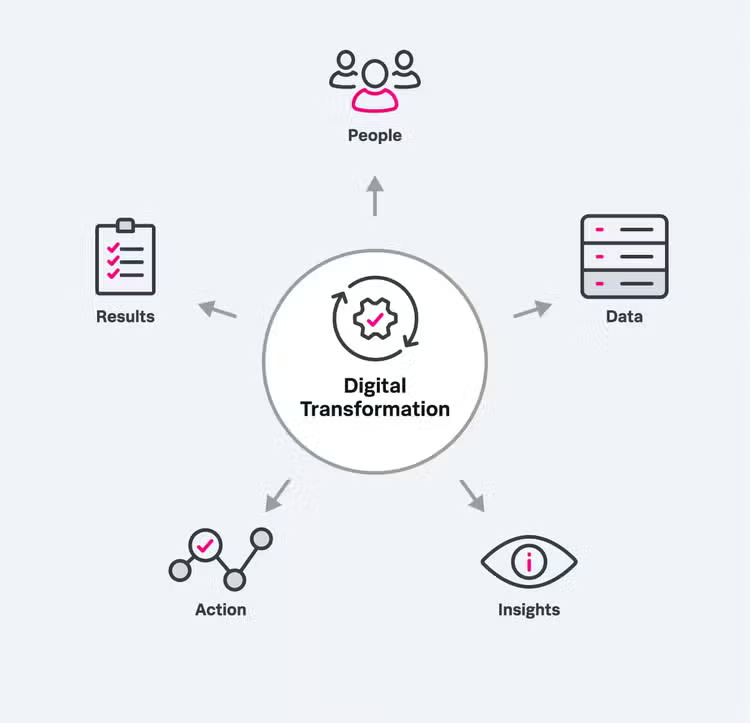
The five main components of digital transformation include people, data, insights, action and results.
Benefits of digital transformation
We know that digital transformation can fundamentally change the way your business operates. Here are some specific real-world benefits can you expect:
- Competitive advantage. Leveraging the latest technologies allows you to rethink your entire business model. Early adoption or pioneering new tools can help you approach challenges in unique ways, grow market share, and stay ahead — while competitors are still catching up.
- Improved customer experience. Digital transformation enables you to enhance the customer journey from start to finish. With advanced technology, you can personalize interactions, streamline service, and develop innovative solutions that address customer needs more effectively.
- Greater efficiency and lower costs. Automating manual tasks streamlines workflows, reduces errors, and frees employees to focus on higher-value work. These efficiencies lead to cost savings through better resource allocation, fewer bottlenecks, and, in some cases, reduced staffing needs.
- Faster decisions and more agility. Real-time data and integrated systems provide teams with improved visibility, allowing your business to respond and adapt quickly to market changes, customer demands, or internal challenges.
(Do you know what customer journeys are the most critical? Learn how to monitor user journeys and turn that insight into improvement.)
Why digital transformation fails (and how to avoid it)
While organizations pursue digital transformation for the long-term benefits, it’s not without its challenges. Here are some common difficulties to be aware of:
- High upfront costs. Adopting cutting-edge technology is expensive, especially when developing new solutions. Beyond the technology itself, training, recruitment, and unexpected downtime can add to costs. The long-term ROI is positive, but profitability isn’t immediate.
- Staff pushback. A complete overhaul of existing processes can create genuine uncertainty for employees. Concerns about training, adapting to new skills, or even job security are common, often leading to resistance if the reasons for change aren’t clear. Without buy-in from management and staff, digital transformation is more likely to fail.
- Integration challenges. Rolling out digital transformation all at once is hardly practical: the scope is too broad and the risk is too high. But rolling out new systems gradually can result in integration issues with existing legacy infrastructure, leading to data silos, bottlenecks, and frustration for employees and customers.
- Security concerns. Systems become more connected and cloud-based, the potential attack surface grows. Strengthening security measures is critical to address operational risks and meet compliance requirements.
Digital transformation strategies
There’s no single blueprint for digital transformation. Every organization faces different challenges, priorities, and opportunities. But successful strategies do share some common traits: they’re grounded in business goals, flexible enough to evolve with emerging tech, and tailored to an organization’s people, processes, and industry.
Below, we explore several types of digital transformation strategies — and how to start building the one that’s right for your business.
Align with business goals
Start by identifying the key outcomes you want to achieve. Are you trying to reduce costs, grow revenue, improve customer experience, or build more resilient infrastructure? The most effective strategies are designed backward — from desired outcomes to the technologies and processes that can deliver them.
Types of digital transformation strategies
Your strategy may include several focus areas depending on what you're trying to accomplish:
- Operational efficiency: Streamline processes using automation, cloud migration, and AI-based optimization to reduce costs and boost speed.
- Customer experience transformation: Deliver more personalized, consistent, and seamless interactions across every touchpoint, often powered by data and intelligent systems.
- Business model innovation: Introduce new products, services, or delivery models (like digital subscriptions, marketplaces, or self-service platforms) to generate new revenue streams.
- Workforce Enablement: Equip employees with digital tools, enable remote collaboration, and invest in upskilling to support transformation from within.
- Resilience and Risk Management: Strengthen cybersecurity, improve compliance, and design systems that are more adaptable and fault-tolerant.
Build a transformation roadmap
Once you’ve identified your objectives, it’s time to turn strategy into action:
- Assess your digital maturity: Understand where your organization stands today, across people, processes, and platforms.
- Define success metrics: Use KPIs tied to both business performance and technical impact.
- Prioritize initiatives: Start with pilot programs or “quick wins” that can be scaled up once validated.
- Establish governance: Assign ownership and accountability to cross-functional leaders who can drive the change.
- Stay agile: Be ready to pivot as technologies shift and customer expectations evolve.
Tailoring strategy by industry
Different industries face different transformation pressures. For example:
- Healthcare might focus on patient access and remote monitoring.
- Finance may emphasize digital onboarding, fraud prevention, and compliance.
- Retail could prioritize omnichannel experiences, supply chain automation, and personalization.
Bottom line? A digital transformation strategy isn’t a checklist — it’s a dynamic approach that connects where your business is today with where it needs to go. And like any good strategy, it should evolve as fast as your market does.
Evolving strategies in an AI-powered world
Digital transformation strategies are increasingly shaped by the larger shifts happening around us. Many of today's initiatives can be traced back to the COVID-19 pandemic, which fundamentally changed how people work, shop, and interact.
What began as a workaround during lockdowns is now deeply ingrained. There’s still high demand for remote work, digital collaboration, and seamless online experiences, whether it's virtual healthcare, digital banking, or on-demand services. We’ve experienced convenience, and we’re not willing to give it up. Businesses have had to rethink their operations and offerings to meet this new reality: strategies must reflect that shift.
At the same time, artificial intelligence (AI) has moved from being a buzzword to a critical part of digital transformation strategy. Approximately 75% of all businesses are already using AI in some capacity, and that number will grow. After all, businesses are scrambling to integrate AI into their processes, not just to save time and money but also to:
- Automate repetitive tasks.
- Analyze data at scale.
- Deliver more personalized and intelligent services.
The most effective transformation strategies now treat AI and post-pandemic behaviors not as temporary trends, but as permanent drivers of innovation. Staying relevant means staying adaptive — and that starts with recognizing how much the landscape has changed.
Getting started: How to start your digital transformation journey
Start by focusing on business impact, not technology for technology’s sake. Leadership alignment, small early wins, and a clear roadmap are essential. But don’t overlook people: support, training, and buy-in are what ultimately turn plans into progress.
Real-world examples of digital transformation
Digital transformation occurs across every industry, from retail and logistics to healthcare and government. To see this in action, let’s explore two very different examples.
Amazon logistics: Smarter, faster fulfillment
Once an eCommerce store, Amazon has become a tech giant spanning retail, cloud computing, streaming, and smart home technology. One of its most transformative achievements is none of these — it’s logistics.
Launched in 2005, Amazon Prime reset consumer expectations for online shopping, making fast, reliable, low-cost delivery the new standard. Behind the scenes, Amazon has revolutionized fulfillment with automation and AI, deploying its one-millionth warehouse robot in 2025. These robots handle tasks like locating, retrieving, and transporting inventory, boosting efficiency and enabling over 700,000 employees to move into higher-value roles.
Standout innovations include:
- DeepFleet AI: Coordinates robot traffic to prevent collisions and delays.
- VAPR (Vision-Assisted Package Retrieval): Uses robotic arms, cameras, and sensors to efficiently load delivery vehicles.
- Wellspring: An AI-powered system that optimizes delivery routes and powers real-time customer tracking.
NHS UK
Digital transformation isn't limited to private companies. The UK's National Health Service (NHS) has made significant strides in modernizing patient care. Historically, booking a GP appointment involved calling during a brief morning window — a process that was notoriously outdated and frustrated many patients.
During the COVID-19 pandemic, the NHS rapidly adopted digital tools to improve care access and reduce the burden on staff:
- An updated and upgraded NHS App that allows patients to book appointments, request prescriptions, and access health records via their phones.
- Video consultations became standard, reducing the need for in-person visits while improving convenience for patients.
- Several hospitals launched "virtual wards," where patients with chronic or less acute conditions could be remotely monitored via wearable devices that track vital signs. This allowed them to remain at home — freeing up hospital beds for more urgent cases and helping staff focus resources more effectively.
Keep innovating
Once you adopt the digital transformation mindset, it becomes a never-ending pursuit. Technologies evolve. Customer and employee expectations shift. And businesses that stand still risk becoming outdated.
Whether you're streamlining operations, enhancing customer experiences, or modernizing your infrastructure, the goal remains the same: to adapt, improve, and stay relevant.
By staying on top of industry trends and the technologies reshaping them, you can build a business that not only keeps up but also leads the way.
Digital Transformation: Frequently Asked Questions
Related Articles

What Is a NOC? Network Operations Centers, Explained

User and Entity Behavior Analytics (UEBA) For Enterprise Security