Architectures for Multi-Agent Systems
Learn Pratik BhavsarKey takeaways
- Architectural pattern choice dictates information flow, failure modes, and scaling behavior, directly impacting the long-term success of agentic projects.
- Patterns like centralized hubs offer predictability at the risk of bottlenecks, while decentralized and hierarchical models trade consistency for increased resilience.
- Effective multi-agent operations require observability that traces non-linear execution paths to identify coordination failures that aggregate metrics often miss.
Scaling from a single AI agent to a multi-agent system changes the fundamental engineering challenge from prompt optimization to architectural design. As systems grow in complexity, the information flow, failure modes, and scaling behavior of your agents become the primary determinants of project success or failure.
Choosing the right framework isn’t merely a design preference—it is a critical decision that dictates your system’s scalability, failure recovery, and long-term cost. This guide evaluates four core architectural patterns and the trade-offs required to build reliable, production-grade agentic operations.
Why architecture shapes everything: Factors of performance
Organization determines what you can trace, scale, and recover. In Anthropic's write-up of its multi-agent Research system, three factors explained 95% of the performance variance on the BrowseComp evaluation: token usage alone explained 80%, with tool-call count and model choice the other two. The same post reports that multi-agent systems use about 15x more tokens than chat interactions, so architecture determines how efficiently those tokens spread across parallel work.
- Information flow: Centralized systems route data through one hub, creating a bottleneck but simplifying consistency. Decentralized systems allow direct peer communication, speeding local decisions but risking global inconsistency.
- Failure modes: A centralized orchestrator is a single point of failure. Decentralized architectures can keep running through individual agent failures, but coordination gets harder.
- Scaling patterns: Single agents scale poorly as tools and context grow. On the NoLiMa benchmark (International Conference on Machine Learning (ICML) 2025), GPT-4o fell from 99.3% to 69.7% at 32,000 tokens, and 10 of 12 models scored half their baseline or less at that length. Multi-agent designs spread context across agents with separate windows.
Splitting work isn't free — coordination creates its own costs. A Nature Machine Intelligence study of 260 configurations across six benchmarks found multi-agent performance changes from +80.8% to −70.0% relative to a single agent, and every multi-agent architecture degraded on SWE-bench Verified.
Four primary architectures for multi-agent systems
1. Centralized: The orchestrator pattern
One agent allocates tasks, monitors progress, synthesizes results, holds global state, and makes routing decisions. Actions trace back to one place, and the pattern scales through map-reduce.
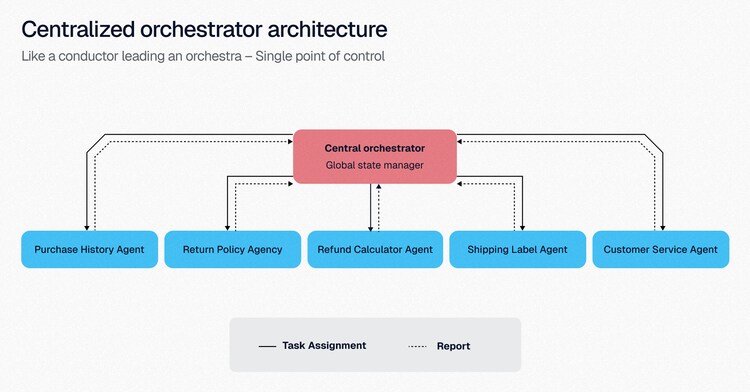
Take Anthropic's Research agent handling "emerging AI startups in healthcare." The lead agent spawns subagents for funding data, clinical applications, regulations, and competitive dynamics, then synthesizes their reports. Anthropic reports that a Claude Opus 4 lead with Claude Sonnet 4 subagents outperformed single-agent Claude Opus 4 by 90.2% on its internal research eval, and parallelization cut research time by up to 90%.
Performance characteristics:
- Token efficiency: higher when the orchestrator prevents duplicate work
- Latency: rises with sequential coordination
- Throughput: capped by orchestrator capacity
- Context: concentrated in the central agent
The cost lands on the hub. In one fault-injection study, a fault injected into a LangGraph central hub produced 100% system-wide failure, while leaf-node injection produced 9.7%. A returns system delegating purchase history, policy checks, refund math, and shipping labels stops processing every return if its orchestrator fails.
LangGraph's Command(goto=...) routing still implements this pattern, though create_react_agent is deprecated in favor of create_agent.
2. Decentralized: Peer-to-peer coordination
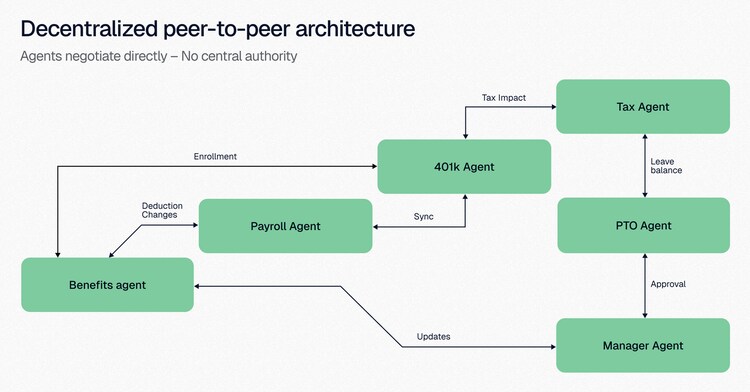
Agents talk directly to neighbors and decide locally. No agent sees the whole picture, and each keeps its own state. Picture a human resources (HR) system during open enrollment. The benefits agent coordinates directly with payroll on deduction changes. If it goes down for maintenance, the others can keep working.
The Agent2Agent (A2A) protocol, now governed under the Linux Foundation's Agentic AI Foundation, standardizes this collaboration: independent agents discover each other through Agent Cards and exchange stateful Tasks over a network. Performance profile shifts:
- Token efficiency: drops, duplicate work likely
- Latency: falls for local decisions
- Throughput: scales until coordination saturates
- Context: distributed evenly
You gain resilience, but global coordination gets hard and chatter can hurt. One study found naive full-broadcast synchronization raised hallucination rates by 34% (0.66 versus 0.49). Research from Shanghai Jiao Tong University (SJTU), Caltech, Johns Hopkins University (JHU), and the University of California, Berkeley found homogeneous ensembles plateau around four agents and heterogeneous ones around eight, with two diverse agents matching or exceeding 16 identical ones across seven benchmarks.
3. Hierarchical: Multi-level management
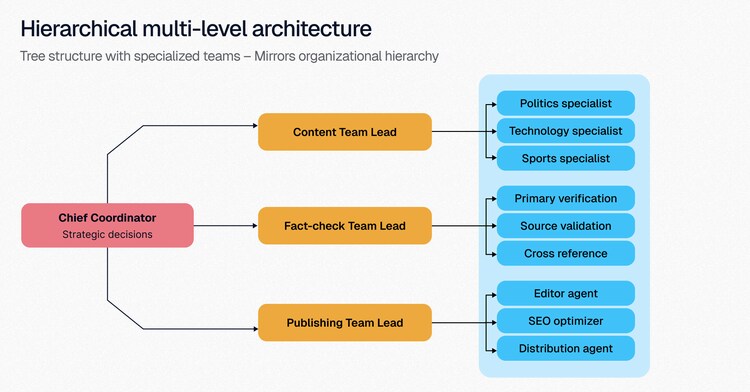
Layers of supervision form a tree: specialist teams work under leads who report to higher coordinators. Decisions cascade down, information bubbles up, and each level abstracts complexity.
Google's Agent Development Kit (ADK) builds the pattern in: attach child agents to a parent, and delegation happens when the parent's large language model (LLM) emits transfer_to_agent(agent_name='target_agent_name'), per the ADK docs.
A news platform shows the shape: a top supervisor coordinates content, fact-checking, and publishing teams, while the content supervisor manages beat agents for politics, technology, and sports.
Performance balances between extremes:
- Token efficiency: moderate, some redundancy
- Latency: moderate, multi-hop coordination
- Throughput: high through parallel teams
- Context: segmented by level and team
Hierarchy isolates faults. In an ICML 2025 resilience study, a hierarchical structure lost 5.5% performance under fault injection, versus 10.5% and 23.7% for the two other structures tested, and an inspector agent recovered up to 96.4% of errors. Depth has a price: OrchestraBench measured mean cascade radius growing from 0.93 at pipeline depth three to 4.67 at depth seven.
4. Hybrid: Strategic center, tactical edges
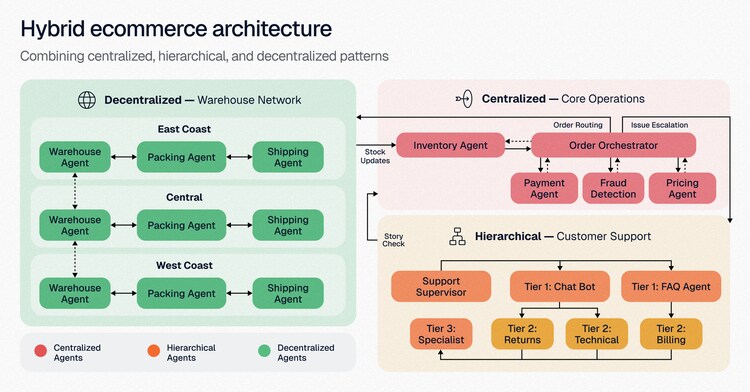
Hybrid designs pair centralized strategic coordination with decentralized tactical execution: global decisions flow from the center, while local optimizations happen through peer interaction.
In a food delivery platform, the central orchestrator handles order placement and payment, where transaction integrity matters. After confirmation, regional clusters take over: restaurant agents coordinate pickup timing with nearby drivers.
Performance adapts to requirements:
- Token efficiency: varies with task distribution
- Latency: tuned globally and locally
- Throughput: combines both approaches
- Context: strategic at center, tactical at edges
A token-cost analysis found a hybrid design improved accuracy by 1.1% to 12% while cutting costs by up to 88.1%. Implementation and debugging get harder because you must define when agents escalate versus handle work locally.
There is no universal "best" architecture; there is only the right fit for your specific operational constraints.
- Centralized models provide strong consistency but create potential bottlenecks.
- Decentralized peers offer resilience at the cost of global coordination.
- Hierarchical or hybrid structures allow for nuanced delegation in complex, multi-layered tasks.
The transition to multi-agent systems demands a shift from focusing on individual agent intelligence to focusing on the robustness of the framework that binds them. Regardless of the pattern you select, successful deployment requires matching your architecture to your problem space, enforcing clear communication boundaries, and ensuring you have the instrumentation necessary to trace failures across non-linear execution paths.
Ensuring reliability in complex architectures
Choosing an architecture is the first step, but regardless of the pattern, the complexity of agent-to-agent interaction creates "black box" failure modes. Whether you opt for a centralized hub or a decentralized peer network, you must have the instrumentation to trace failures across non-linear paths.
- If you choose Centralized: Your observability must focus on the hub. Splunk Agent Observability renders the orchestrator’s decision logic, allowing you to catch bottlenecks before the entire system hangs.
- If you choose Decentralized/Hierarchical: You need to map "agent flows" to identify where coordination chatter impacts token efficiency or where a specific sub-agent is causing downstream hallucinations.
By rendering every branch, decision, and tool call, you transform raw machine data into an intelligence layer. This is how you move from experimental agentic projects to trusted, production-grade operations. Read The Agentic Shift: Redefining Observability for the AI Era to see how observability extends from services to the agents that run on them.
Ready to explore solutions? Splunk Agent Observability enables you to observe, evaluate, and secure the agents, models, and infrastructure behind your AI.
FAQs about multi-agent architectures
Related Articles

Stateful vs. Stateless: Understanding Key Differences for Apps and IT Systems

What is Cloud Security? Types, Risks & Benefits Defined