What is Cryptanalysis? A Detailed Introduction
Learn Muhammad RazaCryptanalysis is the art of breaking cryptographic systems to uncover hidden weaknesses. While cryptography works to protect sensitive data, cryptanalysis tries to crack these defenses, testing their limits with clever techniques and strategies.
In this article, we’ll dive into what cryptanalysis is, exploring powerful methods and attack models that help uncover vulnerabilities, ultimately making cryptographic systems stronger and more secure.
What is cryptanalysis?
Cryptanalysts examine cryptographic systems with the aim of discovering vulnerabilities or flaws that could be exploited, breaking the system’s security.
Cryptanalysts use a variety of techniques to analyze how encrypted information might be cracked. These techniques range from mathematical analysis of encryption algorithms to exploiting weaknesses in the way the encryption was implemented.
In practical terms, cryptanalysis can be used to break a wide array of systems, such as:
- Email encryption
- Secure web communication
- Military communications
It plays a critical role in improving the overall security of cryptographic systems, similar to ethical hacking, for instance. This is because as weaknesses are discovered, cryptographers can create stronger encryption methods to prevent future breaches.
Examples of real-world cryptanalysis
- Breaking the Enigma code (World War II): One of the most famous examples of cryptanalysis is the breaking of the Enigma code during World War II. The German military used the Enigma machine to encrypt their communications. However, the British cryptanalysts, led by Alan Turing at Bletchley Park, were able to crack the Enigma code. This breakthrough is considered one of the key factors in shortening the war and saving millions of lives.
- Cracking SSL/TLS vulnerabilities: In modern times, cryptanalysts work to identify weaknesses in widely used encryption protocols like SSL/TLS. For instance, in 2014, a vulnerability called “Heartbleed” was discovered in OpenSSL, a popular implementation of the TLS protocol. This flaw allowed attackers to read encrypted data from servers, including sensitive information such as passwords and private keys. Cryptanalysts discovered this vulnerability, which led to the immediate patching and improvements to the encryption standards.
- RSA key cracking: In the early 2000s, researchers demonstrated that RSA keys (used in many encryption systems) could be cracked by factoring large prime numbers. This type of cryptanalysis led to improvements in RSA encryption, including increasing key lengths to make them more resistant to attacks.
Cryptography vs. cryptanalysis
While cryptography focuses on designing secure communication and data protection methods, cryptanalysis works to challenge these protections. This can be done by finding ways to decrypt or bypass encryption without the original key.
The foundation of cryptographic algorithms
The theory behind cryptography algorithms is well established. The choice of these algorithms guarantees specific security levels. For example:
- A 56-bit DES algorithm is relatively easy to break using high performance computing (HPC) systems.
- A strong algorithm such as the 256-bit AES encryption may be impossible to break using brute force attacks in a reasonable amount of time (unless we have a breakthrough in quantum computing technology in the near future).
The choice of cryptographic algorithm directly determines the security level of your system. In fact, the algorithm promises theoretically sound guarantees for security as described earlier. This is known as information-theoretical or unconditional security.
Of course, the algorithm you choose is one thing — you also need to implement it correctly.
(Check out our cryptography explainer.)
The role of implementation in cryptographic systems
Weaknesses may arise in the pipeline that implements cryptographic algorithms. The goal of cryptanalysis is precisely, to understand how cryptography is implemented within a system and identify weaknesses within this pipeline. A weakness itself may render the cryptographic implementation as ineffective.
For example, your messaging app may use strong encryption protocols for all data in transit between the user device and the backend communication servers. A security weakness may exist in the messaging app itself. For example, a vulnerability may allow malicious actors to read the keystrokes when typing a message and then exfiltrate this information to an external server.
This information will be sufficient to reproduce the original message from the sender, without having to access or decrypt the user’s encrypted data. A decryption key is not required to read the message. This is because the cryptography algorithm only protects data in transit, not the plaintext produced and stored within the application or device itself.
(Related reading: key management.)
Use cases of cryptanalysis
Consider the case of symmetric key cryptography: both the sender and receiver share the same key to encrypt and decrypt a ciphertext. Here, the goal of cryptanalysis may be to either:
- Recover the key itself or
- Deduce the mathematical function used for encryption and decryption (and then you no longer need the key).
Other goals include information deduction, such as mathematical, physical and computing properties of the cryptographic implementation. Weakness within these systems can help uncover the inner workings of the algorithm itself.
Alternatively, distinguishing algorithms that learn how to identify random blocks of ciphertext based on unique properties can also help in key recovery or at least, give a jump start on key discovery. If this behavior is deduced correctly, cryptanalysis can be used to systematically inject known plaintext input that corresponds to cipher blocks that are easily distinguishable.
Cryptanalysis models
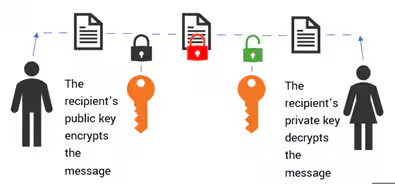
Cryptanalysis can be used to evaluate security risks associated with various models of cryptography systems, including public-key algorithms the symmetric key algorithms:
Black box model
In this case the malicious actor can only access the plaintext and possibly, the ciphertext. The inner workings of the algorithm and the implementation system are hidden. Cryptanalysis evaluates the mathematical properties of the black box system to identify the algorithm.
Gray box model
The cryptography algorithm is implemented on software or physical hardware. Cryptanalysis evaluated the entire system, exploiting weaknesses in the implementation of the algorithm itself.
Common gray box techniques include:
- Power analysis
- Differential fault analysis
- Acoustic and timing attacks
White box model
In this case, the attacker has complete access to the cryptography algorithm and implementation controls. Cryptanalysis may be used to extract encryption keys or even tamper with memory channels.
Implementing cryptographic algorithms
So how do you ensure that cryptographic algorithms are implemented correctly? It’s best to start in this order:
- Choose a secure cryptographic algorithm. Select an algorithm with proven information-theoretical security that has been rigorously tested.
- Use established techniques. Avoid creating custom cryptographic protocols. Instead, rely on widely accepted, peer-reviewed standards that have been analyzed for security flaws.
- Secure the implementation foundation. Ensure the cryptographic system is secure at all stages — including data creation, transmission, and access — beyond just the algorithm.
- Evaluate the entire system. Look beyond the algorithm and assess the entire cryptography pipeline, including hardware, software, and communication channels.
- Conduct regular testing and reviews. Perform continuous testing, security audits, and peer reviews to identify and address vulnerabilities.
- Stay updated on threats. Monitor emerging threats and cryptographic research, and update systems to address new vulnerabilities.
The future of cryptanalysis
Cryptanalysis is crucial for strengthening cryptographic systems and ensuring digital security. As technology advances, new attack methods, like side-channel attacks, are emerging. Side-channel attacks are a type of cryptanalysis that gather information from physical traces, like power usage or timing, to break cryptographic systems and uncover secret data.
Quantum computing also presents a challenge for current encryption methods, but it also opens new opportunities for cryptanalysis. Quantum computing threatens current encryption methods by using algorithms like Shor's to break systems like RSA and ECC faster than classical computers, but it also opens opportunities for developing quantum-resistant encryption.
As encryption evolves, cryptanalysis will continue to adapt, staying ahead of emerging threats to keep data secure.
FAQs about Cryptanalysis
Related Articles

Business Process Reengineering Explained

SLA Templates: How To Create Service Level Agreements