Benefits of Multi-Agent Systems
Artificial Intelligence Pratik BhavsarKey takeaways
- Multi-agent systems improve performance by assigning specialized agents to specific subtasks, which reduces hallucinations and prevents the context overload common in single-model architectures.
- Parallel processing and sequential validation gates enhance both system speed and output reliability, enabling automatic self-correction and graceful degradation during component failures.
- Strategic model routing optimizes operational costs by pairing lightweight models with simple tasks while reserving high-performance reasoning models for complex, critical queries.
Everyone's racing to build bigger language models, but the real breakthrough is happening in coordination. OpenAI's Swarm enables lightweight multi-agent orchestration. Google’s ADK helps developers build complex multi-agent applications.
The pattern is clear: coordinated AI agents solve problems that single models fumble. Multi-agent systems trade simplicity for capability. The core question is whether your use case actually needs the complexity of multiple agents, or if you're better off with one well-tuned model.
Single agent vs. multi-agent: When specialization beats generalization
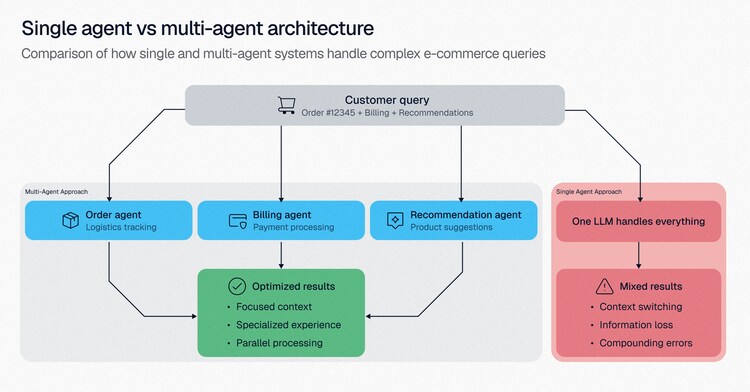
Imagine asking one LLM to handle an entire e-commerce customer inquiry: "My order #12345 hasn't arrived, and I noticed you charged me twice. Also, can you recommend similar products to what I ordered?"
A single agent must manage order tracking, payment processing, and product recommendations, often producing mediocre results across all three. The model loses context as it switches between database queries, financial calculations, and recommendation algorithms. Information gets dropped, and errors compound.
Now, if we took a multi-agent approach instead, consider the same query handled by specialized agents:
- Order tracking agent: Checks logistics databases, provides precise shipping updates.
- Billing agent: Reviews payment records, identifies duplicate charges, initiates refunds.
- Recommendation agent: Analyzes purchase history, suggests relevant alternatives.
Each agent excels at its specific task, maintaining focused context that reduces hallucinations. The Order Agent uses logistics-specific prompts and maintains shipping context. The Billing Agent focuses solely on transaction records with financial calculation optimizations. The Recommendation Agent analyzes purchase patterns without getting bogged down in payment disputes.
The real power comes from model selection flexibility. Your Math Agent can use Claude for reliable calculations at a temperature of 0.1. Your Creative Agent uses GPT-4 at temperature 0.9 for marketing copy. Your Summary Agent runs on Gemini to cut costs. You match tools to tasks, not forcing one model to handle everything.
You might have heard about the router in GPT-5. If 70% of your queries are simple FAQs, why send them to a reasoning model? Route them to a lightweight model that costs 1/100th as much. Reserve your premium models for the 5% of queries that actually need complex reasoning. This is how production systems achieve 60% cost reductions while maintaining quality.
Improving accuracy through orthogonal validation
Single-agent approach
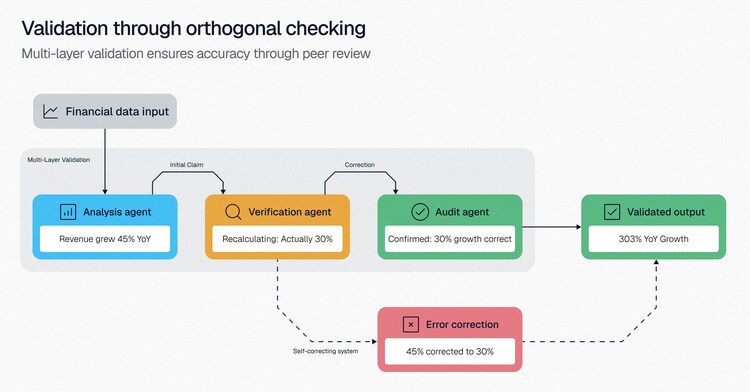
A single LLM analyzing financial data might confidently state: "Based on the Q3 reports, revenue grew 45% year-over-year."
If this is wrong, there's no internal mechanism to catch the error. The model has no self-doubt, no verification loop, no way to question its own output.
Multi-agent approach
The same analysis with validation layers:
- Analysis Agent: "Revenue grew 45% YoY"
- Verification Agent: "Wait, let me recalculate: Q3 last year was $10M, this year $13M, that's 30% growth"
- Audit Agent: "Confirmed: 30% growth is correct. The 45% figure was comparing different quarters"
The system self-corrects through peer review. Each agent validates different aspects:
- Generation Agent creates the initial response
- Logic Agent checks reasoning consistency
- Fact Agent verifies claims against knowledge
- Safety Agent ensures appropriate content
Anthropic's Constitutional AI demonstrates this in practice. One model generates responses, and another critiques them based on constitutional principles. The critique-revision loop catches outputs that the initial model misses.
Sequential validation gates have changed the way we handle errors in production systems. As we know, AI in insurance is on the rise, so let's take an example of claim processing:
- Intake Agent captures details (catches incomplete data)
- Validation Agent checks requirements (prevents downstream errors)
- Fraud Detection Agent analyzes patterns (flags suspicious claims)
- Approval Agent makes decisions (only sees pre-validated claims)
Each gate prevents errors from propagating. A single model trying to handle all these checks simultaneously often misses edge cases that specialized validators catch.
Scaling workloads with parallel agent processing
Single-agent approach
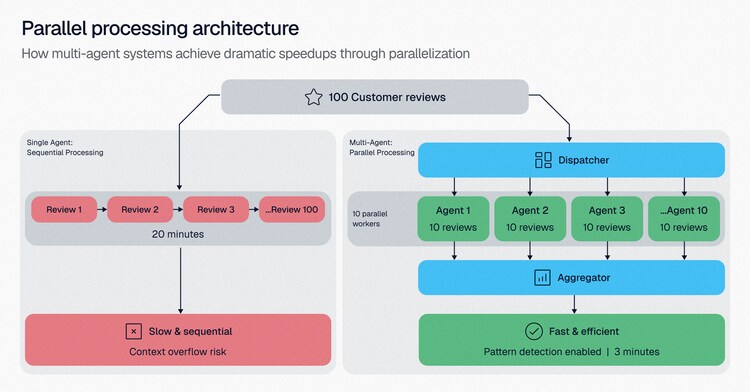
Picture a single LLM working through a pile of customer reviews like a lone analyst reading through feedback forms one by one. It starts with review #1, analyzes the sentiment, writes a summary, then moves to review #2. By the time it reaches review #50, it's struggling to remember patterns from review #5. The context window is filling up with processed reviews, leaving less room for new analysis.
- Review 1 → Sentiment analysis → Summary →
- Review 2 → Sentiment analysis → Summary →
- Review 3 → Sentiment analysis → Summary →
- … continues for 20 minutes
The model maintains growing context, risks token limit overflow, and processes each review in isolation. It can't identify patterns across the dataset because earlier reviews get pushed out of context. After 20 minutes of processing, you get individual summaries but miss the bigger picture—like discovering that 40% of complaints mention the same shipping issue.
Multi-agent approach
- Dispatcher Agent: Splits reviews into batches
- 10 Analysis Agents: Process 10 reviews each simultaneously
- Aggregator Agent: Combines results into a final report
Time reduced from 20 minutes to 3 minutes. But speed isn't the only benefit. Parallel agents can identify patterns across reviews that sequential processing misses due to context limitations.
Copilot and Cursor demonstrate this in practice. They analyze entire codebases simultaneously, understand dependencies across files, and suggest multi-file edits in parallel. One agent updates function signatures while another fixes all calling locations. A third update tests. This parallel approach enables refactoring that would be impractical sequentially.
Building resilience: fault tolerance and graceful degradation
Single-agent approach
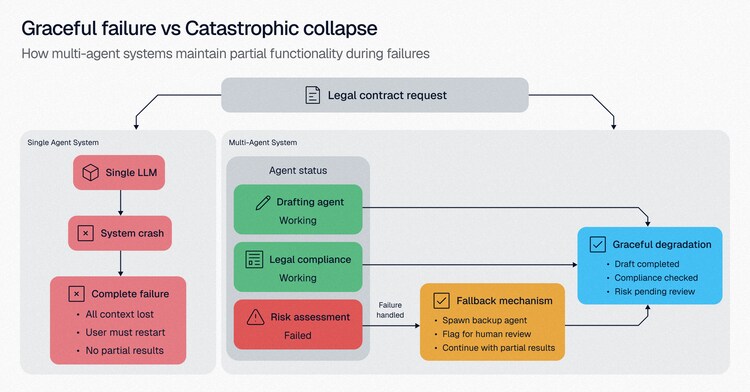
If an LLM crashes or produces nonsensical output while generating a legal contract, the entire process fails. You get an error message, and the user has to start over, losing all context.
Multi-agent approach
This risk is substantially reduced when leveraging a multi-agent approach.
- Drafting Agent: Creates initial contract
- Legal Compliance Agent: Reviews for regulatory issues
- Risk Assessment Agent: Identifies potential liabilities
If the Risk Assessment Agent fails, the system can:
- Continue with other agents' work
- Spawn a backup risk agent
- Flag the specific issue for human review
The partial work isn't lost. The user gets a draft contract with compliance review, plus a note that risk assessment is pending.
Circuit breaker patterns prevent cascade failures. When an agent fails repeatedly, the system stops calling it and routes around the problem. Primary Analysis Agent times out? Switch to Backup Analysis Agent. Backup fails? Return cached results with staleness warning. The user gets degraded but useful response, not an error.
This matters in production. Imagine a customer service system where the Payment History Agent fails due to database maintenance. In a single-model system, the entire interaction fails. In a multi-agent system, you still provide shipping updates and product recommendations. The response acknowledges the limitation: "Your order ships tomorrow. I'm unable to access payment history right now, but here are similar products you might like."
Intelligent routing for cost and performance optimization
Single-agent approach
We usually treat every query the same way. Simple FAQs and complex technical issues use the same model and approach. There is no adaptation based on query complexity or model confidence.
Multi-agent approach
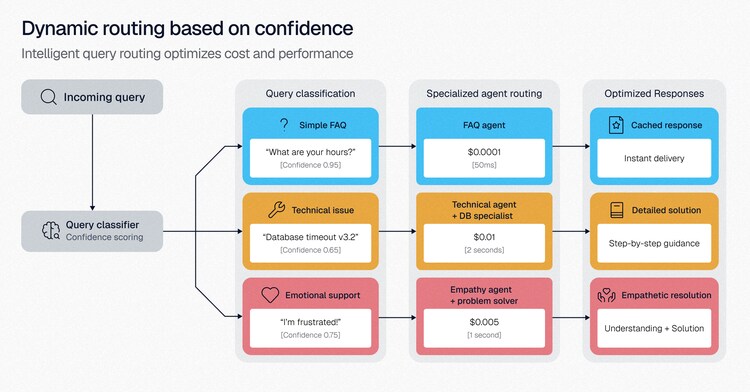
The system dynamically adjusts based on query classification:
For "What are your business hours?"
- Routes to FAQ Agent
- Uses cached response
- Costs $0.0001, responds in 50ms
For "My database connection keeps timing out after upgrading to v3.2"
- Routes to Technical Support Agent
- Spawns Database Specialist Agent for backup
- Costs $0.01, responds in 2 seconds with detailed troubleshooting
For an angry customer expressing frustration
- Empathy Agent handles emotional response
- Problem-Solving Agent works on the actual issue
- Both collaborate on a unified response
Confidence-based escalation enables progressive automation:
- High confidence (>0.9): Fully automated response
- Medium confidence (0.7-0.9): Agent response with human review option
- Low confidence (<0.7): Route to specialized agent or human
This creates a gradient of automation rather than a cliff. You start conservative, gradually increasing automation thresholds as you gather data. The system learns which queries it handles well and which need help.
Maintaining context consistency in extended interactions
Single-agent approach
In a long conversation, a single LLM might forget earlier context or contradict itself as the context window fills up. By message 50, it has no memory of message 5. Critical information gets pushed out of the context window.
Multi-agent approach
- Conversation Manager Agent: Maintains conversation state
- Memory Agent: Stores and retrieves key facts
- Response Agent: Generates replies using provided context
- Consistency Checker Agent: Ensures new responses align with previous statements
This architecture maintains coherence even in extended interactions. The Memory Agent can recall facts from message 5 when you're at message 50. The Consistency Checker prevents contradictions. The system maintains context without cramming everything into a single overflowing window.
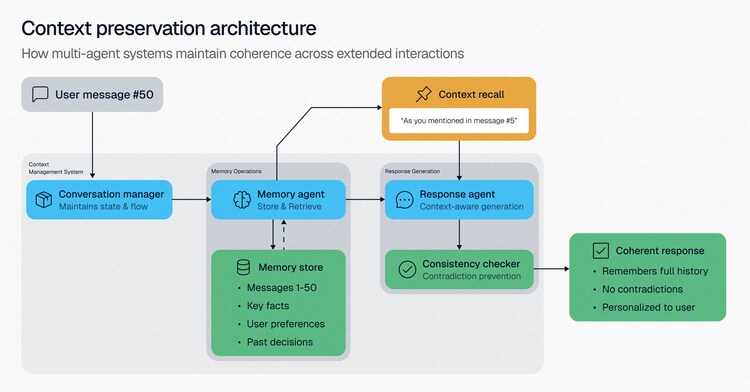
ChatGPT's memory explicitly separates memory management from response generation. The system extracts and stores important information from conversations, then retrieves relevant context for future interactions. This separation enables coherent conversations across sessions without cramming entire histories into every prompt.
The observability advantage: Debugging multi-agent workflows
It is evident that multi-agent systems clearly provide visibility that single models lack. You can track exactly where things go wrong, measure each component's performance, and optimize incrementally.
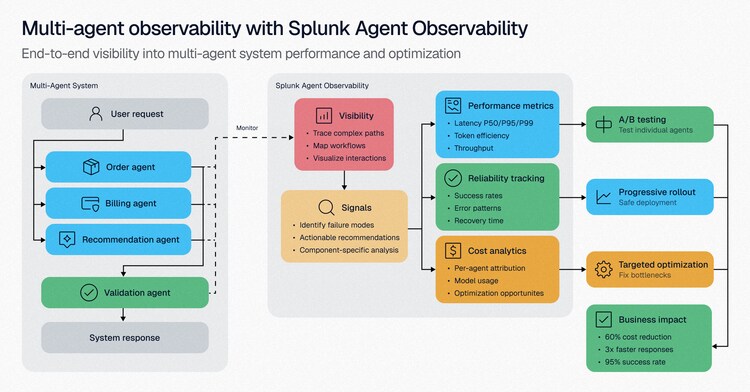
Splunk Agent Observability addresses this directly. Agent Visibility lets you trace complex agent paths and map multi-agent workflows. You see every branch, decision, and tool call at a glance. When agents fail, Signals identifies failure modes and provides actionable recommendations tied to specific components.
This observability enables continuous improvement:
- A/B test individual agents without touching others
- Roll out improvements progressively
- Identify bottlenecks in specific workflows
- Track token usage per agent for cost attribution
- Monitor success rates for each component
Single models are black boxes. When something goes wrong, you can only guess why. Multi-agent systems are glass boxes where you can see and optimize each component. If the Validation Agent has a high failure rate, you know exactly where to focus improvements.
Getting started: A practical roadmap for multi-agent orchestration
If you're considering multi-agent architecture, start simple. Swarm emphasizes beginning with two agents solving one clear problem:
- Generator + Validator
- Researcher + Writer
- Analyzer + Synthesizer
Prove value before adding complexity. You have mature options for orchestration. CrewAI offers hierarchical structures with defined roles, and LangGraph models agent interactions as state machines.
Monitor everything from day one. Track latency, agentic success rates, token efficiency, and cost per agent. Tools like Splunk Agent Observability provide specialized observability for multi-agent systems, helping you understand agent interactions and identify failure patterns.
Design for partial failure. Every agent needs timeouts, should return partial results when possible, and must log enough context for debugging.
The reality check
Multi-agent systems are becoming standard for production AI applications, but they're not a panacea. Gartner predicts 40% of agentic AI projects will be canceled by 2027 due to reliability issues. The successful 60% will be those who match architecture to actual needs.
The evidence from production deployments shows clear patterns. Multi-agent systems excel when you need:
- Different types of expertise for subtasks
- Parallel processing for scale
- Validation layers for accuracy
- Graceful degradation for reliability
- Flexible routing for cost optimization
They struggle when you need:
- Sub-second response times
- Complete context for every decision
- Minimal operational complexity
- Tight budget constraints
The lesson is clear: multi-agent systems are powerful tools for specific problems. They're not universal solutions. Organizations that succeed with them understand this distinction and design accordingly.
Start with a problem that genuinely benefits from specialization. Build a two-agent proof of concept. Measure carefully. Scale what works. The goal isn't architectural elegance—it's solving problems that single models handle poorly.
Splunk Agent Observability
The tooling has matured, and the patterns are proven. The question isn't whether to adopt multi-agent architectures but which specific problems in your stack would benefit most from specialized agent teams. Try Splunk Agent Observability to stress-test your specialized agents without burning time or budget
FAQs about multi-agent systems
Related Articles

What Is Data Analytics? The 4 Analytics Types You Need To Know

Chargebacks vs. Showbacks: Everything You Need to Know