What Is Context Engineering?
Learn Pratik BhavsarKey Takeaways
- Context engineering moves beyond simple prompt crafting by treating the context window as a managed resource—analogous to system RAM—that requires intentional memory management and curation.
- The distinction between context (volatile, immediate, expensive) and memory (persistent, vast, low-cost) is the fundamental architectural split that determines an agent's scalability and efficiency.
- Future-proof agent design shifts from manual, static input handling toward autonomous, automated pipelines that prioritize a high signal-to-noise ratio over raw context window capacity.
If you are building AI agents today, you likely face a frustrating reality: for every token your agent generates, it processes roughly 100 tokens of input. This massive input-to-output ratio is where most projects lose their way.
Most development teams treat their agent’s context window like a "junk drawer." They throw in raw documents, long logs, and disorganized history, hoping the model is smart enough to sift through the clutter. The results are predictable: agents that hallucinate, repeat themselves endlessly, or confidently select the wrong tools. The industry is slowly waking up to a fundamental truth: how you manage the information inside your agent's context window matters more than the model you are using.
What is context engineering?
Context engineering is the systematic practice of selecting, structuring, and refining the information provided to an AI agent or system of agents to ensure optimal decision-making and performance.
At its most foundational level, it is the process of curating the "input" so that the model can focus its attention on relevant signals rather than drowning in noise. When we practice context engineering, we stop treating the input as a passive dump and start treating it as a managed resource that determines the agent's reliability, cost, and overall success.
The evolution: From prompts to context
To understand why context engineering has emerged as a distinct discipline, we have to look at how agent architecture has evolved since 2022.
In the early days of generative AI, the focus was on prompt engineering: crafting the perfect string of instructions to coax a response from a model. It was a language-centric challenge. However, as agents moved from simple chatbots to autonomous systems capable of executing dozens of tool calls in a single task, the nature of the work changed.
AI researcher Andrej Karpathy famously described modern LLMs as a new kind of operating system, with the model serving as the CPU and the context window functioning as its RAM. If we follow this metaphor, prompt engineering was simply writing the "code" for the processor. Context engineering is the science of memory management — ensuring that the CPU has exactly the right data loaded into its working memory at exactly the right time.
This shift requires us to clearly distinguish between where we keep our information and how we present it to the agent, which leads us to the most fundamental distinction in agent design: the difference between memory and context.
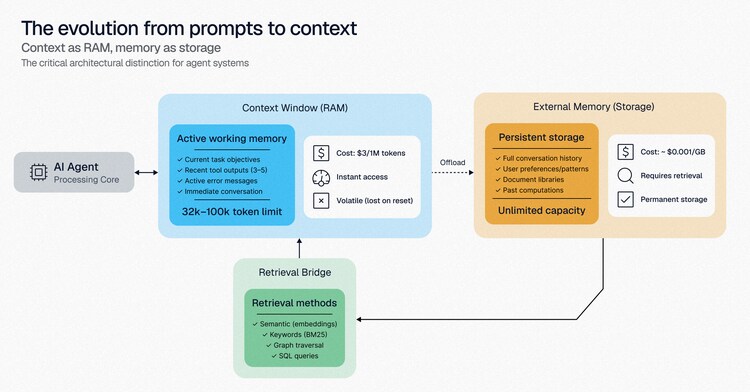
Memory vs. context: A strategic comparison
The distinction between memory and context is one of the most misunderstood aspects of agent design, yet it fundamentally determines your system's architecture.
Context is your agent's working memory. It is the immediate information available during inference, analogous to RAM in a computer. It's what the model can "see" right now, limited by the context window, expensive to maintain and cleared between independent sessions. Every token in context directly influences the model's response, for better or worse. With a large input-to-output ratio (ex. 100:1), context management becomes the dominant cost factor.
Memory is your agent's long-term storage. It is the persistent information stored externally that survives beyond individual interactions. It's unlimited in size, cheap to store, but requires explicit retrieval to be useful. Memory doesn't directly influence the model unless actively loaded into context. Think of it as your hard drive with vast capacity but access overhead. Reading memories is another retrieval problem; writing memories requires nuanced strategies.
The practical implications of this shape the architecture of agents:
Context characteristics
- Immediate but expensive: Every token costs money, especially uncached ones (10x more)
- Limited but powerful: Direct influence on model behavior, no retrieval needed
- Degrades with size: Performance drops after 30k tokens, depending on the model
- Volatile: Lost between sessions unless explicitly preserved
Memory characteristics
- Vast but indirect: Can store millions of documents, but requires retrieval
- Cheap but slow: Storage costs negligible, but retrieval adds latency
- Structured for access: Must be organized (vectors, graphs, files) for efficient retrieval
- Persistent: Survives across sessions, builds organizational knowledge
At scale, the distinction between memory systems and RAG blurs. Both involve selecting relevant information and loading it into context. The difference lies in intent. RAG typically handles knowledge retrieval while memory systems manage agent state and learned patterns.
Retrieval bridges memory to context, and this is where most systems fail. Windsurf's experience shows that simple embedding search breaks down as memory grows. They evolved to a multi-technique approach combining semantic search, keyword matching and graph traversal. Each method handles different types of query.
Use the table below to keep your architecture clear.
Comparison of memory vs. context
Here is how different products handle this distinction:
ChatGPT maintains a separate memory store of user facts and preferences, retrieves relevant memories based on conversation similarity, and loads only pertinent memories into context for each turn. This keeps context focused while maintaining continuity across sessions.
Manus treats the file system as infinite memory, with agents writing intermediate results to files and loading only summaries into context. Full content remains accessible via file paths, achieving high compression while maintaining recoverability.
Claude Code uses working memory (context) for active task state, with project files as persistent memory. The CLAUDE.md file serves as procedural memory, loaded at session start but not constantly maintained in context.
The critical design decision is what belongs in context versus memory:
- Current task objectives and constraints
- Recent tool outputs (last 3-5 calls)
- Active error states and warnings
- Immediate conversation history
- Currently relevant facts
- Historical conversations and decisions
- Learned patterns and preferences
- Large reference documents
- Intermediate computational results
- Completed task summaries
The future of this distinction may disappear entirely. As models improve and context windows expand, the boundary between memory and context blurs. Till then, we need to do intentional memory design where retrieval is explicit and purposeful.
Types of context in agent systems
Let's understand different types of context for effective management as each presents unique challenges.
Instructions context
Instructions context includes system prompts, few-shot examples, and behavioral guidelines that define how the agent should operate. This context tends to be stable but can grow large with complex instructions. Poor instruction context leads to inconsistent behavior and misaligned responses.
Knowledge context
Knowledge context encompasses facts, memories, retrieved documents, and user preferences that inform the agent's decisions. This dynamic context changes based on the task and can quickly overwhelm the context window. The challenge lies in selecting relevant knowledge while avoiding information overload.
Tools context
Tools context contains tool descriptions, feedback from tool calls, and error messages that enable the agent to interact with external systems. Models perform poorly when given multiple tools, making tool context management critical for performance.
History context
History context preserves past conversations, previous decisions, and learned patterns from earlier interactions. While valuable for continuity, historical context can introduce contradictions and outdated information that confuse the agent.
The trade-offs of context engineering
Context engineering is effectively the "architectural layer" of modern AI. When done well, it’s a competitive advantage.
Benefits
At its core, intentional context engineering transforms an agent from a hit-or-miss tool into a reliable system. By curating exactly what information enters the context window, you gain three critical business benefits:
- Cost efficiency: You stop paying the "compute tax" on redundant or irrelevant data. By filtering inputs to include only what is necessary, you significantly reduce token usage—especially in high-frequency production environments.
- Performance stability: Agents become more predictable. When an agent is fed only the "signal" and not the "noise," it is far less likely to hallucinate, ignore instructions, or get stuck in repetitive loops.
- Scalability: Clearer context structures allow your agents to handle more complex, multi-step tasks. Instead of hitting the ceiling of the context window with "junk data," you maximize the utility of the tokens you do have, allowing for longer, more sophisticated workflows.
Challenges
While the benefits are clear, the challenge lies in the inherent balance of the task: you must provide the agent with enough information to be intelligent, but not so much that it becomes distracted.
- Information overload: More isn't always better. Providing too much background can lead to attention drift, where the model loses focus on the core objective because it’s struggling to prioritize competing pieces of information.
- Complexity of governance: Unlike simple prompts, context engineering requires ongoing maintenance. As your system grows, you must constantly audit what information is being retrieved and how it is being prioritized, which requires a shift from a "set it and forget it" mindset to a continuous operational rhythm.
The future of context engineering: From curation to automation
As context windows expand from thousands to millions of tokens, there is a temptation to view context engineering as a temporary hurdle that will vanish once models can ingest an entire codebase or library in one go. However, the reality is the opposite: as the capacity for information grows, the necessity for intentional curation becomes even more critical.
The future of context engineering isn’t about fitting more data into a window; it’s about perfecting the signal-to-noise ratio. An "infinite" context window is essentially an infinite junk drawer. Without intentional architecture, a model with a 2-million-token window is just as prone to distraction, confusion, and hallucination as one with a 16k window. The future belongs to systems that treat context as a managed resource, not a passive storage space.
The shift toward autonomous curation
We are moving away from manual "prompt engineering" toward automated context pipelines. Tomorrow’s agents will not just receive context; they will dynamically negotiate it. We will see the rise of:
- Self-Summarizing Memory: Agents that proactively distill their own history and retrieved data into "compressed" summaries before the context becomes overloaded.
- Intelligent Retrieval Layers: Systems that evaluate the relevance of information at the query level, discarding contradictory or outdated data in real-time.
- Context Telemetry: Just as we monitor CPU and RAM usage in traditional software, we will see the rise of observability tools that track "context health"—alerting engineers when an agent's context is becoming "poisoned" or overly bloated.
In this next phase, context engineering moves from being a manual design task to a core component of the agent's operating system. The most successful teams will not be the ones with the largest models, but the ones that build the most disciplined systems for managing the information those models see.
FAQs about context engineering
Related Articles

What is DevOps Automation?

How To Prepare for a Site Reliability Engineer (SRE) Interview