Operationalizing Your Vector Database for Production RAG
Artificial intelligence Pratik BhavsarKey takeaways
- Effective RAG operations require moving from static configurations to continuous measurement of metrics like tail latency, filter selectivity, and recall.
- Selecting between pre-filtering and post-filtering should be based on real-world traffic data, as inefficient filtering strategies can cause significant performance degradation as the corpus grows.
- Integrating embedding and reranking models natively into the database simplifies infrastructure but requires periodic evaluation to ensure these components stay aligned with evolving query patterns.
Picking the right vector database is only the first half of a successful RAG strategy. The real challenge begins at production scale, where retrieval quality can drift downward while system dashboards remain green.
Operating a reliable RAG system requires four critical shifts: measuring filter selectivity on live traffic, dynamically tuning hybrid search parameters, tracking recall as an independent metric, and connecting database health directly to downstream LLM evaluation.
This article covers the query-time decisions and monitoring strategies required to maintain high-fidelity retrieval as your corpus grows and your query patterns evolve.
Filtering: Pre-filtering vs. post-filtering
In production, vector similarity alone is rarely enough. Queries usually carry metadata constraints — time ranges, access control, document type, source system, etc.. How the database applies those filters determines whether query performance holds up as the corpus grows.
- Pre-filtering applies metadata conditions first, then runs vector search only over the matching subset. This works well when filters are selective and cut the search space down sharply. When filters match a large portion of the corpus, though, pre-filtering interferes with graph-based indexes such as HNSW: the index no longer reflects the true neighborhood structure, which reduces recall and increases latency.
- Post-filtering reverses the order: the system searches the full index, then discards results that fail the metadata conditions. Index behavior and recall are preserved, but the number of candidates examined goes up — returning ten valid results may mean evaluating many more vectors if only a small fraction satisfies the filter.
Some vector databases avoid the tradeoff by integrating metadata directly into the index. Qdrant and Weaviate build filtering into their indexing and query execution paths, which allows complex Boolean conditions without the sharp performance penalties of naive pre- or post-filtering.
The right choice depends on a number you can measure rather than a rule you can memorize.
Pro tip: Measure your own traffic. Log 50-100 production queries with their filters and calculate selectivity for each (matched vectors divided by total vectors). High selectivity above 10% suggests pre-filtering works well. Below one percent, however, post-filtering is usually more efficient. If selectivity varies widely, you need a database with adaptive filtering.
Hybrid search with BM25
Hybrid search combines dense vector similarity with sparse keyword matching. Dense retrieval captures semantic similarity; sparse methods such as BM25 make sure exact terms in the query still influence the ranking. Together they cover the case where a semantic match misses a document containing a critical keyword — a product code, an error string, a legal citation.
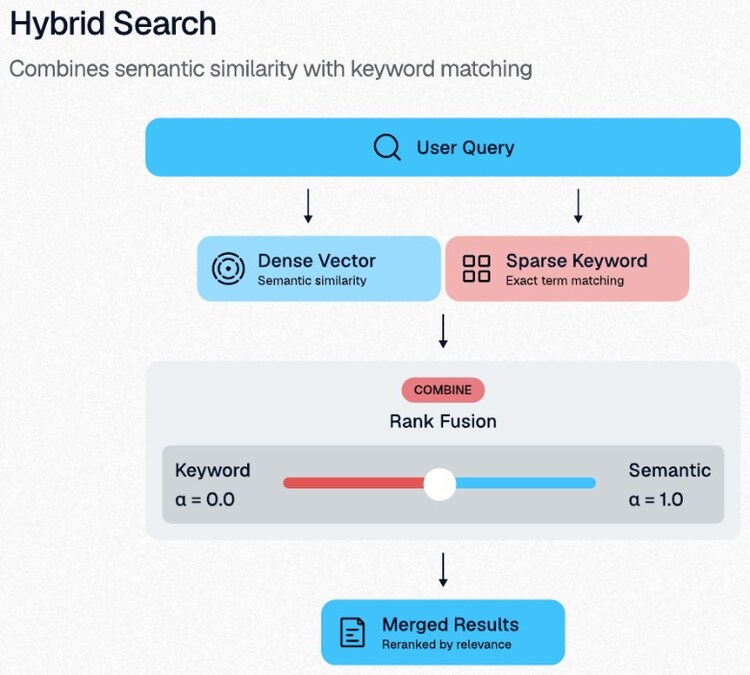
Weaviate and Elasticsearch run both searches in parallel and merge results using rank fusion. An alpha parameter controls the balance: higher values favor semantic similarity; lower values favor keyword matching. The optimal value depends on your query patterns and must be evaluated against real workloads rather than assumed.
Alpha is the single most under-tuned parameter in most RAG deployments. Teams set it once at integration and never revisit it, even as query patterns shift from exploratory questions toward specific lookups. It is worth re-evaluating whenever your traffic mix changes.
Model inference support
Filtering and hybrid search decide what comes back. The next decision is where the models that produce and reorder those results actually run.
Production deployments benefit when the vector database integrates directly with embedding and reranking models, because native integrations remove the need to run separate inference infrastructure.
Embedding model integration
Some vector databases generate embeddings automatically during document ingestion. Configured with a supported model, the database accepts raw text and handles embedding generation internally, which means no separate embedding service and no embedding API calls to manage. Commonly integrated models include sentence transformers, Mixedbread, BGE, OpenAI and Cohere. Weaviate supports multiple providers through its module system, letting you specify the model at index creation.
The tradeoff is flexibility. You inherit the database's supported models and its update schedule. For organizations standardized on one embedding model, that is fine. For teams experimenting with new models or running custom embeddings, separate infrastructure gives you more control.
Reranking integration
Rerankers refine initial search results by reordering candidates with a more sophisticated relevance model. Vector search identifies approximate matches quickly; rerankers apply cross-attention between the query and each candidate to produce more accurate relevance scores.
Native reranking support means the database handles this step itself — after retrieving initial candidates, it applies the reranker before returning results. That reduces data transferred between services and simplifies application code. Weaviate and several others support Cohere's reranking models natively. As with embedding integration, you trade control over model selection and update timing for operational simplicity.
Modern production systems often use Late Interaction models, such as ColBERT, which provide a middle ground between the speed of a standard vector search and the accuracy of a reranker by storing multi-vector representations.
What to monitor: Monitoring and detecting degradation
Production vector databases do not fail with a 500 error; they degrade quietly. To catch these issues, you must pair database-layer health metrics with RAG-layer retrieval signals. If you monitor these in isolation, you will miss the connection between a database drift and a hallucination downstream.
Feedback loop: Tracing the failure
Do not alert on arbitrary thresholds. Instead, establish your baseline during a stable production window and alert on deviations. When a metric shifts, trace the failure through the stack:
- If Latency spikes: Check the trace graph to see if the bottleneck is in the embedding lookup, the reranker, or the filter logic.
- If Recall drops: Check if metadata filters are becoming too restrictive or if your embedding model is no longer semantically aligned with new documents.
- If Context Relevance fails: Use the span hierarchy to look at the retriever output. If the chunks are relevant but the LLM output is poor, your issue is prompting. If the chunks are irrelevant, your chunking strategy or index has failed.
Agent observability with Splunk
A vector database in production is a living system. As the corpus grows and query patterns shift, the index will eventually stop matching the assumptions it was built under. By moving from static configurations to a model of continuous measurement and correlation, teams can identify these shifts before they impact the user experience.
However, retrieval is still only half the job. Even a well-tuned vector database often returns a mix of highly relevant results and near-matches. Passing all of these to a language model wastes tokens and introduces noise. Reranking is the final step: it is what turns good retrieval into the high-quality context required for a production-grade RAG system.
Understanding your RAG system at work is key to trusting AI systems. Learn about Splunk Agent Observability and get hands-on with the Splunk Observability Cloud Free Edition today
Operationalizing vector databases FAQs
Related Articles

Staff Picks for Splunk Security Reading March 2021
The DarkSide of the Ransomware Pipeline
