Multicloud Monitoring & 7 Must-Have Capabilities
Learn Khalid AliCloud services offer clear advantages especially with respect to speed and agility. But those advantages comes with added complexity, which is further compounded by a workforce skills shortage.
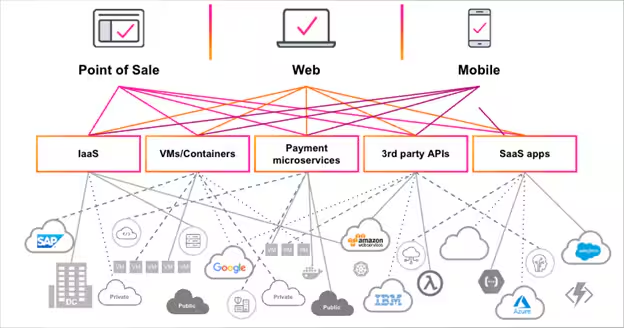
When you layer multiple cloud services on top, it’s no wonder that modernization efforts to migrate workloads to the cloud require careful planning and consideration. As part of that planning, comes the need to have comprehensive visibility over your entire digital landscape — from infrastructure to application and one cloud to another.
Real-time data is often the foundational element required to make sense of it all and also to take actions to ensure business applications remain running and that your organization can remain resilient.
In this article, I’ll describe what multicloud monitoring is, revisit the shared services model for IaaS PaaS and SaaS, explore what makes an effective multicloud strategy, and end with describing how multicloud monitoring works — including the 7 must-have capabilities for multicloud monitoring.
What is Multicloud Monitoring?
Multicloud monitoring is a practice that involves continuous and real-time observation of the performance and health of applications, services, and resources that support them deployed across multiple cloud providers.
This monitoring strategy is crucial for businesses that rely on a combination of public and private clouds. A successful multicloud monitoring strategy helps to:
- Ensure the seamless operation of your systems.
- Optimize resource utilization.
- Maintain security.
- Comply with applicable regulations and standards.
(Beware: the term “multicloud monitoring” sometimes falls short, depending on the vendor. Some vendors believe that organizations are already entirely in the cloud – and we know that’s not true.)
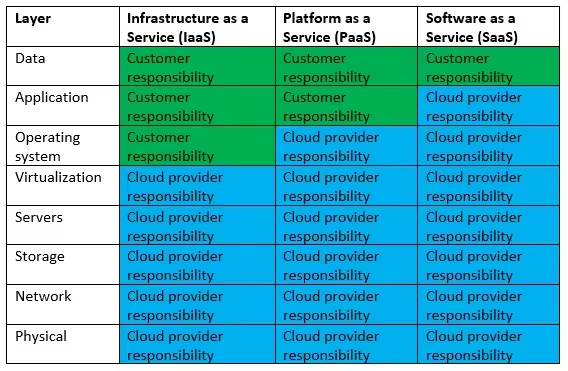
The role of the Shared Responsibility Model in the cloud
The fundamental shift from on-premises monitoring to cloud monitoring involves the introduction of a shared responsibility model. Here, you are no longer responsible for monitoring the underlying infrastructure in IaaS environments, no longer responsible for supporting the operating system in PaaS environments, and not even the application in SaaS environments.
But, you are accountable for delivering an excellent delivering an excellent customer experience to internal constituents and external customers. To ensure seamless operation from the application down, you need comprehensive visibility. For that, real-time data is your best ally.
(Source)
Components of an effective multicloud monitoring strategy
To effectively monitor a multicloud environment you first need to consider the overall cloud migration strategy and evaluate the approach for each application to ensure you have the right tools to achieve comprehensive visibility.
- Do your on-premises monitoring tools stretch to provide the visibility you need to monitor containerized applications and microservices?
- Are your cloud-native tools limited? Are they unable to offer the ability to monitor critical on-premises systems whose functionality cannot move for an extended period of time because of complexity or security and compliance concerns?
If one or the other is insufficient (as they are for most organizations today), the ability for different tools to interoperate programmatically via APIs is imperative. This supports not only multicloud monitoring, but also seamless interaction with back office workflow systems like IT service management (ITSM) and other ticketing platforms — all things that support amazing customer experiences.
Remember, monitoring multicloud environments also means you’re able to:
- Automate actions to reduce mean time to repair (resilience) when something inevitably goes awry.
- Prevent problems altogether with predictive capabilities.
How multicloud monitoring works
Comprehensive multicloud monitoring and visibility requires extreme flexibility.
At its most fundamental, you need to be able to collect real-time data from disparate sources and through various methods. This could involve a range of activities, such as:
- Installing agents or clients on cloud compute instances.
- Streaming data made available through cloud APIs that are able to pull data and push data when it is high volume, high velocity or both.
Making that data available at reasonable intervals is sometimes the differentiating factor when selecting one of those approaches.
For instance, a business critical application leveraging one cloud service provider for high-compute resources, while leveraging another for low-cost storage, needs comparable visibility into both cloud environments. It’s possible one cloud service provider may not offer the granularity or even appropriate streaming data required to effectively monitor for subtle changes that can impact the application — requiring you to pivot to an agent-based approach.
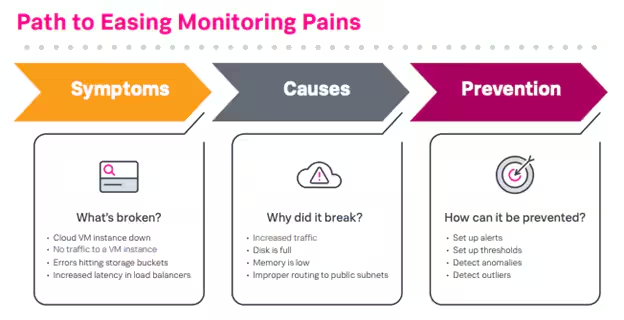
Multicloud monitoring success: 7 must-have capabilities
With that understanding and context, let’s now turn to the seven capabilities you must have to successfully monitor across you entire multicloud:
Real-time data collection platform
Evaluate platforms that enable data collection from various sources. IaaS, PaaS, and SaaS vendors will all offer data through different vehicles.
If you don’t have a platform that can help you take action on any log, metric, event, or trace across any multicloud environment, you have a potential data silo with a purpose-built monitoring tool. And that’s OK!
The data platform should be able to receive real-time alerts and alarms from monitoring point solutions as much as it does from applications and the underlying infrastructure that supports them.
Flexible data collection mechanism
Data is made available through different means — so, naturally, you’ll want to select the right collection mechanism based on how the source offers the data. While data pushed from a source in real-time is the ideal approach, the service provider may not have the means to do this. Or, it may be cost-prohibitive.
Data adaptability
Just as data is made available through different approaches, it also looks very different from each cloud provider or application vendor.
For streaming data, for example, syslog format has largely been replaced by JSON. But just as RFC 5424 doesn’t break out message sub-fields, cloud providers and application developers can choose to put anything they want in a JSON log, so the most important part here is the ability to catch data, regardless of format.
Data correlation
When identifying the root cause for incidents across multicloud environments, you must be able to stitch events together to create a story with data.
The single-best parameter for grouping real-time events across the OSI stack, still very relatable for multicloud environments, is timestamp. Additionally, as data can be provided from disparate sources with perhaps just format in common, having a data interpreter in the mix to normalize the events is very useful.
With many data platforms, this comes in the form of a data model used to connect varying fields and values from different systems that are effectively saying the same thing.
Data interrogation
Once the data is in the system with the ability to correlate events by timestamp, it’s time to ask some questions. The questions should never require re-ingesting data — meaning the schema for any of the data types in the platform should be flexible enough for you to iterate on the questions asked and answers received, much like the way we search on the internet.
Additionally, different teams may require slightly different answers to the same questions. For instance:
- An IT operations team may be focused solely on what’s happening now or soon.
- A capacity management team may want to better understand what infrastructure limitations they may run into months from now.
Visualization
The mighty dashboard is only as powerful as the customization capabilities it offers. Being able to paint the canvas with whichever visualizations best tell the story is table stakes across teams.
Again, operations may want one view, where app developers prefer another, and security teams yet another.
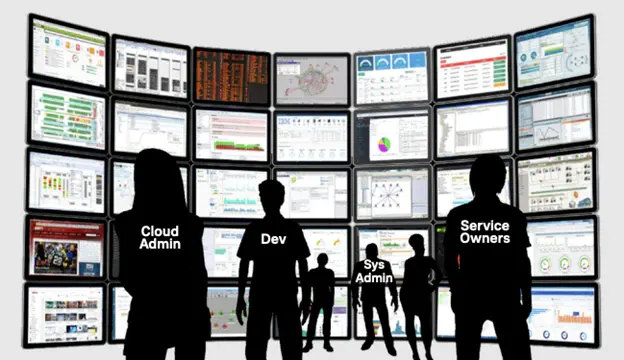
And the data could be the same or entirely different depending on the team. Having visualization capabilities appropriate for executive audiences can avoid having yet another purpose-built visualization tool in the mix. If visualizations are indeed insufficient, having a southbound interface available to allow third-party visualization tools to interact with the data in the platform is important.
Action
Finally, real-time data platforms for multicloud monitoring should be fully capable of generating alerts required for most operations-focused personnel — but they don’t have to be all encompassing.
Just as with any other platform or tool in the environment, there are points of intersection and overlap where another tool is purpose-built to hand off to, for continuation of a workflow. It’s important for the platform to be open and flexible enough to allow for programmatic interaction with upstream and downstream systems and vendors in the ecosystem.
Real cloud monitoring delivers actual cloud benefits
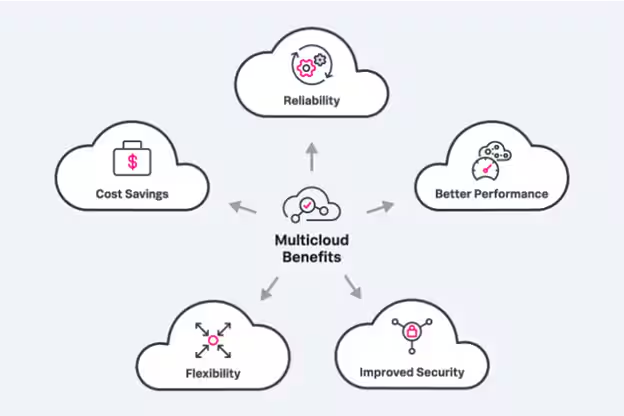
When it comes to multicloud, the benefits outweigh the drawbacks — which is exactly why multicloud adoption by both private and public sector organizations is well north of 90%. With a comprehensive multicloud monitoring strategy and approach, most challenges become surmountable.
Splunk supports all 7 must-haves for true multicloud monitoring. Learn more about monitoring CSPs with Splunk or talk with us today.
Related Articles

What Are Distributed Systems?

Data Modeling: An Introduction