What Is OpenTelemetry? A Complete Guide
Key Takeaways
- OpenTelemetry (OTel) is an open-source observability framework that standardizes the collection of telemetry data (logs, metrics, and traces) across distributed systems, enabling organizations to gain deep insights into system performance and resolve issues more efficiently.
- By providing vendor-neutral APIs, SDKs, and tools, OpenTelemetry minimizes vendor lock-in, simplifies integration across diverse environments, and future-proofs observability efforts as technologies and needs evolve.
- OTel enhances observability by bridging visibility gaps, enabling real-time tracking, and integrating with platforms like Splunk, helping organizations improve system reliability, reduce downtime, and achieve business goals.
Observability is much more than just monitoring — it provides a holistic view of systems. And, as evangelist Greg Leffler describes:
Unlike traditional monitoring, which answers what went wrong, observability delves into the why, enabling teams to resolve issues faster and improve system reliability.
OpenTelemetry, an open-source standard, plays a key role in achieving this by unifying the collection of telemetry data across diverse environments. By adopting OpenTelemetry, organizations can:
- Standardize observability data.
- Minimize vendor lock-in.
- Gain deep insights to optimize performance and enhance digital experiences.
In this comprehensive article, we’ll take a closer look at OpenTelemetry, how it works, and how it helps organizations achieve the observability in their distributed systems needed to meet their business goals.
What is OpenTelemetry?
Simply put, OpenTelemetry is an open-source observability framework that helps you understand the performance and health of your cloud-native apps (and supporting infrastructure). Commonly known as OTel, the framework offers:
- Vendor-agnostic or vendor-neutral APIs
- Software development kits (SDKs)
- Other tools for collecting telemetry data
How OpenTelemetry helps
Managing technology performance across complex, distributed environments is extremely difficult. Telemetry data is critical for helping DevOps and IT groups understand these systems’ behavior and performance. To gain a complete picture of how your services and applications are behaving, you need to instrument all their supporting frameworks and libraries across programming languages.
And here is the problem: no commercial vendor has a single instrument or tool to collect data from all of an organization’s applications. This lack of unification results in data silos and other ambiguities that make troubleshooting and resolving performance issue a real challenge.
OpenTelemetry is important because it standardizes the way telemetry data is collected and transmitted to back-end platforms. This has two effects:
- OTel bridges visibility gaps by providing a common format of instrumentation across all services. For example: engineers don’t have to re-instrument code or install different proprietary agents every time a back-end platform is changed.
- OpenTelemetry is also futureproofed: OTel will continue to work as new technologies emerge. Contrast that to commercial/proprietary solutions, which require vendors to build new integrations to make their products interoperable.
The history and future of OpenTelemetry
OpenTelemetry was created in 2019 by the merger of OpenTracing and OpenCensus — two active observability frameworks at that moment. It's one of Cloud Native Computing Foundation's (CNCF) big open-source projects together with Prometheus and Kubernetes. Its goal was to unite the industry under a single standard of capturing and exporting telemetry data.
Since then, OTel has rapidly gained traction in both open-source and enterprise communities and is now one of the key building blocks of the CNCF landscape.
Looking at the future, the demand for more observability with cloud-native and distributed systems will continue to position OpenTelemetry at the frontline. Additional development may be in areas like deeper integrations with AI and machine learning on anomaly detection, further improvement of trace context propagations, and enhanced compatibility with emerging observability back ends.
The support of major tech companies, like Splunk, and the excellent community ensures it'll evolve with industry needs and be core to the future of observability.
Now, let's take a brief detour into the world of observability for distributed systems, then we can see how and why OTel is so valuable.
Overview: observability, distributed systems, and telemetry data
Let's step back and look at the state of IT and tech systems today.
Distributed deployments
Distributed deployments vary widely, from small, single-department setups to large-scale, global systems. Organizations must consider certain factors — like network size, data volume, processing frequency, user count, and data availability needs — when planning deployments. These deployments are generally categorized as departmental, small enterprise, medium enterprise, or large enterprise.
Systems can also evolve over time, growing from departmental solutions to larger enterprise-level infrastructures as needs expand.
The importance of distributed systems
Distributed systems are foundational to modern computing, powering wireless networks, cloud services, and the internet itself. Even for enterprise tasks without massive complexity, distributed systems offer critical benefits that monolithic systems cannot achieve, like:
- Scalability
- Improved performance
- Advanced capabilities
Whether backing up data across nodes or enabling everyday activities like sending emails, gaming, or browsing online, distributed systems leverage the combined power of multiple computing devices to deliver functionality that a single system couldn’t handle alone.
Telemetry data
Telemetry data is essential for understanding system performance. By collecting and analyzing outputs from various sources, you'll get insights into relationships and dependencies within distributed systems.
This data is divided into the "three pillars of observability" — logs, metrics, and traces. Sometimes expanded to include IT events, forming the acronym MELT: metrics, events, logs, and traces. Together, these components enable teams to monitor, analyze, and troubleshoot systems effectively.
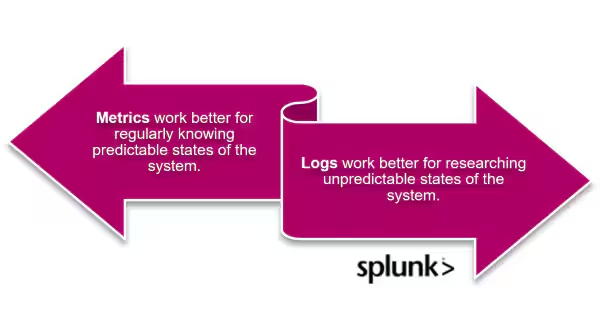
Logs and metrics
Logs are text-based records of events that happen at specific times, providing detailed context about an action or system event. They act as a "source of truth" for diagnosing problems, especially when investigating unplanned issues or failures in distributed systems.
Metrics, on the other hand, are numeric values measured over intervals of time and include attributes like timestamps, event names, and values. Metrics are structured and optimized for storage, making them ideal for:
- Analyzing trends.
- Answering specific questions.
- Powering alerts to quickly detect potential problems.
(Related reading: logs vs. metrics, what's the difference?)
Traces
Traces capture the end-to-end journey of a request as it moves through a distributed system, providing critical visibility into operations by breaking them into spans. Spans contain data such as trace identifiers, timestamps, and other contextual information. This helps teams pinpoint latency issues, errors, or resource bottlenecks.
Distributed tracing also enhances troubleshooting by linking relevant logs and metrics, while generating key performance metrics like RED (rate, errors, and duration) to identify and resolve system issues efficiently.
(Read our full explainers on telemetry & MELT for more details.)
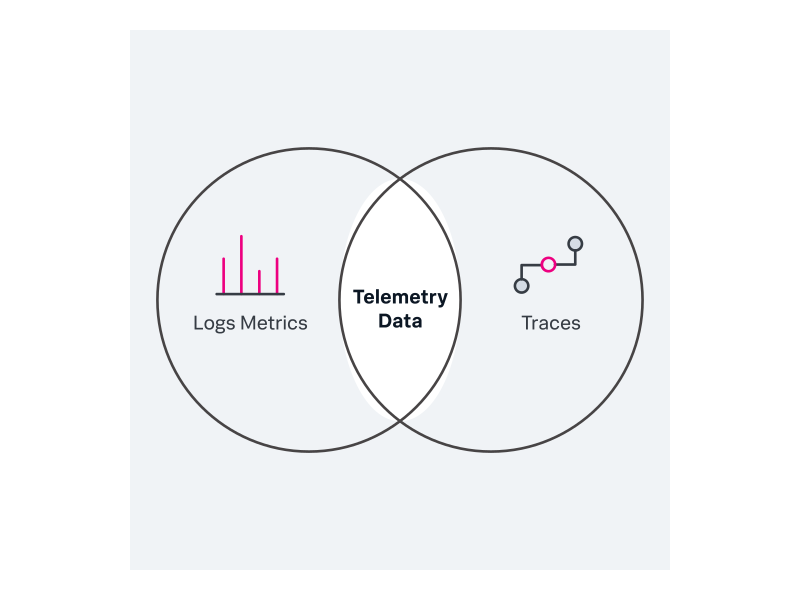
Individually, logs, metrics and traces serve different purposes, but together they provide the comprehensive detailed insights needed to understand and troubleshoot distributed systems.
Components in the OpenTelemetry framework
So, where does OTel come in? OpenTelemetry collects telemetry data from distributed systems. The goal, of course, is to troubleshoot, debug, and manage applications and their host environment. OTel offers an easy way for IT and developer teams to instrument their code base for data collection and make adjustments as the organization grows.
OpenTelemetry collects several classes of telemetry data and exports them to back-end platforms for processing. Analzying this telemetry data makes it easier to understand multi-layered, complex IT environments. Now it is much easier to observe the systems’ behavior and address any performance issues.
The OpenTelemetry framework includes several components:
- Language-specific OpenTelemetry APIs — Java, Python, JavaScript, and more — to instrument code for data collection.
- Exporters that transmit telemetry data to the back-end observability platform.
- Language-specific OpenTelemetry SDKs are the bridge between the APIs and the exporters.
- OpenTelemetry Collector is a vendor-agnostic implementation for receiving, processing, and exporting telemetry data.
OpenTelemetry simplifies alerting, troubleshooting, and debugging applications. While telemetry data has always been used to understand system behavior, increased network complexity that we've seen in the 2000s (global workforces, cloud applications) has made collecting and analyzing tracing data more difficult. Tracking the cause of a single incident using traditional MELT methods in labyrinthine systems can take hours or days.
But OpenTelemetry improves observability in these systems by correlating traces, logs, and metrics from a bevvy of applications and services. Further, the open-source project removes roadblocks to instrumentation so organizations can get down to the business of vital functions such as application performance monitoring (APM) and others. The net result is greater efficiency in identifying and resolving incidents, better service reliability, and reduced downtime.
Benefits of OpenTelemetry to your organization
Here are some of the key benefits of OpenTelemetry:
- Consistency. OpenTelemetry provides a standardized way to collect and transmit telemetry data across applications, eliminating inconsistencies and reducing the need to change instrumentation, enabling a holistic view of performance.
- Simpler choice. By merging OpenTracing and OpenCensus, OpenTelemetry combines the strengths of both frameworks into a single, backward-compatible solution, simplifying adoption for organizations.
- Streamlined sbservability. OpenTelemetry enables real-time tracking and analysis of application performance, helping identify and resolve issues to improve system stability and support business goals.
- Vendor independence. As a vendor-neutral solution, OpenTelemetry prevents vendor lock-in, allowing organizations to switch back ends or providers without major changes.
- Future-proofing. Backed by the CNCF and open-source community, OpenTelemetry is built to evolve and remain relevant in the rapidly advancing observability landscape. (More on that OTel Community at the end of this guide.)
Challenges of OpenTelemetry
While OpenTelemetry is a robust observability solution, it has some limitations that make it less suitable in certain scenarios.
- Small or simple systems: If your system has really minimal needs in terms of observability, OpenTelemetry is overkill. Complex set-up and data collection are unnecessary for small environments with limited infrastructure or monitoring needs.
- Advanced security monitoring: By default, OpenTelemetry cannot provide detail capturing of request bodies or parameters that are really critical in advanced security analysis. Deep security would require extensive customization, adding to the complexity.
- Resource-constrained environments: OpenTelemetry can generate quite a high volume of data, resulting in very high storage and processing costs. In resource-constrained environments or where infrastructure is at a premium, it may not be cost-effective.
OpenTelemetry FAQs
Does OpenTelemetry "play" with AI?
Yes, OTel and AI can work together in powerful and exciting ways! OpenTelemetry provides rich, unified telemetry data that can be used to enhance AI-driven observability, performance optimization, and anomaly detection. Here’s how they intersect:
- AI-powered observability: Telemetry data collected via OpenTelemetry can be fed into AI/ML models to automatically identify patterns, detect anomalies, and predict system failures before they occur. For example, AI can analyze trends in distributed tracing data to detect bottlenecks or forecast latency issues.
- Optimizing AI workloads: OpenTelemetry can instrument AI/ML pipelines and frameworks to monitor the performance of models, resource utilization, and data flow. This ensures AI models and inference workloads are optimized and operating efficiently.
- Better insights through correlation: By combining OTel data with AI, organizations can correlate telemetry data across complex systems, extract actionable insights, and automate root cause analysis (RCA) for faster issue resolution.
- Adaptive monitoring: AI can dynamically adjust the granularity and focus of telemetry data collection based on system behavior, ensuring efficient observability in large-scale, distributed environments.
In short, OpenTelemetry provides the essential data foundation that AI can leverage to make systems smarter, more efficient, and self-healing.
How is the ease of integration with OpenTelemetry?
The ease of integration with OpenTelemetry is one of its standout features. The modular architecture of OpenTelemetry allows for easy integrations with all types of systems.
Reasons that make integration so easy include its unified and standardized approach, broad supports for many languages (including Java, Python, Go, and more), integrations with existing frameworks and libraries, automatic instrumentation which reduces manual code changes, and its backend flexbility.
Plus, OTel is something that teams can adopt in increments: you don't need to perform a massive integration all in one go. This is the best way to transition from legaycy monitoring and O11y solutions and move to more modern and agile observability.
What is OpenTracing?
OpenTracing was a project offering vendor-neutral API specification designed to track and monitor application requests. Today, however, the OpenTracing project is archived. The official website explains that users are now required to migrate to OpenTelemetry. OpenTelemetry continues the work started by OpenTracing and has expanded upon it by offering a broader and actively supported observability framework
How does Splunk work with OpenTelemetry?
Splunk works with OpenTelemetry (OTel) by providing tools and integrations that seamlessly ingest, analyze, and act on the telemetry data collected using OTel's open-source framework. OpenTelemetry supports the collection of metrics, logs, and traces, which Splunk Observability Cloud and other Splunk products can process to deliver actionable insights.
How Splunk products work with OTel:
- Data collection: Splunk integrates directly with OpenTelemetry agents and SDKs, which collect telemetry data from various sources, including applications, infrastructure, and services.
- Ingestion and analysis: OpenTelemetry data can be ingested into Splunk Observability solutions, where it is analyzed in real-time. This includes metrics for monitoring system health, traces for distributed system visibility, and logs for troubleshooting.
- Unified view: Splunk correlates OTel data across logs, metrics, and traces to provide a single pane of glass for full observability, enabling faster problem detection and resolution.
How Splunk supports OTel:
- Open-source contribution: Splunk actively contributes to the OpenTelemetry project (donating libraries, components, enhancements, and other resources), ensuring the framework remains robust and widely adopted.
- Native support: Splunk Observability Cloud natively supports OpenTelemetry, allowing organizations to standardize telemetry data collection without being locked into proprietary tools.
- End-to-end integration: Splunk provides pre-built dashboards, integrations, and streamlined ingestion pipelines to simplify the process of using OpenTelemetry data.
Through its support for OpenTelemetry, Splunk enables organizations to adopt an open, vendor-neutral approach to observability while leveraging Splunk’s powerful analytics and real-time visibility capabilities.
Where can I find and contribute to the OTel community?
The OpenTelemetry community is a vibrant, open-source ecosystem where observability enthusiasts (a.k.a. o11y nerds) unite to build the future of telemetry data collection. Whether you're contributing code, writing docs, or just joining the discussions on GitHub or Slack, there’s a place for everyone to learn, share, and make an impact. From epic hackathons to geeky brainstorming sessions, it’s a playground for observability evangelists to collaborate, solve challenges, and celebrate wins—while making metrics, logs, and traces the coolest trio in tech! 🚀
Here are the places to bookmark and visit often:
- The official OpenTelemetry Blog for news, updates, and insights
- GitHub Repository to contribute code, raise issues, and track progress
- OTel Documentation "Docs" to get started and learn from others
Related Articles

Business Process Automation, Explained

What Are Machine Learning Models? The Most Important ML Models to Know

What is Customer Data Management? Its Importance, Challenges and Best Practices

Using ISO/IEC 27001 for Information Security Management Systems (ISMS) Excellence

Top LLMs To Use in 2026: Our Best Picks

Internet Trends in 2026: Stats, Predictions, AI Growth & Mary Meeker

Agentic AI Explained: Key Features, Benefits, and Real-World Impact

How Chain of Thought (CoT) Prompting Helps LLMs Reason More Like Humans