What is Customer Data Management? Its Importance, Challenges and Best Practices
Ever noticed how customer data is almost always discussed through the lens of marketing or customer service? That’s because those teams rely on it for different purposes, such as personalization, marketing campaigns, and customer support.
However, the actual business of managing customer data is not limited to one department. Every department, from marketing and customer service to business operations, IT, and Sales, has a stake in it. Across the customer journey, this fosters:
- A culture of customer-centricity
- Elimination of silos
- Support for personalization
Customer data management is an expansive concept, and so is its impact. To help you demystify this concept, this article will explain in detail what customer data management is, its benefits, challenges, and best practices for making it work.
Let’s begin!
What is customer data management (CDM)?
Customer data management (CDM) is a discipline that encompasses the process, strategy, tools, and policies for acquiring, managing, storing, and using data about customers to drive business objectives. It entails first-party and third-party data collection, data integration from different systems, data storage, and data governance within an organization.
Hence, to manage customers' data effectively, you need a strategy allowing for data governance, customer data privacy, and the adoption of tools that make data visualization possible.
Now you’re probably thinking, how’s this different from customer analytics? Well, glad you asked. CDM is the foundation on which customer analytics thrives. With CDM, your goal is data availability, security, and organization. With customer analytics, you make sense of the data by analyzing it to derive meaningful information, i.e., insights.
It’s like a library and a reader. A library exists regardless of whether readers troop in. On the other hand, the reader needs books, an organized space to read, and librarians to guide their hunt for a specific resource to get the knowledge they seek.
Why is customer data management important?
Customer data management is valuable in keeping an organization’s customer information accurate, timely, and accessible. It does so in the following ways:
- Providing data-driven insights to drive more effective marketing decision-making.
- Providing a single source of truth within an organization for all customer data.
- Increasing the success rate of marketing efforts through understanding and personalizing based on the customer journey.
- Helping to build a complete picture of each account by understanding individual customers and customer needs within that account.
- Powering account-based marketing campaigns (ABM) and activities.
- Ensuring compliance with regulatory standards.
Challenges of customer data management
Trying to manage customer data is not a straightforward process, as it will be met by certain challenges, some of which are:
Data volume
Since you’ll be managing data from different sources, the volume will likely be higher, which means more stakes are involved, making the process more difficult. For instance, a car manufacturing company will have to handle its internal data from different departments, as well as data from its external partners at car dealerships, car parts stores, and many others.
Keeping up with all this data to understand the customer's journey will require more engineering resources and time.
Data quality
With the influx of data, customers' information in databases will likely conflict (e.g., customers who have moved on to other companies but still have their old information in their records). In other cases, the data in your database may be corrupted, incorrectly categorized, or have multiple versions in different locations.
Data silos
Often, departments of large organizations create and maintain their databases of customer data. This creates data silos, as it will be difficult to unify customer data across different departments and create a single source of truth for all customer data.
Data security
Customers are more paranoid than ever about how companies use their information, and this fear is justified. In fact, personal data containing customer data topped the list of categories of data involved in data breaches. Hence, every such incident that organizations are mandated to notify customers about gives customers less reason to trust corporate bodies with their information.
Then, other forms of cyber-attacks and data misuse are in the mix to compound this mistrust.
How to develop a CDM strategy
A CDM strategy is foundational to the success of your CDM program. When creating one, you must consider your organizational goals, processes, technological solutions, and ethical use of customer data.
That said, these four elements will help you build an effective CDM strategy:
1. Business goals
Since we’ve established that CDM is an org-wide affair, your strategy for managing customer data should be tied to your business goals. How do you intend to use customer data to drive marketing campaigns, improve sales, and advance the business vision? Your answer here will influence what you’ll adopt or let go of in the three remaining elements.
For example, a car manufacturer launched an online car configurator tool, which drew many car enthusiasts to its website. However, they struggled to know the true intent of those website visitors. Using a customer data P=platform (CDP) and integrating it with an AWS data lake, it built unique customer profiles for each visitor and separated dreamers from prospects looking to purchase.
2. Data governance
Data governance is a key factor in a CDM strategy. It specifically identifies what data an organization collects and how. The data governance plan must be comprehensive and current, especially if it is required for regulatory compliance.
Your data governance plan should cover:
- Ownership of data assets
- Level of access and control of data
- Compliance policies to keep up with
With this step in place, you’ll give customers more reasons to trust you, hold you accountable for the way you manage their data, and ensure the integrity of the insights you gain.
(Related reading: data governance vs data management.)
3. Data lifecycle management (DLM)
Data lifecycle management refers to best practices for overseeing an information system's data flow from creation to deletion. At this stage, the goal is to set up tools, roles, and policies to manage every stage in the data lifecycle and maintain customer data confidentiality, integrity, and availability.
Most experts believe data governance falls under DLM, but as we did above, it’s worth considering as a standalone element.
4. Customer data management tools
We’ve come a long way from manual delivery to AI-powered tools, and you should be hopping on that train to make your customer data management work. CDM tools today carry out automatic functions, save time, and, most importantly, give a centralized view of customer data.
Speaking of CDM tools…
Best tools for customer data management
Managing customer data efficiently requires the right tools tailored to your business needs. The solutions below help unify, organize, and analyze data to empower teams and drive better customer experiences.
Customer data platform (CDP)
A customer data platform (CDP) is the best tool for managing customer data. This software solution brings together data from different tools (like ad platforms, lifecycle marketing tools, and CRMs) into a single centralized database that is easily accessible. Twilio Segment CDP report 2025 highlights that data warehouses work best with a CDP, enabling businesses to combine historical data from record systems.
Remember when we earlier stated that CDM should be an org-wide affair? Well, CDP is the ideal tool for achieving that, plus it solves the problem of data silos, integration and volume.
Despite their unifying function, CDPs also segment data by creating customer profiles that fit the needs of different departments that need insights into customer information. They do this by taking in raw or unstructured data from various sources/tools and presenting a clean version for leadership, marketing, sales, and IT teams to work with.
Examples of CDPs are:
- Tealium
- Bloomreach
- Treasure Data
- Twilio Segment
- Blueshift’s Smarthub
Customer relationship management (CRM) software
Customer relationship management (CRM) software is also ideal for managing and visualizing customer interactions with sales, marketing, and customer Support teams. It does this by:
- Storing customer information.
- Tracking their interactions with your organization on different channels.
- Automating marketing campaigns.
- Carrying out several other functions.
They come in different types, such as on-premises, cloud-based, or industry-specific. Your use case, budget, and infrastructure determine which one you should settle for. CRMs are common and often used in place of CDPs due to the assumption that they are interchangeable, but both solutions have distinct functions.
CRMs work best for customer-facing teams since they manage customers' one-on-one interactions with your brand. However, to reap their full benefits, CDPs need to be integrated with other software, such as marketing tools, customer analytics software, and even CRMs.
You can use only a CRM tool in your organization, but a CDP won’t exist alone. This is why you’ll find the latter in enterprises and large organizations with the budget to support it. Startups and small businesses can find CRMs that fit their budget and help manage customer data.
Examples of CRMs are:
- Zoho
- Hubspot
- Zendesk
- Pipedrive
- Salesforce
Other helpful tools are customer Intelligence tools, customer analytics software, and digital experience platforms (DEP).
Best practices for customer data management
The following best practices will help the effectiveness of your CDM program:
Build data privacy into every process
Every step you take in managing customers' data should be
- Transparent: Communicate clearly to your customers how much of their data you collect at every stage of their journey.
- Align with governmental and regulatory laws: these laws exist for a reason, so it’s in the best interest of all stakeholders for your organization to comply.
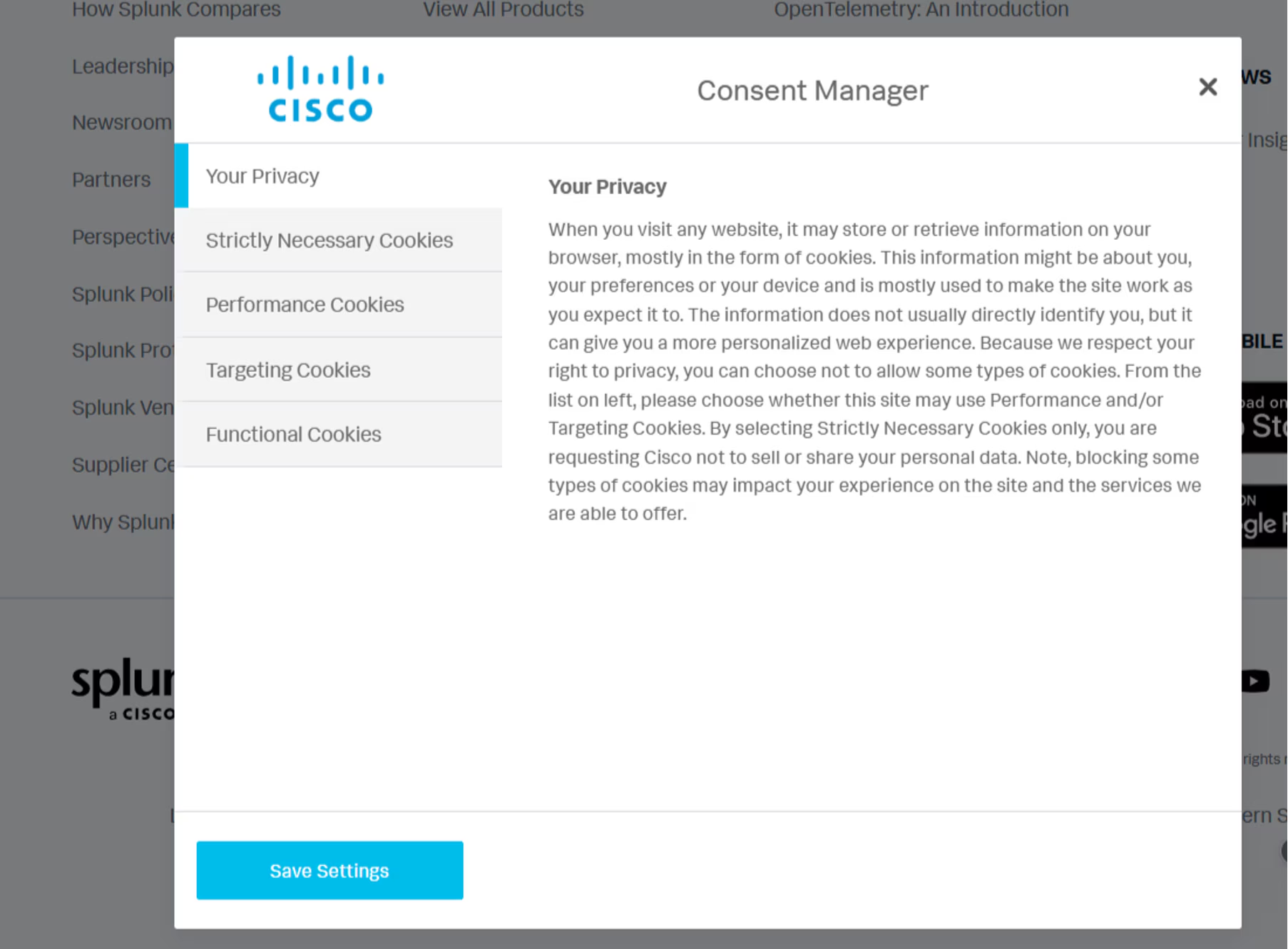
- Done with customers' consent: Beyond transparency, customers should be able to control how much of their data they access and store. This is why most websites have this cookie policy pop-up.
Focus on the data that matters
If you have outlined goals for the data you’re managing, you should focus on collecting the data you need at the time and filtering out the irrelevant ones. This will prevent your team from being overwhelmed, lessen storage costs, and allow for better insights.
Prioritize data quality
Do you know what’s worse than no data? Bad data. And with how valuable CDM is, you don’t want bad data in the mix, messing up your attempt at making data available, secure, and organized. You can improve data quality by validating every data that comes in, tracking changes to your data, and training your team to handle data.
Building foundation for customer insights
The quality of your customer insights is only as good as the systems in place for managing their data. To create long-term value, build a good customer data strategy by using the right tools and technologies.
FAQs about Customer Data Management
Related Articles

How to Use LLMs for Log File Analysis: Examples, Workflows, and Best Practices

Beyond Deepfakes: Why Digital Provenance is Critical Now

The Best IT/Tech Conferences & Events of 2026

The Best Artificial Intelligence Conferences & Events of 2026

The Best Blockchain & Crypto Conferences in 2026

Log Analytics: How To Turn Log Data into Actionable Insights

The Best Security Conferences & Events 2026

Top Ransomware Attack Types in 2026 and How to Defend