What Is OpenTracing?
Learn Shanika WickramasingheWhether you call it misinformation, malinformation, or fake news, everyone instinctively knows what disinformation is and understands how it can disrupt and destroy personal or organizational wellbeing.
Let’s take a deeper look at disinformation and how it’s creating an emerging technology category called disinformation security that aims to counter disinformation threats.
What is disinformation?
According to the Cybersecurity and Infrastructure Security Agency (CISA), disinformation is inauthentic content that takes three forms (PDF):
- Misinformation: False information that is communicated and spread, regardless of its intent to deceive. Misinformation misleads.
- Disinformation: False information that is intentionally crafted and spread to deceive. Disinformation deceives.
- Malinformation: Factual information that is taken out of context and presented to cause harm. Malinformation sabotages.
Even though it encompasses three forms, inauthentic content is commonly referred to as “disinformation”.

(Image source: CISA PDF.)
Types of disinformation
The table below outlines several types of disinformation. Each type hurts people and organizations in different ways — spreading false stories, ruining reputations, enabling criminal activity, prompting cyberattacks, stealing money, impersonating trusted entities, and more.
Inauthentic (false) video and audio clips are generated to deceive.
- Audio deepfakes simulate other people’s voices.
- Video deepfakes feature recognizable faces and full-body video of people, places, and things.
Techniques to trick or lure users into disclosing sensitive, confidential, or personal information.
- Phishing uses proxy (fake) websites and deceptive email to get users to disclose information.
- Vishing uses voicemails or phone calls to trick users into information disclosure.
- Smishing uses fraudulent text messages to collect user information.
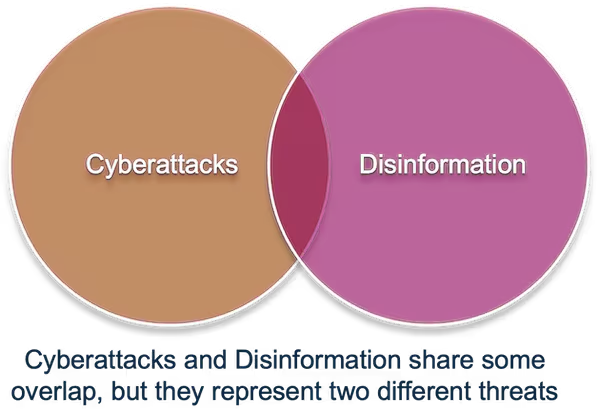
Disinformation vs. cyberattacks: what’s the difference?
There is some overlap between disinformation and cyberattacks, but they represent two different security threats.
Cyberattacks hack and target computer infrastructure — these attacks are digital by nature.
Disinformation campaigns target our biases, psychological vulnerabilities, critical thinking skills, and confidential knowledge to do several things, including:
- Steal critical confidential information including financial information, login credentials, and personally identifiable information (PII).
- Influence and change individual behaviors regarding thoughts, opinions, and beliefs.
- Galvanize individuals, groups, communities, governments, and societies to disrupt their harmony and to target perceived enemies.
- Impersonate individuals and organizations to cast aspersion, damage reputations, and cause financial, ethical, or legal issues.
With increased artificial intelligence usage, disinformation campaigns are expected to grow in frequency and sophistication — making them more effective and dangerous.
What is Disinformation Security?
An emerging technology category called disinformation security aims to counter and mitigate disinformation threats. One of Gartner’s 2025 Top 10 Strategic Technology Trends, disinformation security is designed to help identify what can be trusted. Disinformation security has three goals:
- Create systems that ensure accurate information.
- Verify authenticity and prevent impersonation.
- Monitor the spread of harmful content.
These goals are designed to help organizations and individuals avoid being misled, manipulated, or harmed by disinformation.
Areas of disinformation security
Gartner identifies these core detection, prevention, and protection areas for disinformation security.
- Deepfake detection includes GenAI and digital forensic technologies that discern legitimate (real) content from inauthentic (artificial) content.
- Impersonation protection: Holistically evaluating behavior to validate authentic actions and to provide assurance of the integrity and origin of any content.
- Reputation protection: Stopping bad actors from targeting an organization by tracking their operations, influence, and infrastructure.
By 2028, Gartner estimates that 50% of all enterprises will adopt products, services, or features that specifically address disinformation use cases. That’s up from less than 5% of organizations that adopted these products in 2024.
Solutions for Disinformation Security: technology, people, and processes
Unfortunately, there is no overarching suite of innovative technologies that by themselves will stop or mitigate all disinformation campaigns. Current technologies and services that may be able to identify and counter disinformation include:
- Bot protection: Mitigation and management techniques to identify, prevent, and block bot attacks, such as man-in-the-middle attacks, phishing, and account takeovers.
- Deepfake detection solutions: Detect modification and alteration to images, video, and audio by using forensic analysis tools; blockchain analysis; digital watermarking; and more.
- Fact checkers: Identify, extract, and assess the truth of claims presented in textual content.
- Identity verification: Protection against identity impersonation using deepfakes, synthetic media and other attempts to bypass identity and access management (IAM) systems.
- Phishing detection: Identifying and detecting sophisticated phishing attacks in email and other mediums.
A technology and systems-based approach can help prevent disinformation attacks, particularly when paired with Gen AI, digital forensic techniques, and other detection and response methods.
However, technology alone is not enough to ensure disinformation security. Your approach should also be paired with organizational and individual responses to disinformation attacks, including:
Disinformation awareness training
Educating users on how to spot, avoid, and respond to disinformation campaigns. CISA estimates that 90% of successful cyberattacks start with a phishing email.
Elevating disinformation awareness — especially among the most vulnerable populations — can significantly cut down on successful disinformation attacks.
Cross-functional protection
Aligning technology, people, and processes from across the organization to reduce, spot, and respond to potential and successful disinformation attacks. Organization-wide disinformation response teams can include executives, enterprise security, marketing, financing, public relations, human resources, legal counsel, and more.
Just as organizations create disaster recovery plans for business outages, you could create a separate response/security plan for a disinformation crisis. Planned cross-functional response plans can help prevent disinformation from damaging organizations.
The disinformation arms race
Like disinformation campaigns themselves, the effectiveness of disinformation security technology, people, and processes will only increase with artificial intelligence techniques. Disinformation security vendors and users will be continually modifying their defenses while disinformation providers will continue to refine their campaign tactics.
And both disinformation offense and defense will occur at AI speed. The disinformation arms race has intensified.
Related Articles

Call Center Analytics & Metrics for Success

Big Data Analytics, Explained