Internet Trends in 2026: Stats, Predictions, AI Growth & Mary Meeker
Trends once spread slowly, lasting for seasons if not years. Today, trends leap from screens to real life in an instant, fueled by social media’s ability to connect influencers, global brands, and everyday people.
The internet of 2025 is evolving faster than ever, with AI transforming how we work, connect, and consume content — truly a generational shift. Plus, rising internet usage and skyrocketing digital ad revenues are reshaping industries. These changes are part of a larger story that Mary Meeker’s iconic Internet Trends reports began documenting decades ago, capturing the pulse of the digital age.
Today’s internet trends reveal how technology, data, and human behavior are shaping the next chapter of the internet.
Who is Mary Meeker? What happened to her reports?
Dubbed the “Queen of the Internet,” venture capitalist Mary Meeker became synonymous with tracking the digital revolution. Her meticulously researched Internet Trends reports, which expanded significantly over time, covered everything from how many Americans were online in the mid-1990s to the rise of cell phones, at-home internet plans, and web browsers (remember dial-up?). Over the years, her work and investments garnered widespread attention, with coverage in outlets like TechCrunch, Vox, and Barron’s.
Meeker’s career began in the early 1980s at Merrill Lynch as a stockbroker, before earning her MBA in Finance from Cornell and focusing on technology as an analyst. She quickly carved out a niche in the booming personal computer and software industries. At Morgan Stanley, she played a pivotal role in the Netscape IPO in 1995 and co-authored the inaugural The Internet Report the following year, laying the groundwork for her deep dives into topics like:
- E-commerce
- Search engines
- Mobile internet
- China’s digital transformation
Her reports weren’t just data dumps — they were visionary. As Fortune’s Andrew Serwer noted in 2006:
After leaving Morgan Stanley, Meeker joined Kleiner Perkins before founding her own VC firm, BOND Capital, in 2018. Though her last official Internet Trends Report was published in 2019, Meeker has returned in the last year or so, releasing reports on smaller topics:
- AI and Universities, July 2024
- USA Inc., March 2025, which revisits a 2011 report on America's Financial Statements
Still, the Internet Trends legacy endures — indicating our collective curiosity about the digital zeitgeist and its history.
“The Internet Report” (1995)
The first Internet Trends report was a behemoth out of the gate, getting started with 322 pages. Fans would get used to this incredible mix of first-person predictions in concise, sometimes cutting prose and pages and pages of data, well-organized to enable you to drill in on just what you want.
The Table of Contents alone is a stroll down memory lane, with sections dedicated to:
- Features and uses of the Internet
- Infrastructure and data networking, from worldwide and ISP infrastructure to the customer
- Consumer trends, like worldwide connectivity, internet host growth, regional growth, browser and operating systems and at-home hardware like PCs and modems
- Stock across internet-specific, internet-related, media and technology firms
We particularly like that this report starts off with a “Trail Map”: directions on how to read the report, depending on your knowledge and experience and what (or who) you’re seeking to impress:

Just for fun, let’s look at some examples. In 1995, Meeker and McPuy indicate how technology analysts are used to change. They point to the debut of the minicomputer and the original Macintosh, the emergence of the PC, the “pervasiveness of the spreadsheet, the invasion” of ATMs and the “rapid acceptance” of Windows.
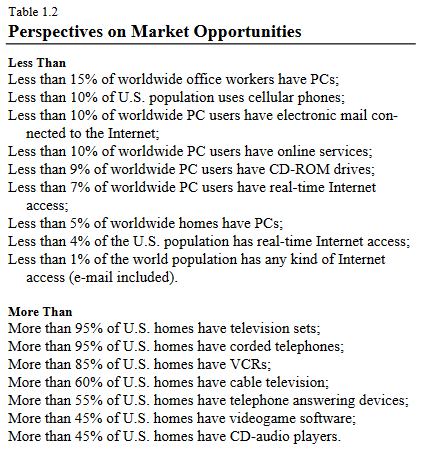
(Meeker and McPuy applied a less than/more than perspective to indicate market opportunity. This example is from mid-1995. Imagine what work-from-home would mean with so few people having real-time Internet access.)
In regards to the rise of the internet, the authors write:
Indeed, nearly 30 years later, we do not have clear answers to most of these questions.
Internet Trends Report (2019)
Now let’s fast forward nearly 25 years, almost to today — but not quite. The 2019 report totaled 333 slides, freely available for download. Much remains the same: lots and lots of stats, punctured with context and helpful predictions.
Just a quick look at this table of contents illustrates exactly how The Internet has worked its way into our personal and professional lives, into education, immigration and healthcare, and, for some, could even have a geopolitical story to tell:
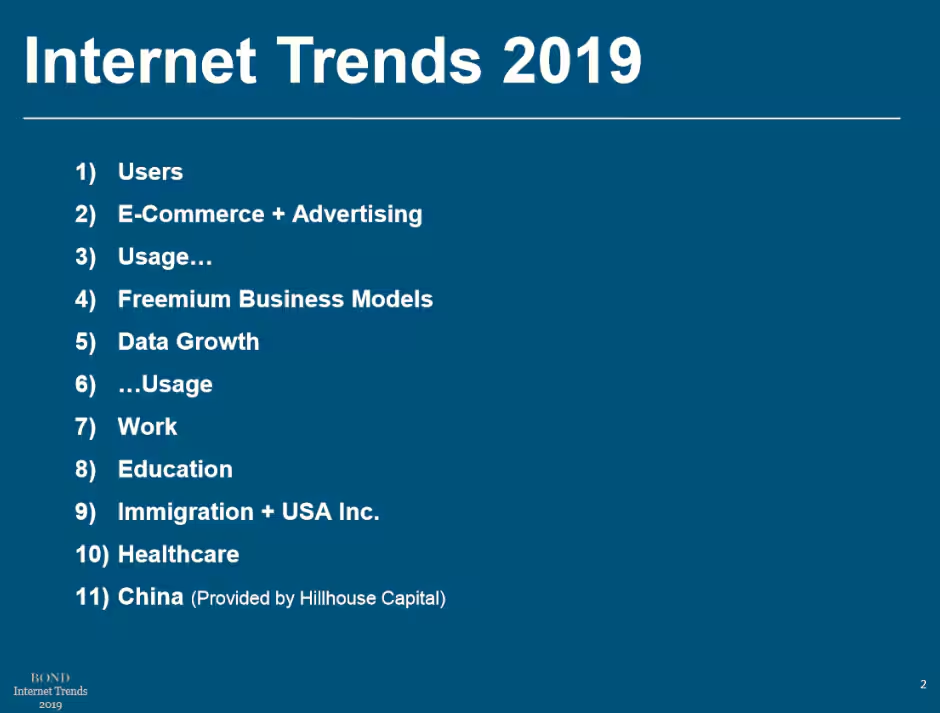
It’s common for different media outlets to comb through big reports like this and pull out facts that are most relevant to their audience. This roundup from Rani Molla at Vox sums up some super interesting costs that reflect the internet as most closely resembles today.
A majority of the world was online by 2019. Information indicates that less than half (49%) of the global population was online in 2017. Though growth started slowing, by 2019, some 51% — that’s 3.8 billion people — were internet users. (Scroll down to see today’s percentages.)
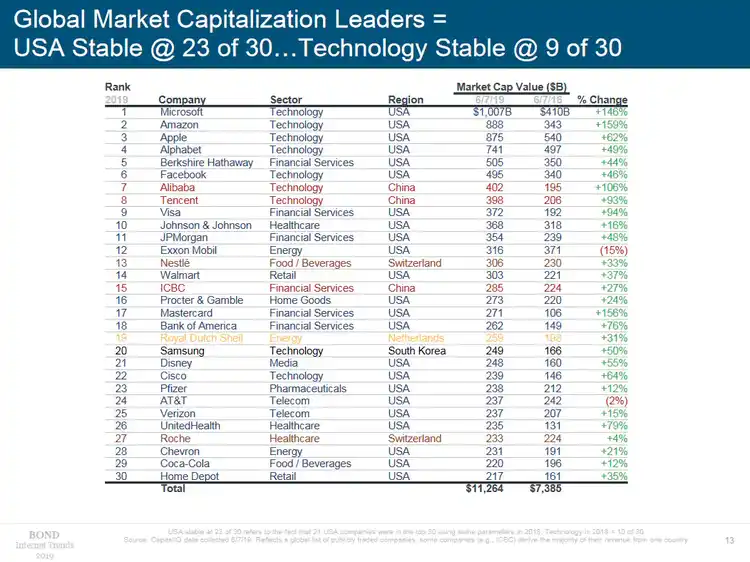
At that time, seven of the 10 most valuable companies by market cap were tech companies (take a guess who). The “non-tech” companies included Berkshire Hathaway, Johnson & Johnson and Visa.
- Spending on internet ads accelerated, totaling ~$90 billion by 2019, with a little over a third of that going to desktop-based ads and the majority going to mobile ads.
- Cost to acquire new customers increased. Meeker points out that, in some cases, this is unsustainable: the cost to acquire a single new customer was actually sometimes surpassing the long-term revenue that customer would bring.
- Americans spent 6.3 hours a day online in 2018, on average. This is a steady increase over time, with that growth often coming from mobile devices and non-traditional paths (versus desktop/laptop usage). People seemed to paying more attention to the time spent online, realizing perhaps it isn’t all positive.
- 87% of all global web traffic was encrypted. From 2016 to 2016, global web traffic encryption increased 53%, likely as governments and standards began requiring more encryption.
Here’s our favorite 2019 prediction: “Health care is steadily becoming more digitized. Expect more telemedicine and on-demand consultations.”
We know from hindsight that the COVID-19 pandemic affected the entire world and finally put a spotlight on telemedicine and on-demand consultations. That’s something many people continue to opt for today.
Internet trends in 2025
Now let’s look at a few of these numbers today to get some perspective on the state of the internet in 2025.
Global internet users
- 2018-2019: 3.18 billion global users (51% of world population)
- 2023: 5.16 billion global users
- 2024: 5.44 billion (Nearly 63% of world population), including 5.07 billion social media users globally.
- 2025: 5.64 billion global internet users as of April — equivalent to more than two-thirds of the world’s population. That’s a 3.67% YoY increase. Social media users also continue to grow, reaching 5.31 billion.
Time Americans spend online, per person (“screen time”)
- 2018-2019: 6.3 hours a day online
- 2023: 6.59 hours a day. Why wasn’t this a bigger increase over five years? Our hunch is that most Americans were already spending a lot of time online. Countries that were online in smaller numbers 10 years ago, however, are more likely to see more growth in this number.
- 2024: 7 hours, 3 minutes per day. For comparison, the country that spends the most time online is South Africa, and the citizens of Japan spend the least amount of time online. (Seems like AI hasn’t drastically changed our lives just yet. 😉)
- 2025: Americans remain online, though slightly less: adult internet users now spend a daily average of 6 hours and 38 minutes online.
Most valuable companies by market cap
- 2018-2019: 7 tech companies and 3 non-tech companies
- 2023: 9 tech companies, including Tesla & Taiwan Semiconductor Manufacturing and only 1 "non-tech" company in Berkshire Hathaway.
- 2024: The 7 tech companies in the Top 10 include Microsoft, Apple, Nvidia, Alphabet, Amazon, Meta, and Taiwan Semiconductor Manufacturing. Other Top 10 market-cap leaders are in pharmaceuticals (Eli Lilly), oil and gas (Saudi Arabian Oil) and the cross-industry behemoth Berkshire Hathway. Notably, the top seven companies all have market caps exceeding $1 trillion. Microsoft leads the pack at $2.89 trillion.
2025: Today’s list looks much like last year’s, with 8 tech companies landing in the Top 10 orgs by market cap. You could make a case for a 9th company being in tech too: Tesla (although officially they’re in the “Consumer Discretionary” sector). Berkshire Hathaway continues its dominance, though with recent news of long-time leader Warren Buffett stepping down, let’s see what happens in the next year.
What changed year over year? Broadcom moved into the Top 10, while Eli Lilly was just barely squeezed out. Saudi Arabian Oil, however, took a much bigger hit. Seven of the Top 10 companies have market caps of $1.1 trillion or higher, with the other three hovering in the 900 billion-range. (Not too shabby.)
Internet advertising revenues
- 2018-2019: ~$90 billion
- 2023: ~$209.7 billion
- 2024: ~$225 billion. That’s an increase of 7.3% YoY. The biggest channels for growth included retail advertising ($43.7billion), video advertising, and social media advertising (~$65 billion).
In 2025, internet ad revenue is increasingly hard to track, though some estimates put digital ad spend as high as $700 billion this year. (Google and YouTube alone may bring in $200 billion.) Why has it gotten so complicated to track? Because the way we watch and create entertainment has evolved. There are a few reasons for this:
- The rise of social platforms. Social video platforms like TikTok and YouTube are dominating entertainment, offering free, algorithm-driven content that is highly engaging and ad-optimized. They now rival streaming services and traditional TV for viewer time and advertiser dollars
- Pay TV in decline. Cable subscriptions continue to fall, especially among younger generations. High prices and outdated ad experiences are pushing viewers toward cheaper, more flexible streaming and social video options.
- Ad dollars shift to social. Social platforms outperform streamers in ad relevance and targeting, especially with Gen Z and Millennials. Traditional studios struggle to match the personalization and scale of social media ad tech.
- Creators take the lead. Younger audiences prefer content from social media creators over traditional TV and film. Creators offer relatability, authenticity, and cultural relevance that studios can’t match.
AI growth trends in 2025
This is our second year looking specifically at growth and trends in artificial intelligence. After all, AI is every techie’s favorite new topic. This long-time-coming technology is really coming into its own, especially in LLMs and generative Ais. The industry at large is primed and ready for wild growth, even if AGI still seems a bit out of reach.
So, while we may not have a long look back, we do have some early reporting and estimates from Statista:
- 2024: The global AI market size is projected to reach US$184 billion in 2024, with the largest market being the United States. The market size is expected to show an annual growth rate (CAGR 2024-2030) of 28.46%, resulting in a market volume of US$826.70 billion by 2030.
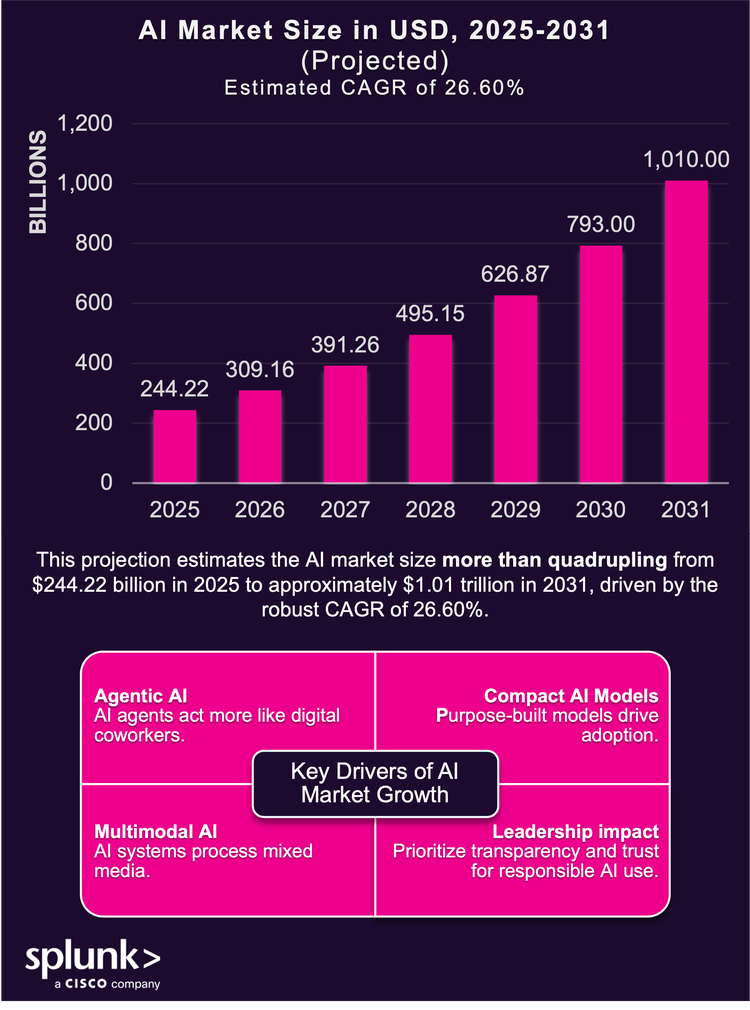
- 2025: The AI market size is projected to reach US$244.22 billion in 2025, with an estimated annual growth rate (CAGR 2025-2031) of 26.60%, resulting in a market volume of US$1.01tn by 2031. (That’s quite the increase YoY!) The largest market size will be United States at $73.98 billion this year.
So, the estimates show that AI is expected to have a massive impact on…just about everything. Here’s what is driving this spend:
Specialized and compact AI gains momentum. Businesses are moving beyond large, general-purpose AI to adopt smaller, purpose-built models that are faster, more efficient, and often open-source. These tailored solutions meet specific needs, require fewer resources, and offer enterprises the flexibility to customize AI for their unique goals. Different horses for different courses.
Agentic AI as “coworkers”, not mere tools. The next big wave isn’t just chatbots — it’s autonomous AI agents. These systems can perform tasks like writing reports or managing operations, acting more like proactive team members than static tools.
Multimodal AI redefines interaction. The rise of models like GPT-4 Omni, which can process text, images, audio, and video, signals a shift toward more natural and accessible AI interactions across industries.
Leadership and responsibility will define impact of AI. To unlock AI’s full potential, leaders need to prioritize transparency, trust, and sustainability. Managing risks like privacy concerns and energy consumption is critical to ensuring AI systems benefit everyone responsibly.
One prediction we are 100% confident in? The AI field is only getting started: stay tuned over this next year for real innovation and bigger spend.
Check out more IT and tech trends
All Internet Trends Reports & related reports
You can access all of the 22* Internet Trend reports here, available for browsing and downloading:
*Note: no reports released from 1998-2000. There are a couple additional Special Reports:
- USA Inc., A Basic Summary of America’s Financial Statements, from February 2011
- Our New World, from April 2020
- AI and Universities, July 2024
- USA Inc., March 2025, which revisits the 2011 report above
Dig in for yourself and see what you uncover.
Related Articles

How to Use LLMs for Log File Analysis: Examples, Workflows, and Best Practices

Beyond Deepfakes: Why Digital Provenance is Critical Now

The Best IT/Tech Conferences & Events of 2026
The Best Artificial Intelligence Conferences & Events of 2026

The Best Blockchain & Crypto Conferences in 2026

Log Analytics: How To Turn Log Data into Actionable Insights

The Best Security Conferences & Events 2026

Top Ransomware Attack Types in 2026 and How to Defend