DataOps & Data Operations Explained
Whether you're a small business or a large enterprise, working with data consumes time and effort. But what if there was a way to turn this data into opportunities for growth? That’s what DataOps offers.
DataOps helps create a collaborative environment to improve data quality by automating manual processes. Research shows the market for DataOps platforms will grow from USD 3.9 billion in 2023 to USD 10.9 billion by 2028. This growth shows how steadily organizations will streamline their operations.
Learn more about DataOps and its benefits in this guide.
What is DataOps?
DataOps unites technology, processes, and people. Its approach is to automate data orchestration in order to improve the quality, speed, and collaboration of data across your organization. Gartner defines DataOps as:
Yes, DataOps can sounds like plenty of related practices: data science, data analytics, data engineering, data management, business intelligence — and more! Either way, making a data-centric approach your go-to preference to deliver value to your audience at the right time can help you to:
- Manage data risks.
- Improve the data quality.
- Build efficient data pipelines.
- Enhance analytics and decision-making capabilities.
Understanding the data operations manifesto
Collaboration, automation, and continuous improvement deliver value to customers. To make sure these core values are fused in your working processes, the DataOps manifesto lays out 18 principles to follow:
- Deliver value to customers — not rigid processes.
- Create working analyses with accurate data, systems, and frameworks to make valuable decisions.
- Collaborate with customers to understand them and build strong relationships.
- Build teams with people from different backgrounds and interests to increase productivity and creativity.
- Work together and interact with one another and customers.
- Self-organize teams to produce the best analytical insights, algorithms, architectures, requirements, and designs.
- Teams and processes should be sustainable and scalable.
- Take feedback from customers or exchange feedback from team members to improve processes and give better performance.
- Use different tools to access, combine, shape, and show data.
- Everything from data to tools and teamwork should fit together smoothly for successful analysis.
- Track data versions, the nitty-gritty details of hardware and software setups, and the instructions for each tool you use.
- Provide your team with simple, isolated, and safe technical setups that match their real working environment.
- Embrace simplicity. Find ways to do the most important work and avoid unnecessary tasks.
- Focus on efficient processing to continuously make better analytic insights.
- When building analytic pipelines, ensure they can automatically spot problems and security issues in the code, instructions, and data.
- Take notes if things aren't going as expected.
- Avoid repeating the same work individually or as a team for efficient analytics insights.
- Streamline your customer's requests by enhancing the development and releasing phase of the analytics lifecycle.
This manifesto evolves with time. As the data landscape changes, new principles will be added, and existing principles may be modified.
DataOps vs. DevOps
DevOps automates development and operations to make software development and delivery more efficient. DataOps break down silos between data producers and consumers to make data more reliable and valuable.
Both emphasize collaboration, automation, and continuous delivery/integration. And they follow similar approaches to achieving their goals. But the choice of methods depends on the specific needs and objectives of the organization.
(Check out the most popular DevOps metrics.)
DataOps vs. Data Management
Data management is a combo of collecting, storing, managing, and using data. This process includes data governance, quality assurance, and security.
DataOps is a newer approach, incorporating agile technologies and DevOps to automate the data lifecycle from ingestion and preparation to reporting and analysis. Doing so shortens the time of analytics development and improves data quality.
How DataOps works
DataOps uses statistical process control (SPC) to monitor quality in real-time and detect anomalies or deviations from expected data patterns. Here's how the cycle works:
Continuous integration
Data pipelines or ETL (Extract, Transform, Load) processes are continuously integrated. Automated CI pipelines then build and test these changes. If tests pass, the changes are merged into the main branch. This ensures that the code is always working and ready for further development.
Continuous testing
Automated tests are run as part of the CI/CD process to validate data quality and model accuracy. These tests provide feedback to data engineers and scientists to help them catch issues in the development process.
Configuration management
Organizations use tools to manage configurations for data processing pipelines and analytics environments. They do this to reduce the risk of discrepancies between development, staging, and production environments.
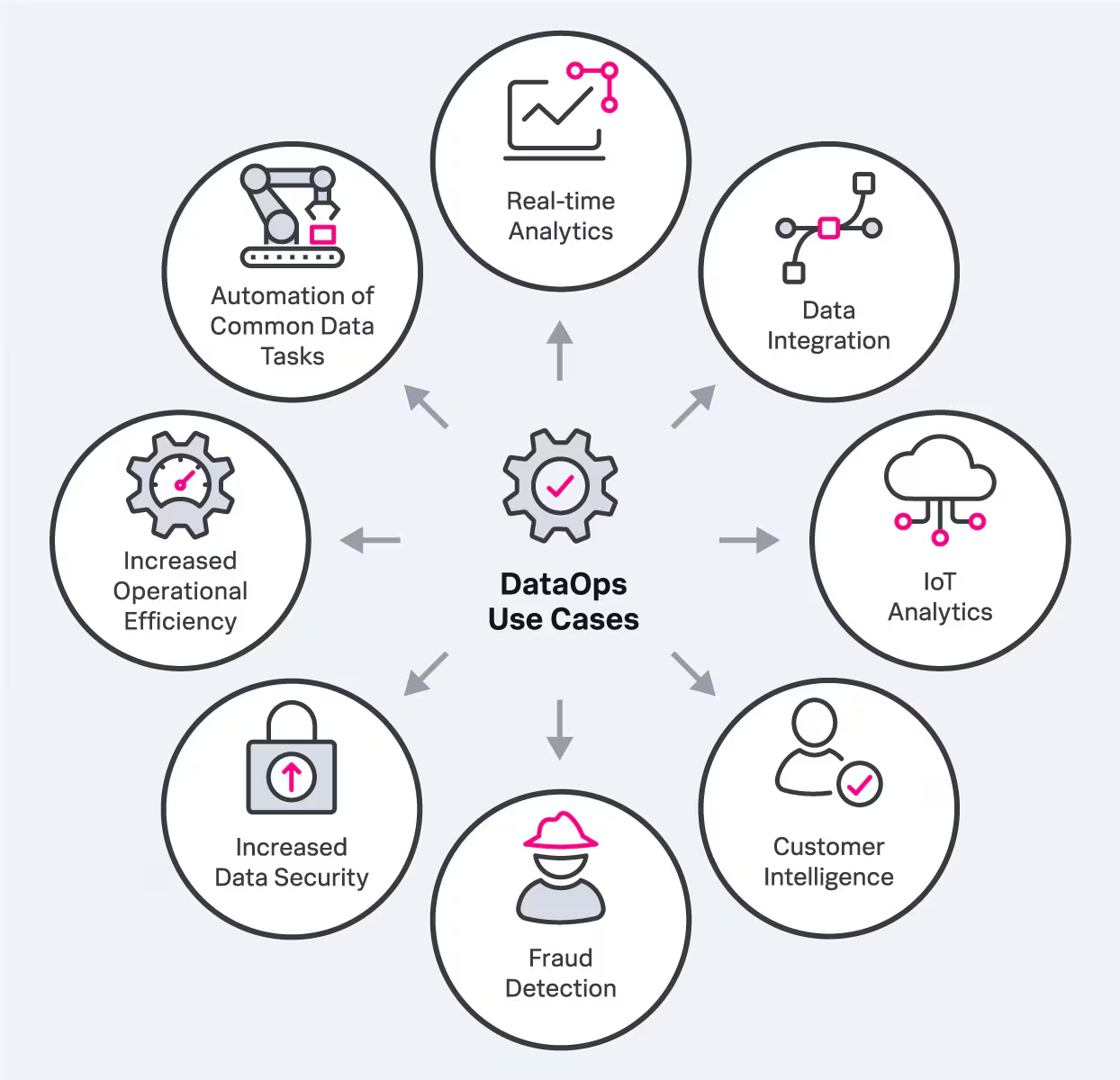
The foundation of data operations
DataOps is based on these 5 primary pillars:
Creating data products
Instead of data being siloed, organizations can leverage it to build products and solutions that provide value. But, productizing requires adopting the next-generation business model. And here's how you can do that:
- Conduct extensive research.
- Create a hypothesis and experiment.
- Collect the data at a centralized source.
- Perform analysis.
Aligning cultures
The mindset and behavior of teams should align with the DataOps principles. Your organization can only produce quality data products if the data team is collaborative and supports individual inputs from different team members.
To do so, you should encourage team members to be transparent and contribute their data-driven decision-making skills.
(Learn more about cultural & organizational change models.)
Operationalizing analytics and data science
To achieve goals quickly and know your progress, integrate data and analytics into your daily business operations. This helps build better products out of your data. All you've to do is — manage, monitor, and refine models so they remain relevant and valuable to the organization.
Plan your analytics and data science
Having well-defined plans — written in roadmaps or blueprints — that define your business methodologies and strategies for data projects ensures you reach your target audience quicker and provide them with desired solutions.
Harness structured methodologies and processes
DataOps also encourages organizations to adopt structured methodologies and processes for tasks like data ingestion, transformation, and governance. It makes processes speedy, more reliable, and error-free.
Best practices for DataOps teams
When an organization implements the DataOps principles, its experimentation, deployment speed, and data quality improve. So here are some best practices to maximize your organization's potential too:
- Continuously monitor data operations to identify anomalies in data pipelines. It will help you keep track of and resolve issues quickly.
- Catalog data assets and pipelines to keep a central repository. This way, your teams can use data assets and associated pipelines appropriately.
- Govern your data! Data governance involves managing, protecting, and utilizing data. Implementing it will improve your data security and compliance.
- Use a reliable tool through the stages of data processing. Doing so will eliminate human intervention and speed up pipeline development while keeping your data secure.
- Begin with small, manageable projects and gradually expand.
- Align DataOps efforts with your business objectives to deliver solutions that contribute to your organization's goals.
- Leverage cloud-native environments to reduce infrastructure costs and faster deployment for DataOps architecture.
Starting your career in DataOps
Starting your career in DataOps seems daunting. But here's everything you need to know to get started:
Job roles
DataOps is a broad field. The roles vary depending on the organization's size, structure, and needs. So, here are a few common DataOps roles:
- Data engineers design, build, and maintain data pipelines and infrastructure. They transform raw data into usable formats for analysis.
- Data scientists leverage data to gain insights, build models, and develop predictive or prescriptive analytics solutions. They often collaborate with data engineers to access and prepare data.
- Data analysts interpret and visualize data to provide actionable insights. They work with data engineers to access and clean data for analysis.
- Data architects design and manage the overall data infrastructure, including databases, data warehouses, and data lakes. They ensure data is organized and accessible.
- DataOps engineers combine data engineering and operations expertise to manage data pipelines, automate processes, and ensure the reliability and scalability of data systems.
- Data stewards govern data and ensure it's protected and managed according to organizational policies and compliance requirements.
- DevOps engineers automate and manage data pipeline deployment in the data operations field.
- Data operations managers oversee the entire DataOps process. They ensure teams collaborate effectively, processes are efficient, and operations align with business objectives.
Salary of a data engineer
According to the research, the average salary for a DataOps Engineer in the United States is around $110,685 annually. But this salary can vary per the state, level of expertise, DataOps certifications and other factors. Talent.com surveyed average salaries of DataOps engineers in 2023, and here's what people from different states shared:
- New York: $165,000
- Virginia: $160,000
- Texas: $151,750
- California: $148,900
- Washington: $134,350
- Colorado: $100,000
- Florida: $83,024
- Arizona: $82,500
(Learn more about annual and average IT salaries.)
Courses and certifications
Building your expertise is the most important stage in shaping your career. That's why we’ve picked some of the best courses for you to gain insights into the data operations world:
- Certified DataOps Practitioner (CDOP), offered by CertNexus, trains on the core principles and practices of DataOps. It covers data integration, version control, automation, and collaboration.
- AWS Certified Data Analytics – Specialty certification will help you build expertise around data storage, processing, visualization, and security relevant to DataOps.
- Google Cloud Professional Data Engineer certification covers data engineering concepts and practices. It also includes topics related to data transformation, loading, and orchestration.
- DataOps Methodology by IBM provides insights into the fundamentals of DataOps. It will help you understand the process required to build and deploy data pipelines.
(Explore more data-related certifications.)
Operationalize your data
DataOps delivers products faster — reducing the time it takes to move data from source systems to analytics platforms. Companies with mature practices are twice as likely to collaborate effectively on data modeling and management as those that operate without this approach.
FAQs about DataOps & Data Operations
Related Articles

LLM Monitoring: A Comprehensive Guide on the Whys & Hows of Monitoring Large Language Models

What is Predictive Modeling? An Introduction

QoS Explained: Quality of Service in Networks

Top Cybersecurity Trends in 2026: 9 Trends to Watch

The Role of SCA in Software Security: The Software Composition Analysis Complete Guide

Server Monitoring Today: Why Monitoring Your Servers Matters & How to Approach It

The Software Development Lifecycle: The Most Common SDLC Models

Active vs. Passive Monitoring: What’s The Difference?