What is Predictive Modeling? An Introduction
Key Takeaways
- Predictive modeling uses historical data and statistical or machine learning algorithms to forecast future outcomes, enabling organizations to make proactive, data-driven decisions.
- The process involves collecting and preparing data, selecting appropriate modeling techniques (such as regression, classification, clustering, or time-series forecasting), building and validating models, and deploying them to improve operations and manage risks.
- Predictive modeling is widely used across industries for applications like fraud detection, customer retention, anomaly detection, and predictive maintenance, helping organizations drive efficiency and gain a competitive advantage.
Organizations are increasingly leveraging advanced methods to anticipate future outcomes and make informed decisions. One such method is predictive modeling — a powerful approach that uses historical data to forecast future trends, behaviors, and events.
In this article, we will explore the fundamentals of predictive modeling, its role in analytics, and its applications across various industries.
What is predictive modeling?
Predictive modeling is the process of predicting future outcomes from historical information. It involves developing statistical models that can learn from patterns and trends within data, and use that knowledge to predict future outcomes, given the available knowledge of how the system behaves as represented by the statistical model.
Depending on the complexity of the problem and the data available, techniques to develop a predictive model can range from simple to advanced machine learning and optimization methods that are carefully engineered to solve the modeling problem.
In the domain of enterprise IT, predictive modeling is adopted for many use cases. These include:
- Anomaly detection for incident management and ITOps
- Network breach events for cybersecurity
- Capacity planning for resource optimization
- Other business functions including finance, sales, marketing and customer support
Predictive analytics in technology and IT
Predictive analytics has been particularly transformative in IT. The increased complexity of architecture sourced to virtualization, the cloud, the Internet of Things (IoT), and other technological advances exponentially increases the volume of comprehensible data, resulting in long delays in issue diagnosis and resolution.
Powered by big data and artificial intelligence (AI), predictive analytics overcomes these difficulties. As it identifies patterns, it can create predictors around IT issues such as:
- Performance issues
- Network outages and downtime
- Capacity shortfalls
- Security breaches
- A host of other infrastructure problems
What's the value of knowing all this? It's clear: improved performance, reduced downtime, and overall, more resilient infrastructure.
Predictive models can analyze vast amounts of transactional data to find anomalies or suspicious activities. As a result, it helps in fraud detection and prevention, helping businesses to enhance their security protocols and prevent financial losses.
Predictive analytics models
Predictive modeling is used to predict a future state of the system that is modeled using historical data. Once the system is modelled, the resulting predictions are analyzed in context of the historical information, the present environment state and implications held by a predicted future state.
Analytics maturity model
This analysis is part of the predictive analytics process, which falls within the broader spectrum of the analytics maturity model. Each stage of the model provides increasing levels of insights and complexity in extracting knowledge from historical data. Below are the approaches within the analytics maturity model:
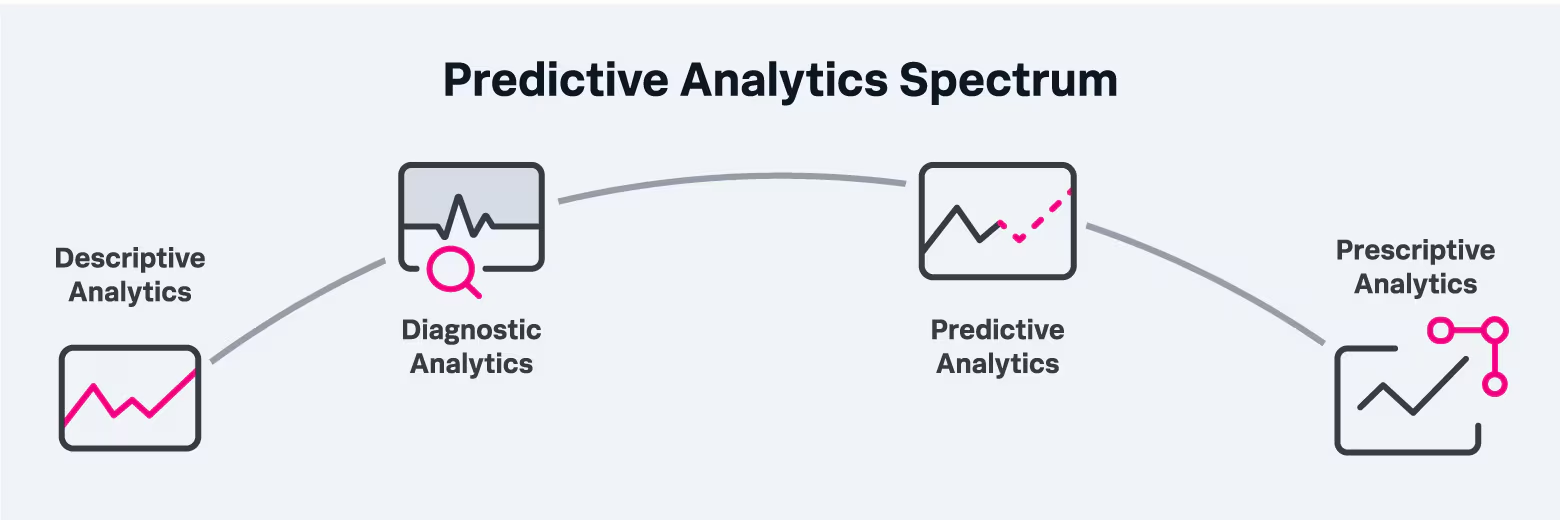
Descriptive analytics
This analytics approach identifies historical trends and patterns and provides a descriptive summary. It may rely on basic statistical techniques such as:
- Frequency distribution
- Time-series
- Measure of central tendency including mean, median and mode
Additionally, it uses data aggregation, reporting and dashboards to answer descriptive questions such as, what happened?
Diagnostic analytics
This approach aims to find the cause behind historical and present events. It may rely on statistical techniques such as:
- Correlation analysis (Pearson/Spearman correlations)
- Control charts
- Hypothesis testing (ANOVA, T-Test, etc.)
It helps answer questions such as, why did it happen?
Predictive analytics
This is where predictive modeling is involved, using mathematical optimization, decision rules and a variety of advanced machine learning algorithms. The goal is to forecast future events based on historical information.
It helps answer questions such as, what is likely to happen?
Prescriptive analytics
The goal of prescriptive analytics is to recommend actions to achieve a desired outcome state or to prevent an issue from arising in the future. Advanced statistical models and machine learning tools are required to model a system behavior, predict a future outcome state and then identify (and prescribe) the best course of action.
The prescriptions may be determined (predicted) by the predictive model itself or fed into a secondary prescriptive engine, which automates the decision-making process given a predicted outcome. In this case, a predictive model is used as the input to such a prescriptive engine.
(Related reading: predictive vs. prescriptive analytics.)
The focus of predictive modeling
An important note here is that the role of predictive modeling is not to understand why an outcome occurs. Instead, it is focused on accurately predicting the probability of an outcome state given the available information used to train the predictive model.
For example, as far as the case of predictive analysis goes, we may not be interested in finding why the email filter moves some email to spam, but if it is correctly filtering out links that may redirect to malicious websites. And as far as black-box (deep learning AI) models are concerned, the predictive models are either entirely non-interpretable or the data high-dimensional datasets may be too complex to interpret.
Importance of predictive modeling
Since predictive modeling is outcome-oriented, we want to ensure that the future predictions are correct. This will determine our model choice, for example using a black-box neural network-based AI model or a simple linear regression model, against model interpretability, which also depends on the complexity of the problem and the available data.
To choose a simple but interpretable modeling approach, additional efforts may be needed to improve the performance of your predictive analytics pipeline. For example, during tasks such as data collection, preparation and preprocessing, noisy data may need to be cleaned (often manually) to enhance signal to noise ratio (SNR).
On the other hand, if you have sufficient high-quality data, you may rely on a complex deep learning model that can learn sufficiently well from large volumes of high-quality information.
How to choose the right predictive model
There are a few things to consider when choosing a predictive model:
- What you’re trying to accomplish: Forecast models are great for predicting future events based on past ones, while classification models are a good choice when you want to explore possible outcomes to help you make an important decision. The right model will depend largely on what you’re trying to learn from your data.
- Amount of training data: In general, the more training data you gather, the more reliable the predictions. Limited data or a few occurrences of whatever you’re trying to measure within a dataset may dictate the use of different algorithms, versus a huge dataset with lots of variables.
- Accuracy and interpretability of the output: Accuracy refers to the reliability of the model's predictions, and interpretability is how easy to understand they are. Ideally, your model will have a good balance of each.
- Training time: The more training data you have, the more time you will require to train the algorithm. Higher accuracy also requires a longer training time. These two factors may be the most significant in choosing a model for many organizations.
- Linearity of the data: Not all relationships are perfectly linear, and more complex data structures may narrow down your options to techniques like neural networks.
- The number of variables: Data with a lot of variables will slow some algorithms down and extend training time, which should be considered before choosing a model.
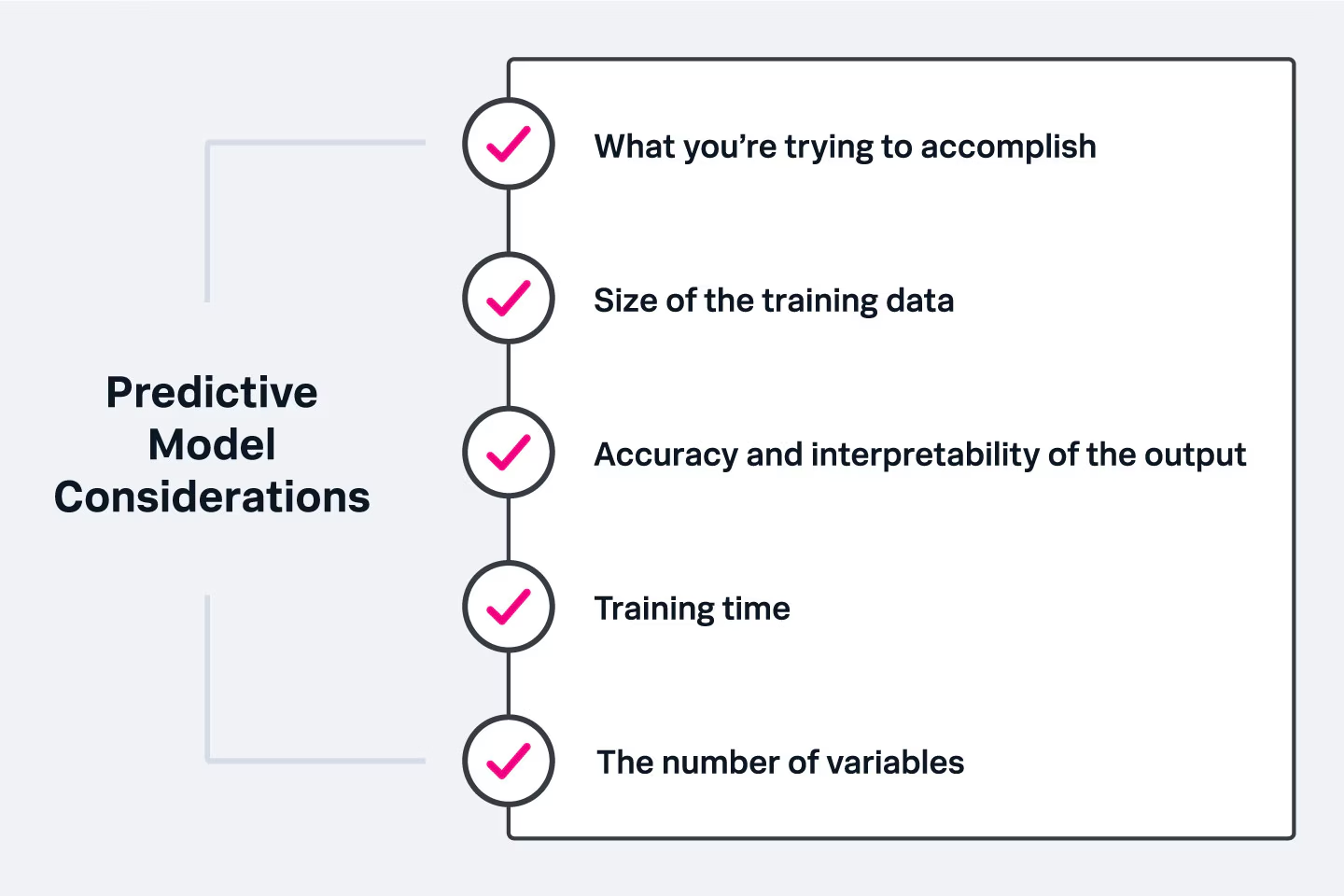
Ultimately, you will need to run various algorithms and predictive models on your data. Also, you need to evaluate results to make the best choice for your needs.
Predictive modeling techniques
Given this consideration, several choices and methods can be used to develop a predictive model. The following categories of statistical modeling techniques and learning algorithms are involved:
Basic statistical models
These may include simple statistical models that are easy to interpret and suitable for small datasets. Predictions from these models may be used as a baseline or a starting point to further improve the performance of your advanced predictive models.
Examples include regression models and Naive Bayes models for simple classification tasks, such as spam filtering.
Classic machine learning models
Since most of the data in the enterprise exists in structured and tabular format, classical AI tools tend to perform very well under certain conditions.
For use cases that require high interpretability, a decision-trees based model may be useful to understand how the predictions are reached (across the decision tree nodes that represent some human-readable logic).
For clearly defined target variables, classical models including regression (for simple datasets) and Support Vector Machines (for high dimensional datasets with a lot of features) may be suitable.
Advanced machine learning models
When the data is complex and high prediction accuracy is required (against the tradeoff of low model interpretability), you can rely on advanced machine learning models. These may range from autoencoder based models (to learn hidden patterns in high dimensional data sets) to transformer-based models (that essentially assign importance to parts of data that may be more useful for predictions). Predictive models that learn from real-time data streams may be constructed with some recurrent architectural approach (RNN, LSTM, GRU etc.).
Engineering and control techniques
In many cases, predictions must come from data that is generated in real-time, in unstructured or semi-structured format. Examples include network logs, sensor data, IoTs and SCADA/PLC devices, and real-time consumer sentiment from social media (across modalities such as text, images, audio/video, Instagram reactions and other formats that must be normalized and preprocessed before analyzing).
You may require an end-to-end predictive analytics pipeline that automates feature extraction and preprocessing. Regarding training a predictive model (post data aggregation, ingestion and preprocessing), an extensive model learning and control paradigm may be adopted.
The following machine learning and control techniques may be particularly useful for predictive modeling applications:
Online learning
Real-time data continuously trains and updates model parameters.
Feedback loops
Present state of the environment and actions are incorporated for predicting future outcomes in real-time.
Adaptive control
The predictive model is integrated with a decision control system that automates the process of executing decisions based on the output of the predictive models. This framework is typically used for prescriptive analytics.
Subsystems and ensemble networks
The predictive model may not be a single unified model but a combination of several distributed and decentralized model instances. This approach is useful for privacy-preserving AI use cases, allowing the models to learn from data directly (on the edge) device instead of having to transfer sensitive information to a third-party backend server. It is also suitable for use cases where each model instance handles a distinct task domain in isolation.
Model distillation and RLHF
Large models learn directly from labeled data. The output of these models is then transformed into a soft target (such as a measure of probability) used to train smaller, task-specific models.
Reinforcement Learning from Human Feedback (RLHF) may be involved (for applications where the predictive model becomes a part of an LLM-based predictive analytics system) to engineer the training process for the predictive model on data and tasks specific to your organization.
In these systems, your organization may be able to engineer policies, expertise and preferences for the AI agents that better align with your business objectives. Essentially, model distillation would ensure efficient training of predictive models, whereas RLHF would ensure better alignment with human (or organizational policies for) decision-making.
To wrap up
As technology and data continue to evolve, so too will the tools and techniques used to build more accurate and sophisticated models. Looking ahead, advancements in machine learning, artificial intelligence, and data engineering will open new possibilities for predictive analytics, driving innovation across industries.
Related Articles

How to Use LLMs for Log File Analysis: Examples, Workflows, and Best Practices

Beyond Deepfakes: Why Digital Provenance is Critical Now

The Best IT/Tech Conferences & Events of 2026

The Best Artificial Intelligence Conferences & Events of 2026

The Best Blockchain & Crypto Conferences in 2026

Log Analytics: How To Turn Log Data into Actionable Insights

The Best Security Conferences & Events 2026

Top Ransomware Attack Types in 2026 and How to Defend