Building the NextGen Factory with Splunk and Bosch Rexroth
Co-authors: Harald Lukosz and Javier Stillig, Bosch Rexroth
For centuries there have been many wise sayings on how to deal with disruptions and prevail amidst uncertain circumstances. Read on to learn how Splunk and Bosch Rexroth are building the next-generation factory to help manufacturers elevate their resilience and take advantage of new market trends and operating models.
Resilience is Key to Recover, Survive and Thrive Amidst Disruptions
The manufacturing industry has a long history of resilience. After the V-shaped recovery following the COVID-19 pandemic, the Global Manufacturing PMI almost continuously deteriorated, leading to cutbacks in output, purchasing and inventories due to weak demand.
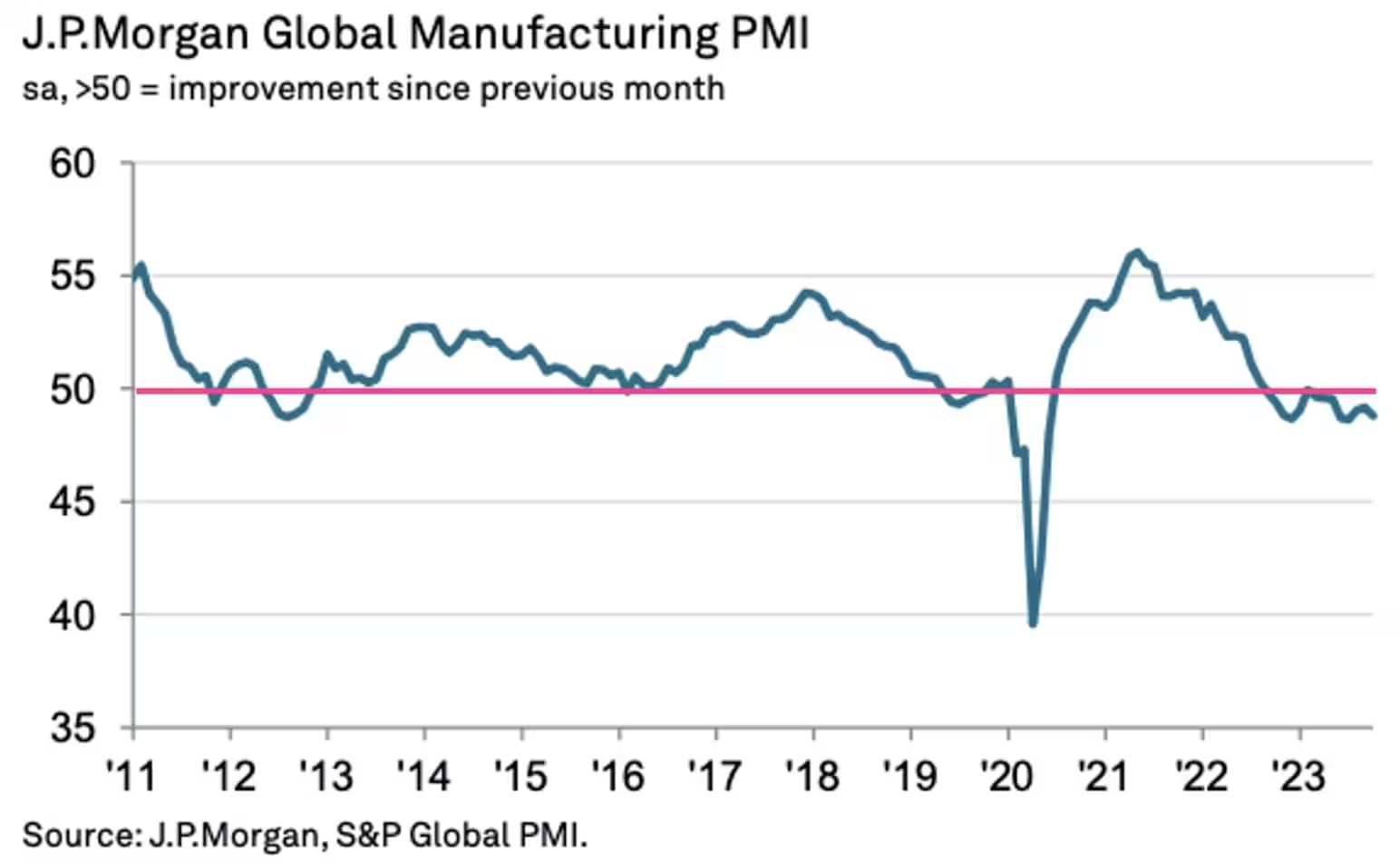
Global Manufacturing Purchasing Managers’ Index (PMI)
A PMI above 50 represents an expansion whereas a reading under 50 represents a contraction, and a reading at 50 indicates no change.
Looking ahead into 2024 things don’t exactly look good for manufacturers. Amidst this upcoming perfect storm resilience is key to recover, survive and thrive amidst disruptions and quickly adapt to new operating models.
The Market Trend “Mass Customization” is Affecting Traditional Manufacturing Operating Models
"The customer can have it painted any color he wants, so long as it's black." Henry Ford once famously declared the user options available for the new Model T. It was the age of mass production and the mantra of economies of scale, manufacturing the exact same products as cost-effective as possible.
Things have significantly changed since then and factory managers of the past decades have been following the efficiency north star, focusing on the key manufacturing KPI OEE (Overall Equipment Effectiveness) by optimizing availability, performance and quality.
Nowadays, driven by the megatrend of individualization, consumers can create their own individual car color and can even customize the entire car interior. Nike allows customers to design their own sports shoes by selecting various customizable options such as colors, and materials and even adding personalized text or symbols.
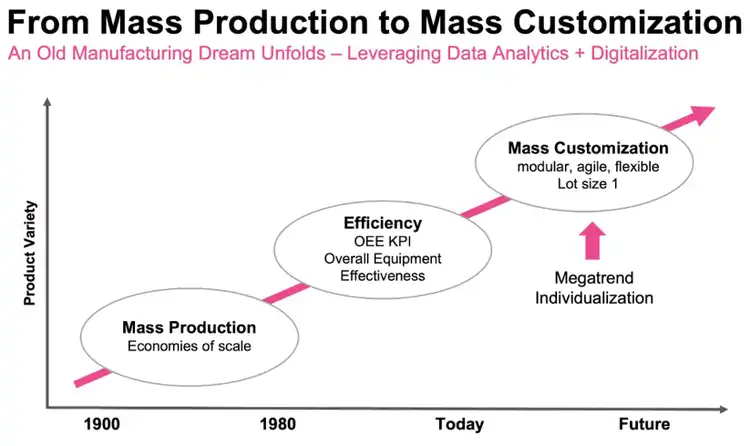
This means factory managers need to change their manufacturing operating model to a modular, agile and flexible production to enable cost-effective mass customization. An old manufacturing dream unfolds with lot size one becoming reality resulting in highly individualized products in constantly changing but small batch sizes. Unit costs, failure rates and machine changeover times would be significantly lower compared to decades before.
A flexible production makes also sense from a pure business perspective in these testing times as the new CEO Philipp Schramm of the German automotive supplier Brose highlights (Source: Handelsblatt, translated into English):
Building the NextGen Factory
Splunk and Bosch Rexroth have joined forces to help manufacturers elevate their resilience and take advantage of new market trends and agile operating models leveraging OT + IT + AI/ML.
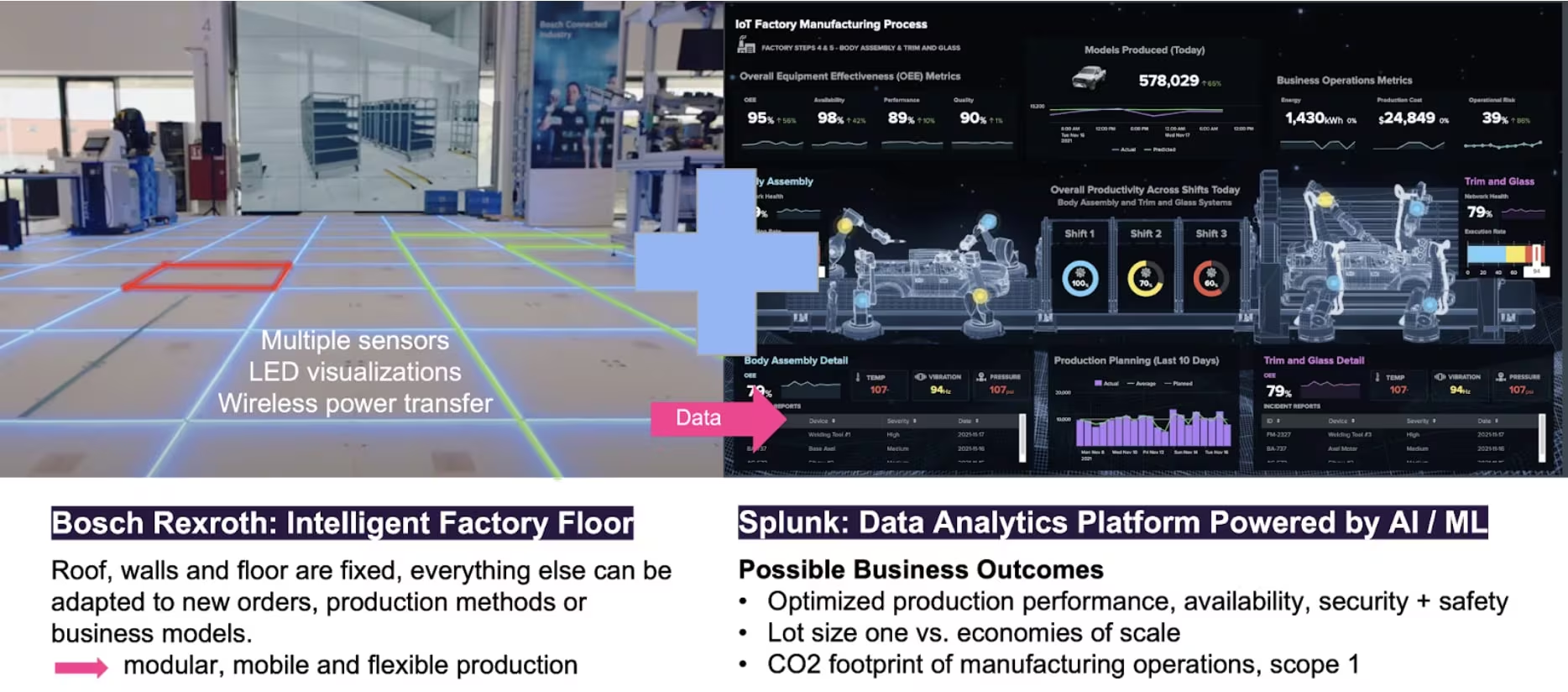
Bosch Rexroth has developed an Intelligent Factory Floor which is above all smart and flexible. Roof, walls and floor are fixed, everything else can be adapted to new orders, production methods or business models. As such, it is easy to reconfigure machinery and to scale up or scale down production lines according to requirements.
The multi-color LED visualization in the floor can flexibly adjust walkways, and define safety zones and logistics areas. The Intelligent Floor collects data such as weight and distance via built-in sensors.
These rich data sources are ingested into Splunk’s data analytics platform leveraging AI capabilities. As a result, possible business outcomes not only include an optimized, agile production performance but also an elevated security posture including IT / OT cybersecurity. Predictive Analytics such as Predictive Maintenance and Predictive Quality based on the Splunk Machine Learning Toolkit can be implemented. Factory managers can finally bring cost-efficient lot size one production to life.
Multiple innovative use cases can be realized, such as sustainability, e.g. the CO2 footprint of manufacturing operations (scope 1) by getting the energy metrics from the Bosch sensors and correlating them with sector-specific calculation tools from the GHG Protocol - leveraging the inbuilt Splunk Sustainability Toolkit.
NextGen Factory @ Splunk Immersive Experience Center in London
Splunk and Bosch Rexroth are currently in the planning process to deploy the Intelligent Factory Floor in the Splunk Immersive Experience Center in London to demonstrate the NextGen Factory in real-life. Stay tuned!
And if you want to read on about the future of manufacturing a little further, we got you covered – check out these resources:
- Splunk Manufacturing (website)
- Building Resilience in Manufacturing with the Power of Data (blog)
- Building Resilience - How leading manufacturing companies keep systems secure, production lines open and profits soaring (ebook)
- Digital Resilience Pays Off (ebook)
- An Introductory Use Case Guide: Splunk Artificial Intelligence for Observability (ebook)
- Splunk Artificial Intelligence and Machine Learning (webinar)
- IoT, Cybersecurity and Sustainability - Friends for Life (blog)
- Splunk Sustainability Toolkit V2 - Doubling Down on IT Sustainability and Beyond (blog)
Related Articles

How Splunk is Helping Shape the Future of Higher Education IT by Tackling EDUCAUSE 2026 Top Issues

Enhancing Government Resilience: How AI and Automation Empower Public Sector Missions

Solving Manual Mayhem in Telecom with Agentic AI

Upgrading to Splunk Enterprise 10.0 and Splunk Cloud Platform 10.0: Key Resources for Public Sector Customers
Building the Next Generation of Defenders: From the Classroom to the SOC of the Future

Analytics That Work: 3 Approaches for the Future of Contact Centers

Observability + Security: Real-Time Digital Resilience for SLED

Digital Resilience for State and Local Governments (Part Two)