Digital Resilience for State and Local Governments (Part Two)
In the first part of our series, we examined the challenges facing state and local governments as they work to secure and maintain the availability of increasingly complex digital systems. Today, we turn our focus to how collaboration—powered by shared data platforms like Splunk—can enhance incident response and overall digital resilience.
Accelerating and Strengthening Incident Response
Effective incident response requires more than just advanced tools; it demands coordinated action across teams and departments. Splunk enables this by providing a unified data platform that connects the right people to the right information at the right time. With streamlined workflows amidst shared context, teams can resolve incidents faster and more efficiently.
Splunk’s built-in automation and orchestration capabilities allow agencies to respond instinctively to many incidents—scaling your response and freeing up skilled personnel to address more complex, high-value challenges. This means less time spent on repetitive tasks and more time focused on protecting critical public services.
Secure Collaboration, Confident Operations
Security is fundamental for state and local governments, especially as they handle sensitive information and critical infrastructure. Splunk’s comprehensive security framework empowers teams to work together without compromising data integrity:
- Data Source-Level Access Control: Manage who can access specific data sources.
- Data Masking and Obfuscation: Protect sensitive information while enabling effective analysis.
- Granular Role-Based Access: Assign permissions based on user roles for precise control.
This ensures security teams can seamlessly collaborate with IT and DevOps counterparts, sharing insights without risking exposure of sensitive data.
From Reactive to Predictive—Powered by AI and Automation
Splunk’s platform, AI, and automation engines are purpose-built to accelerate the detection, investigation, and response cycle. Whether responding to cybersecurity threats, system outages, or incidents that blend both security and observability, Splunk delivers a unified solution to keep your operations running smoothly.
Our industry-leading security solutions equip your Security Operations Center (SOC) with the tools needed for faster threat detection, streamlined investigations, and coordinated responses. This not only helps you comply with regulatory requirements but also reduces risk to your organization’s mission. Similarly, our integrated observability platform gives IT and engineering teams comprehensive visibility into applications, services, and infrastructure, ensuring reliable service delivery to residents.
AI That Empowers, Not Replaces
AI is deeply integrated into Splunk’s security and observability solutions. Our approach is defined by three core principles:
- Domain and Platform Specificity: Our AI is built on deep security and observability expertise, delivering insights tailored to your unique environment.
- Human-in-the-Loop: AI supports—not replaces—your decision making, ensuring public sector professionals remain in control.
- Openness and Extensibility: You can extend our AI models or integrate your own, giving you flexibility to address your organization’s needs.
Recent AI Innovations for Government Agencies
Splunk is advancing the state of digital resilience with new AI-powered capabilities:
- Splunk AI Assistant: An intuitive, conversational tool that helps users write and understand SPL queries in natural language, accelerating learning and adoption.
- AI Toolkit: Enables guided setup for outlier detection, predictive analytics, and clustering—now with support for externally trained ONNX models.
- Splunk App for Data Science and Deep Learning (DSDL) 5.1: Adds advanced machine learning and two new AI assistants for text summarization and classification, leveraging your own domain-specific data.
- Outlier Exclusion for Adaptive Thresholding: Improves accuracy by filtering out abnormal spikes, ensuring more precise monitoring.
- ML-Assisted Thresholding (Preview): Automatically sets dynamic thresholds using historical data, delivering smarter, more accurate alerts with a single click.
State and local governments are increasingly responsible for safeguarding critical digital infrastructure and public services. Splunk’s unified data platform and AI-driven capabilities empower your teams to detect, investigate, and respond to incidents faster—while maintaining the highest levels of security and compliance. With Splunk, you can deliver resilient, reliable digital experiences to your community.
Summary
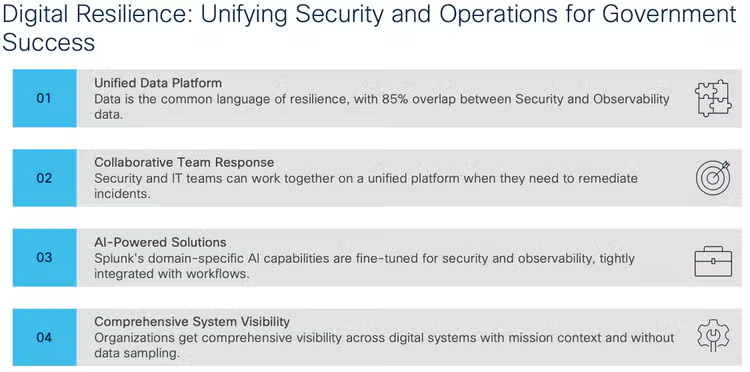
With Splunk, state and local agencies can move from reactive incident response to a proactive, predictive, and collaborative approach—building the digital resilience needed to serve your community today and in the future. Want to know how? Learn more.
Related Articles

Splunk App for Data Science and Deep Learning - What’s New in Version 5.1.1
Navigating the Future: The New Cyber Security Risk Management Construct (CSRMC)