What’s SaaS Monitoring? Why You Need To Monitor SaaS Apps
Learn Muhammad RazaSaaS monitoring is the practice of tracking, analyzing, and managing the performance and utilization of Software as a Service (SaaS) technologies. The goal of SaaS monitoring is overall optimization. Specifically, SaaS monitoring enables you to:
- Optimize the performance of all your applications.
- Improve resource utilization.
- Manage costs.
- Secure communications with the backend cloud servers.
Without monitoring your varied SaaS apps, you cannot be sure that you’re getting what you pay for or that you’re not wasting resources. And you certainly cannot truthfully respond to the questions that your leadership is asking.
The benefits of monitoring your SaaS apps
When it comes to IT and cloud systems, there are many areas to monitor. An area of IT monitoring that might go by the wayside is SaaS monitoring. That’s because SaaS apps are often sold with the promise of “worry about nothing, we’ll take care of everything for you.”
The truth isn’t that clear. That’s because of the inherent nature of SaaS.
The SaaS delivery model allows users to access technology functionality on a subscription basis. This model shares responsibility between the cloud vendor and you, the business users.
- The cloud vendor is responsible for the development and management of technology systems (infrastructure) running a given SaaS service.
- Business users get to trade the high capital expenditures (CapEx) of product development with affordable utilization-based OpEx.
(Related reading: IT spending trends.)
Convenience, with a caveat
This convenience comes with an expectation — and it’s a big one: your organizations is expected to maintain visibility into your own processes and digital assets that are used and engaged with a SaaS service. Why? There are many reasons, including:
- The need to optimize resource utilization based on your own business needs.
- The shared responsibility model of SaaS security, which requires users to take all necessary measures to avoid security incidents, overspending, and risk-exposure.
The challenge in realizing these objectives is two-fold: limited visibility into SaaS operations and lack of risk management controls.

Splunk Infrastructure Monitoring
Whether on-prem, hybrid or multicloud, Splunk delivers real-time monitoring and troubleshooting to help you visualize and analyze performance in seconds and with greater accuracy.
Visibility into SaaS apps
Since the cloud technology runs on third-party servers, the vendor offers its customers only limited visibility into the underlying hardware operations. This makes it difficult, if not impossible, for business organizations to identify the infrastructure nodes and traffic workflows. Without this information, you as the customer cannot…:
- Fully understand the health of the applications you’re running.
- Control the parameters to optimize application performance at the infrastructure layer.
But there’s still a lot that you can monitor at the application layer.
SaaS monitoring pipeline: strategy & key components
Let’s review the key components of SaaS monitoring strategy and tooling that can help your organization optimize cost, performance, and security of your SaaS solutions.

Data collection
All sorts of data and information — including KPIs, metrics, logs, and events data — is generated across the network. This can be collected using agent-based or agentless monitoring functionality.
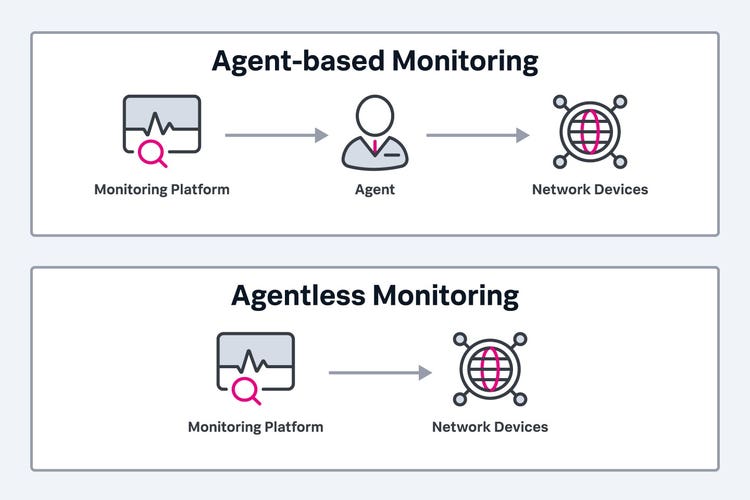
Here, you may opt for an integrated data collection pipeline, considering the the siloed sources of data generation.
In some cases, the SaaS vendor may provide API access to its log aggregation tool. If so, you can corelate this information and enriched with application performance metrics, logs, and traces within your own network.
Asset discovery
Containerized systems run application components in an ephemeral state: these components are packaged and loaded into the infrastructure environment. Once the computing job is completed, the container resource allocation is decommissioned and made available for its next use case.
In the case of SaaS applications, any components running in such a state, or interacting with other container applications, must be discovered and analyzed in real-time.
Data flows and application dependencies
In a software-defined infrastructure environment, hardware resources are allocated dynamically. The SaaS application is decoupled from the underlying hardware. Any change in workload distribution must be traceable and reachable by dependent applications, components, and systems.
Forecasting
Perhaps the greatest uncertainty surrounding SaaS solutions, and cloud-based technologies in general, relates to forecasting.
IT and business executives seek answers to challenging questions:
- How will the usage patterns change in a given time window?
- What are the optimal KPI metrics and SLA indicators to measure the ROI and application performance?
- How stable are the vendor pricing and policies in the near future?
To address the technical concerns surrounding forecasting, start by identifying the metrics and data sources most relevant and impactful to…
- Application performance
- Business outcomes
- External factors such as traffic trends, user behavior, and market expectations
For strategic concerns surrounding vendor relationships, service quality, and pricing, you should be able to forecast your long-term business goals and usage requirements. Use this knowledge as a basis for SLA metrics selection and pricing commitments.
(Related reading: third party risk management, explained.)
Traceability, audit, and controls
Historical information and traceability is important to enforce compliance controls and audits. SaaS monitoring may rely on large volumes of log data to push real-time alerts on application performance and security. This log data is also necessary to maintain usage history and context.
SaaS monitoring can help with distributed tracing functionality for root cause analysis using logs that lead up to an incident.
Centralized log management can take monitoring information for compliance related analysis in the future or real-time anomaly detection. This contextual knowledge can help your organization to:
- Enforce controls, such as alerts when the usage exceeds predefined thresholds.
- Trigger security alerts in response to anomalous activities on the network.
Reporting
SaaS monitoring is all about creating real-time, actionable insights. These insights should be presented with intuitive dashboards that synchronize data from distributed information sources.
Integrated APIs that fetch information in real-time into a centralized log data repository, where it is standardized and preprocessed before running analysis is therefore an important last step of a SaaS monitoring pipeline.
Data is not information
SaaS monitoring is focused on the access of raw data, but it still needs to be transformed into actionable contextual knowledge that is unique to your business use case.
An extended functionality of SaaS monitoring tools may incorporate AI-driven functionality to identify patterns within your SaaS monitoring data. These patterns can help manage SaaS costs and performance based on changing external metrics and usage trends — use this knowledge to plan scalability and resource allocation for your SaaS technologies for improved end-user experience and therefore, business outcomes.
Splunk supports cloud infrastructure monitoring
Splunk is a leader in solutions for monitoring and observability. Access the Gartner® Magic Quadrant™ for Observability Platforms for free or explore Splunk monitoring and observability solutions.
Related Articles

ISP Monitoring Explained: How to Measure, Manage, and Improve Internet Performance

What is SQL Injection?