What Is a Data Platform? A Complete Introduction
Learn Chrissy KiddKey Takeaways
- A robust data platform is essential for managing and analyzing large volumes of data effectively, enabling organizations to gain real-time insights and make informed, data-driven decisions.
- Integrated observability, security, and application performance monitoring modules — built on a shared data fabric — enable cross-domain correlation, holistic troubleshooting, and support for compliance and governance requirements.
- Splunk offers on-premises and cloud-native end-to-end solutions that ingest, process, normalize, and enrich machine data at petabyte scale, providing unified search, analytics, and AI/ML-driven insights.
A data platform is a comprehensive end-to-end solution for all your data. A true data platform can ingest, process, analyze and present data generated by all the systems and infrastructures within your organization.
Some software and apps may masquerade as data platforms; often, these are supporting one or two areas of the data lifecycle, such as data storage (like data warehouses or lakes) or data analysis, but limited to some sources. A true data platform is end-to-end and can collect and analyze data from all sources, as we'll see.
In this topic, there’s a lot of things to understand and consider. So, let’s take a deep look at data platforms, including the definition and related terms, the benefits and use cases, and how to start building your data strategy.
What is a data platform?
Spanning the entire data lifecycle, a true data platform enables end-to-end data management over the entirety of your environment. Data platforms are much, much more than mere storage or only a business intelligence platform. Indeed, most data products out there today are point solutions and purpose-built applications that handle just one or two facets of the data lifecycle.
So, what exactly goes into a data platform? You can think of it as having multiple layers of functions that all come together to improve decision-making for the entire organization. You can segment the functions of data platforms into broad categories:
- Data storage
- Data ingestion
- Data transformation (like normalization and ETL)
- Data modeling (designing structured data frameworks)
- Business intelligence
- Data observability
As your data evolves from storage up through higher layers, it becomes more about information and insight.
Note on terminology: we’ll use “data platform” throughout this article. Similar terms for the same technology include “customer data platforms” and “enterprise data platforms”.
(Splunk is an indsutry-leading data platform. Learn what Splunk does or try it for free.)
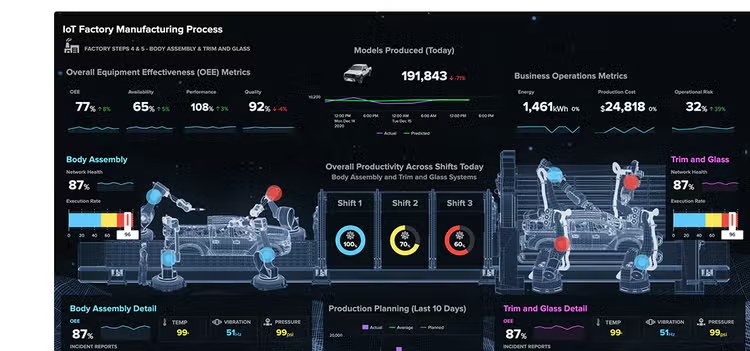
This single-pane, real-time view into a car manufacturing process is only possible because of comprehensive data platforms, like Splunk Cloud Platform.
Challenges with data siloes
Organizations today can certainly customize their infrastructure, piecemealed from data sources that include thousands of apps and services to address their own unique needs. This isn’t easy, of course. Worse is that problems arise when these numerous point solutions cannot integrate with the rest of the network or IT infrastructure.
This lack of integration often results in data silos — data sets that can’t be shared with other teams and for other purposes, preventing your ability to do all sorts of important tasks, like:
- Identify threats.
- Resolve service and security incidents.
- Ensure availability and uptime.
- Collate inventory with demand.
- Understand inefficiencies.
Ultimately, everything you need to make meaningful business decisions.
Today, enterprise organizations are opting for modern data platforms to address these challenges, and they want fewer— yet better — products to do it with. (Stop the tool sprawl!) Data platforms break down silos and enable seamless sharing of data.
Benefits of data platforms
Data platforms offer data centralization — a single platform with visibility across the entirety of an organization. (This, in turn, breaks down silos and provides actionable insights based on a holistic view of the organization’s data.)
To operate most effectively, data platforms must be able to ingest data from nearly any source without creating new inefficiencies or complexity. Ultimately, a data platform should integrate with your existing infrastructure to improve your ability to take action on all of your data.
Indeed, it is exactly the combination of end-to-end features that replace point solutions that enable true data-informed data operations.
A data platform can integrate the capabilities of individual solutions and bring all the data into a single place, where it can be secured, shared, and used most effectively. Data platforms offer more significant benefits to large organizations, including:
- Centralizing and standardizing data functions in one platform. These functions include ingestion, storage, analysis, reporting, etc.
- Supporting data governance, and therefore compliance with regulatory standards (like GDPR).
- Simplifying and improving reporting, often with capabailities for data dashboards and data visualizations.
- Leveraging AI and machine learning for effective automation and predictive insights.
An effective data platform will let you work with any and every data set, regardless of what it is, where it is stored, or how much of it there is — and at a speed, and with a degree of trust, that gives you actionable, real-time insights.
Foundational pillars of a modern data platform include versatility, intelligence, security, and scalability
What goes into a data platform? Must-have components
A modern data platform often ingests many types of data and incorporates a wide variety of data tools and features. For example:
- Data ingestion
- Tiered storage
- Data analytics and business intelligence
- Data governance
- Data security and privacy
Some platforms are optimized for certain types of workloads, including feature sets targeting specific use cases. Data platforms should be flexible and vendor-agnostic so that you can integrate open-source and proprietary tools customized around an organization’s unique business and data needs (and avoid vendor lock-in.) Basically, your data platform should not limit what you can do in the future.
These must-haves are a few essential pillars that lay the foundation of your data platform:
- Versatility: The ability to manage data flow so that all areas of the organization can access relevant data with ease.
- Intelligence: Data ingestion and distributions should be automated and reliably categorize and deliver data to its correct tier, with the ability to respond to changes, identify and mitigate errors and forecast user needs.
- Security: The ability to adequately secure and protect the data that’s being stored is non-negotiable, enabled by strong encryption and robust data lifecycle management that complies with all applicable regulations and laws.
- Scalability: A data platform should adapt to projected growth as data volumes expand.
Incorporating these components into your data platform creates a sustainable, flexible model to help you secure, analyze, and store data in a way that boosts digital resilience and futureproofs your business for change and growth.
Data platforms & related data concepts
With data, there are a lot of terminologies. Let’s clear up any confusion:
Big data & big data platforms
A “big data platform” is no different than a “data platform” — both are intended to handle data at scale. There are three core characteristics that define “big data”:
- Volume: The quantity of generated and stored data
- Variety: Data quality, or the type and nature of the data
- Velocity: The speed at which the data is generated and processed
But at this point, all data is big data, incorporating both structured data and unstructured data. Individual consumers have access to hardware and cloud systems with petabytes of storage. Professional organizations — businesses and the public sector alike — are generating staggering amounts of data and metadata.
(Read all about big data analytics.)
Data platform vs. data architecture
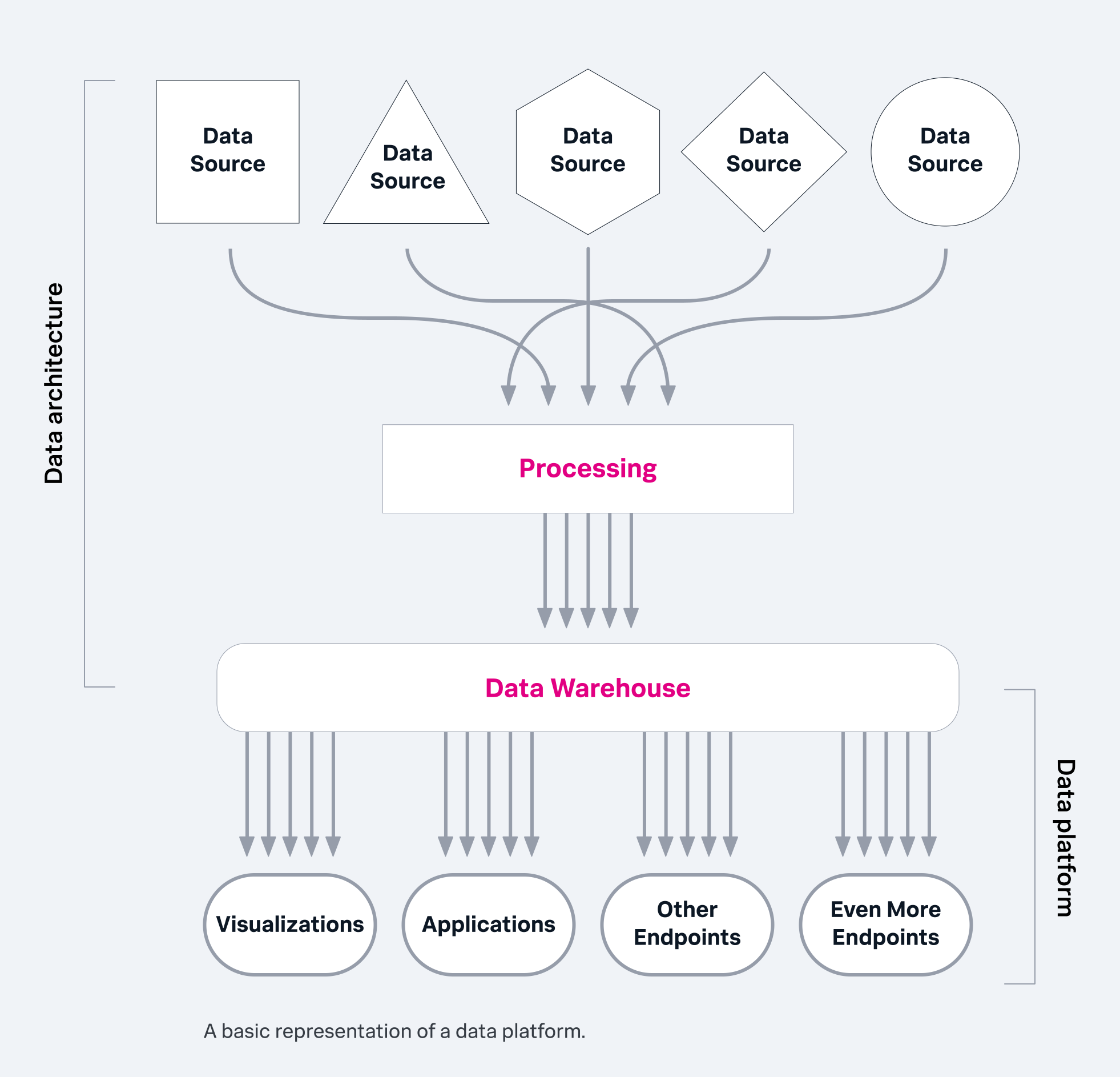
A data architecture is essentially a framework for an organization’s data environment. A data architecture is the plan for ingesting, storing, and delivering the data, while the data platform is the machine that accesses, moves, analyzes, correlates, and validates data for end users.
That’s the importance of a solid data architecture — it’s the backbone of a data-driven organization, the robust infrastructure that supports its existing data requirements and scales to match data and infrastructure growth.
Data platform vs. data warehouses and data lakes
Data lakes and data warehouses are both data storage systems that integrate enterprise data in central repositories, but they work quite differently:
Data warehouses are organized and more immediately useful to business needs, though with certain limitations. Data warehouses can store large volumes of data, and within that storage the data may be processed and analyzed to some degree. These warehouses are your Snowflakes, BigQuery, Redshift, S3, and more. But the data inside a data warehouse is not itself valuable — instead, it requires work and analysis to extract information and insight. Data warehousing saw a kind of renaissance with the eruption of cloud computing, which offered a more scalable, flexible, and cost-effective model compared to legacy, on-premises systems.
Data lakes, on the other hand, store largely unstructured, raw data. They're called lakes because they have no structure, and so much of the data is just there, "floating around", waiting for some action to be taken upon it, like moving it out of a data lake into a data warehouse, a database, or directly into a data platform.

Like the warehouse on the left, data warehouses are somewhat organized and can handle some tasks. Data lakes, in contrast, are vast bodies of raw data, waiting for some work to be performed.
How to choose the right data platform
Choosing the right data platform comes down to seven core considerations.
On-premises, cloud, or hybrid
Multiple factors determine whether you manage your data on site, through a cloud provider, or a combination of both — the hybrid model. Regardless, you’ll want to consider factors including:
- Security and compliance requirements
- Costs of different software licensing models
- Which skills/functions you want to maintain in your in-house IT team
- Which skills/functions you’d acquire through vendors or partners
Scalability
A data platform must be able to perform at today’s scale and be adaptable to the inevitable growth of your data stores. Indeed, it’s this requirement for scalability that is driving more people to adopt data platforms.
Flexibility
Flexibility is essential. Can the platform currently serve multiple groups and use cases? Is it relatively straightforward to add new functions and use cases to the platform? Is there a robust ecosystem of applications and add-ons that can support new functions?
Usability and breadth
Is the platform you’re considering simple to deploy and configure for users of varying skill levels? What’s the learning curve? Applying data to every decision requires that anyone in your organization — from IT wizards to less-technical employees — be able to work with that data.
(Check out these Splunk Tutorials or explore all of Splunk training.)
Security and compliance
You must prevent the sorts of data breaches that dominate headlines and put companies, customers and even nations at risk. That means ensuring that your data platform has robust security features built in, or tools that integrate with your existing security solutions.
The same is true for compliance — a data management platform that adheres to the frameworks and guidelines established by a country or region’s regulatory bodies is essential if your organization does business in that country or region.
Intelligence and automation
Vast quantities of data cannot be understood solely by humans, even if they’re the most dedicated analysts. Innovations in technology, particularly around machine learning (ML) and artificial intelligence (AI), have created new opportunities for organizations of every size to benefit from data-driven insights.
Open source vs. proprietary
Though today many data platforms are proprietary in nature — one brand delivering a single, agnostic, comprehensive data platform — it is technically possible to build your own data platform using open-source technologies. There are, of course, pros and cons to each:
- Open source tools can allow complete customization and integrate with most systems. However, building them to your precise requirements mandates a team of people with technical expertise, additional resources for maintenance and implementation. Suddenly, the cost you expected to save with open-source solutions may not actually pan out.
- For out of the box usage along with high customization, built-in features, company and community support, and ongoing cybersecurity, opt for closed-source solutions like Splunk.
Get started with data platforms: focus on your needs
With so many options available, choosing a data platform can seem like an overwhelming prospect. Set aside the enormous selection and the various labels for products, services and solutions, and approach the search by starting with your needs:
- Know your goals. You can’t address your needs effectively if you don’t know what you hope to accomplish.
- Start small. Focus on a small-scale project to start — proving the efficacy of working with a data management platform is the best way to encourage wider adoption in your organization.
- Build a data culture. Making data analysis accessible to your organization is half of the equation — you have to create a culture that leads with insights from data.
- Think big. Data is extraordinarily powerful and can be useful to every part of a business. Make sure that the platform you choose can be used wherever data can be useful — throughout your organization.
The future of data platforms
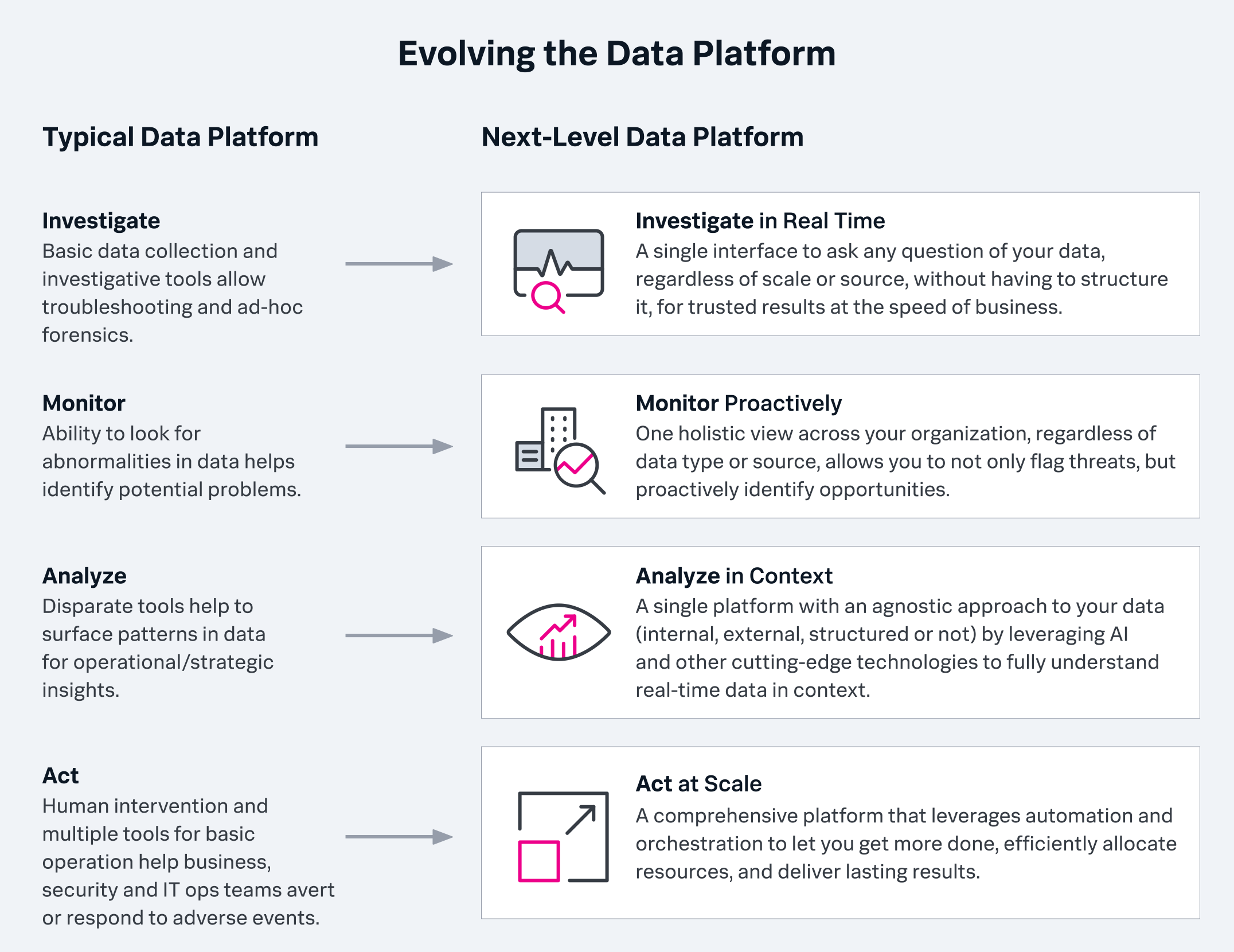
In the future, data platforms will need to handle data sets of greater velocity, variety and volume, while allowing a range of users — from data scientists to business managers — to bring real-time data to every question, decision, and action. A data platform must allow users to investigate, monitor, and analyze data — and take effective action based on the insights revealed.
As new technologies bring more data, in more formats, data platforms will have to evolve as well. To meet the challenges of the present and future, data platforms will need to integrate machine learning and AI to proactively assist organizations with their data-related goals.
Related Articles

What is eBPF?

What Is Computer Vision & How Does It Work?