Data Observability: The Complete Introduction
Learn Austin ChiaKey Takeaways
- Data observability enables organizations to fully understand, monitor, and troubleshoot their data systems throughout their lifecycle, ensuring data reliability and availability.
- By capturing real-time insights into data health, lineage, quality, and performance‚ and automating data-quality checks‚ teams can quickly detect, triage, and resolve issues before they impact analytics.
- Implementing data observability practices increases trust in data, accelerates root cause analysis, and supports scalable, self-service analytics for better decision-making across teams.
When it comes to truly understanding your organization's health and performance, data observability is needed, especially with the rise in AI going into 2024.
In this article, we'll unpack the dynamics of data observability and its components, understand its benefits in your business, and explore real ways to use observable data. Read on to find out more about the potential of data observability.
What is Data Observability?
Data observability is the term for your ability to fully understand, monitor, and manage the quality, reliability, and performance of data across various data pipelines. Observability provides a transparent view of data flows to ensure their accuracy and validity.
Comprehensively speaking, data observability is a proactive approach to data management that allows businesses to gain insights and recognize issues in their data ecosystem. This can be done in real-time, contributing to enhanced decision-making.
Data observability enables the ability to inspect, diagnose, and rectify data inconsistencies within an organization's information system. Data observability also acts as a cornerstone for boosting business intelligence — here's what data observability can unlock for your business:
- Accurate, real-time data insights
- Proactive issue identification
- Streamlined data governance
- Reduced operational risk & enhanced operational efficiency
- Well-informed business strategies
In short, the better question might be, “What can’t I do with observable data?!”
(Related reading: What’s Observability?)
The 5 pillars of data observability
Data observability can be broken down into 5 main pillars:
- Freshness
- Distribution
- Volume
- Schema
- Lineage
Freshness
Freshness refers to the timeliness of data, i.e. how up-to-date and recent given data is at any point in time. This pillar enables businesses to monitor the latency of their data flow, ensuring that the information being used for decision-making is as current as possible.
Distribution
Distribution focuses on understanding how data is being transmitted and moved across various data sources. It involves:
- Tracking the flow of data through its entire journey, from source to destination.
- Identifying any potential bottlenecks or failures.
Volume
Volume refers to the size of data being processed and stored by an organization. This pillar enables you to monitor your storage capacity and cost — and identify any issues with data scaling.
Schema
Schema refers to the structure and organization of data, including its format, type, and relationships. This pillar helps you ensure data consistency across different systems and identify any discrepancies or errors.
Lineage
Lineage refers to the history and origin of data, tracking where it came from and how it has been transformed throughout its journey. Data lineage allows you to best understand the reliability and accuracy of your data, as well as identify any potential data quality issues.
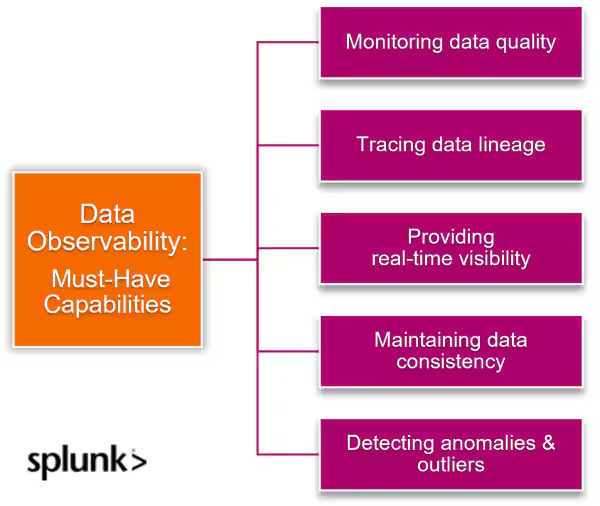
Components & features of data observability
Now, let's have a look at the key components that make up data observability:
Monitoring data quality
Accelerating the advancement of your business through data observability starts with a fundamental element: monitoring data quality. With continuous monitoring, your systems can discern inconsistencies and faults, thus elevating the veracity and reliability of observable data.
- Frequent data quality checks
- Systematic validation for data accuracy
- Routine identification of missing or incomplete data
- Continuous follow-up on data integrity issues
- Proactive detection of abnormal data patterns
Tracing data lineage
Tracing data lineage is essential: it allows tracking of a data item's lifecycle, from its source to its transformation, until it reaches a visualization state. Understanding how data moves, and changes in your organization can have a significant impact on your business strategy. With this feature, you’ll have:
- Data integrated from multiple sources, all in a single spot
- Awareness of alterations made to data
- Reliance on the accuracy and reliability of the information
- Capability to address potential issues more proactively
In the case of an unexpected result, it’s much easier for engineers to efficiently examine the data’s path to identify the problem in the pipeline if there's good data observability.
To simplify this process, use observability tooling (like those from Splunk) to establish data lineage. These tools enable teams to understand better how the resulting output was constructed — allowing engineers to dive into the operations at each step in the workflow.
(Read about distributed tracing, the technology that enables data tracing.)
Providing real-time visibility
Real-time visibility is crucial to data observability. This visibility enables tracking of data in real-time as it moves along the data pipeline, providing transparency into any issues that may arise.
Here are some benefits of real-time visibility:
- Timely identification and resolution of data disruptions
- Prevention of potential business impacts
- Enhanced decision-making and analytics
- Proactive risk management
- Efficient troubleshooting of data issues
(Check out real-time visibility & monitoring with Google Cloud & Splunk.)
Maintaining data consistency
Achieving consistency in your business’ information is paramount in the age of digital transformation. Data consistency underpins trust in business process outcomes, decision-making, and overall data reliability.
Of course, the most affective approach for assuring consistent data is to have data observability. With that, you can:
- Proactively monitor data for potential inconsistencies.
- Implement regular checks to confirm data uniformity.
- Foster integration across different data sources to promote consistency.
- Make use of automation in data auditing to maintain consistency.
Detecting anomalies & outliers
Detecting anomalies and outliers is a crucial facet of data observability. Leveraging the right tools can highlight unexpected data variations, smooth out data streams, and reduce the impact of outliers on your overall analytics. With this feature, you can:
- Use advanced analytics for real-time anomaly detection.
- Leverage machine learning to predict and handle outliers.
- Establish thresholds for data behavior to easily spot anomalies.
- Implement automatic alerts for significant variations in data values.
- Consider the impact of anomalies on data stream normalization.
- Prioritize the correction of data points identified as outliers.

Benefits of data observability
Let's now explore some of the benefits of having data observability in your organization:
Truly accurate, reliable data
With data observability, businesses can base all decisions on accurate and reliable data. Enhanced data observability instills trust in data across the organization.
As a result, some added reliability and accuracy benefits are:
- Reducing data discrepancies and inaccuracies
- Promoting a culture of data democratization
- Acknowledging and correcting data anomalies
- Enabling continuous data improvement
Smarter, proactive decision-making
With data observability, businesses unlock the power to make informed and proactive decisions. By continuously tracking data flows, you can:
- Pinpoint trends.
- Disentangle complexities.
- Forecast outcomes with great accuracy.
In support of decision-making, data observability enables real-time insights into business operations, predictive analytics for strategic planning, and the ability to detect and address risks before they impact business.
Operational efficiency
Data observability has a significant impact on operational efficiency, as it helps organizations eliminate redundant processes, streamline workflows, and accelerate data-driven decision-making. Some ways that data observability can improve operational efficiency include:
- Faster detection and resolution of data issues
- Automation of manual processes
- Better collaboration between teams through the sharing of actionable insights
Actual data security & data governance
Through consistent monitoring and tracking, data observability enhances the security of organizational data. It also enables businesses to adhere to data governance regulations, protecting sensitive information and maintaining customer trust.
Some ways that data observability contributes to data security and governance include:
- Identifying potential security breaches in real-time.
- Tracking and auditing all data movements for regulatory compliance.
- Establishing transparency in data handling processes.
(Know the differences: data governance vs. data management.)
Data transparency
The ultimate goal of data observability is to provide transparency into the entire lifecycle of data. If you do data observability the right way, you’ll get a total view of your data’s movements, transformations, and usage—that is, actual transparency in your data. This transparency enables you to:
- Better understand how data is used across the organization.
- Identify potential areas for improvement in business processes.
- Collaborate and knowledge-share across teams.
How to implement data observability
To successfully implement observable data, you’ll need three things: a keen understanding of your data infrastructure, the appropriate tools and instrumentation, and the right monitoring systems that flag data inconsistencies.
Understand your data infrastructure
The first step is to understand your data infrastructure, including where data is sourced from, how it moves along the pipeline, and where it resides.
- Take inventory of all data sources in your organization.
- Identify potential points of failure in the data pipeline.
- Understand the relationships between different components of your data infrastructure.
Adopting data observability facilitates a 360-degree view of your data infrastructure. It allows you to align the disparate elements of your data ecosystem, ensuring efficient data flow and usage.
Choose the right observability tools
Next, select tools that are best suited for your organization's needs. Consider tools that can easily integrate with your existing data infrastructure and provide comprehensive monitoring capabilities. Some factors to consider when choosing observability tools include:
- Scalability to handle large amounts of data
- Ability to monitor both structured and unstructured data
- Real-time monitoring capabilities
Splunk Application Performance Monitoring is a perfect example of this technology.
Set up monitoring & alerting systems
Lastly, use effective monitoring systems to pivot your business towards data-driven decision-making.
They help track data changes, performance metrics, and data pipeline developments impacting your business. Here are some actions to take:
- Identify key data metrics and establish thresholds for acceptable variations
- Set up automated alerts for when these thresholds are exceeded
- Monitor both real-time and historical data trends
Monitoring systems enable businesses to quickly identify and address potential issues, ensuring the reliability and accuracy of data.
Best practices for data observability
Finally, here are some best practices to ensure successful data observability implementation in your organization.
Define key data quality metrics
Defining key data quality metrics allows organizations to measure and track the quality of their data. Some questions to answer include:
- Completeness: How much data is missing?
- Accuracy: How closely does the data match reality?
- Consistency: Are there any differences in similar datasets?
Establishing these metrics ensures that businesses can identify and address potential issues, reducing the risk of incorrect or incomplete data.
Foster a culture of data democratization
Data observability requires the involvement and cooperation of all teams within an organization. By promoting a culture of data democratization, businesses ensure that everyone has access to data insights and can contribute to improving the quality and accuracy of data. This includes:
- Providing training on how to interpret data for non-technical team members.
- Encouraging data-driven decision-making at all levels of the organization.
(Related reading: organizational change management.)
Establishing clear data governance policies
Establishing an effective data governance policy can embed transparency into your organization's core. A comprehensive framework that outlines data management standards, mechanisms for reporting issues, and auditing procedures is important.
Additionally, it is crucial to involve all stakeholders in the creation of data governance policies to ensure buy-in and alignment toward a common goal.
Regularly auditing data pipelines
A regular audit of data pipelines helps with their upkeep. It allows for early detection of bottlenecks, leading to quicker resolution and streamlined operations.
It guarantees seamless data pipeline processes and facilitates unhindered access to essential data points.
With a focus on maintaining pipeline health, audits help recognize deviations in data quality. This paves the way for accurate business forecasting and data-driven decision-making.
Observability: the starting point for modern data operations
Data observability is a critical aspect of modern data management and governance. It provides complete transparency into the lifecycle of data, helping businesses ensure regulatory compliance, identify areas for improvement, and make more informed decisions.
With proper understanding, tool selection, monitoring systems setup, and best practices adoption, organizations can reap the full benefits of data observability in their operations.
Related Articles

What Is Extortionware? Going Beyond Ransomware

A Guide to Cloud-Native Security: 4Cs, 3Rs, and Essential Protection Strategies