Data Pipelines & Optimizing Pipeline Efficiency
Key Takeaways
- Data pipelines automate the flow of data across systems: They enable the extraction, transformation, and loading (ETL) of data from multiple sources to destinations like data warehouses, ensuring data is organized and ready for analysis.
- Data pipelines are essential for managing modern data ecosystems: streamlining large volumes of data, improving efficiency, and enabling real-time insights in industries such as finance, healthcare, and e-commerce.
- Effective data pipelines require scalability and monitoring: To ensure reliability, pipelines must handle growing data volumes, maintain data quality, and provide visibility into performance for troubleshooting and optimization.
When it’s time to make business decisions, most organizations use data to guide them. But how do you gather and decide which data to use? At least one data pipeline will be involved!
Data pipeline is a comprehensive term. Calling something a “data pipeline” often includes a variety of processes involved in the flow of given data. In brief, it looks like this:
- Data starts in various forms. This data is raw and sourced from many places It requires cleaning and transformation to be useful for business decisions.
- Data pipelines process and clean data using a variety of techniques.
- Once prepared, data is ready for analysis and business application.
This guide will take you through a detailed explanation of data pipelines. We’ll also look at the increasing focus on improving the efficiency of pipelines.
What is a data pipeline?
Let’s define it: A data pipeline is the process, in distinct steps, that carries data from various raw data sources, transforms and optimizes that data as required, and then loads it into a destination system, usually for further analysis or other business operations. The final data—“data products”—then serve appropriate use cases.
The goal of a data pipeline is to automate the flow of data while still maintaining its integrity and consistency.
Consider the data pipeline a generic term, and depending on your goals, types of data, and budget, you’ll use a variety of technologies and techniques within your pipeline.
Types & components of data pipelines
Depending on your business, goals, and challenges, there are several types of data pipelines to choose from:
Batch data pipelines. These manage data in groups (or “batches”). The data is collected over time and then processed at set intervals, such as hourly, daily, weekly, etc. This is a common choice when companies manage large volumes of data that don’t require real-time processing.
Real-time data pipelines. In instances that require real-time data, these pipelines handle data instantaneously as it’s generated. This is also known as data streaming. It’s helpful for use cases such as fraud detection or user behavior tracking on websites.
Cloud-based data pipelines. These pipelines are built and hosted in a cloud environment. They provide companies with scalability and flexibility and can handle both batch and real-time processing.
Machine learning pipelines are designed specifically for ML workflows. Here, the pipeline automates the process of training models, validating data, and deploying models into production.
(Data pipeline example: setting up a pipeline to detect fraud.)
The data pipeline architecture
Search online for the steps in a data pipeline and you’ll get a range of items, from three steps to five, seven, or more phases.
Simple data pipeline architecture
The simplest approach describes the data pipeline as having:
- Sources. Identifying the many places the data for this particular pipeline should come from.
- Processing. Here, the data is extracted from sources, manipulated and changed according to the use case, and finally deposited at its destination. (More on processing techniques below.)
- Destination. The data is finished processing and arrives at a storage location, and data analysis can now begin.
Full data lifecycle
Now, let’s look at the data lifecycle, including the data pipeline and going “beyond” it as well.
Phase 1. Data ingestion. Collecting data from various sources such as databases, APIs, files, SaaS services, streaming data, etc.
Phase 2. Data processing is when the data gets cleaned, transformed, and/or enriched. This can involve filtering out duplicates, handling missing values, and converting data into a suitable format for analysis.
Phase 3. Data storage. Storing the processed data in a target system, such as a data warehouse, data lake, or database, for easy access and analysis.
Phase 4. Data analysis is when the information part truly begins. Analyze the stored data to derive insights. This can involve running queries, generating reports, or utilizing analytical tools.
Phase 5. Data visualization presents the results of the analysis through dashboards, charts, or other visualization tools to facilitate understanding and decision-making. The two main applications of data are:
- Business intelligence: Data is used for insights in different areas like product development and talent recruitment.
- Machine learning and AI: Large language model algorithms are fed with high-quality data for smarter business decisions.
Depending on the size of your business, you may use a comprehensive data platform that enables this step.
Phase 6. Data monitoring & maintenance includes the continuous monitoring of the pipeline for performance, errors, and data quality. This step may involve regular updates and maintenance to ensure the pipeline runs smoothly.
Phase 7. Data archiving/deleting, based on retention policies to manage storage costs and ensure compliance with regulations.
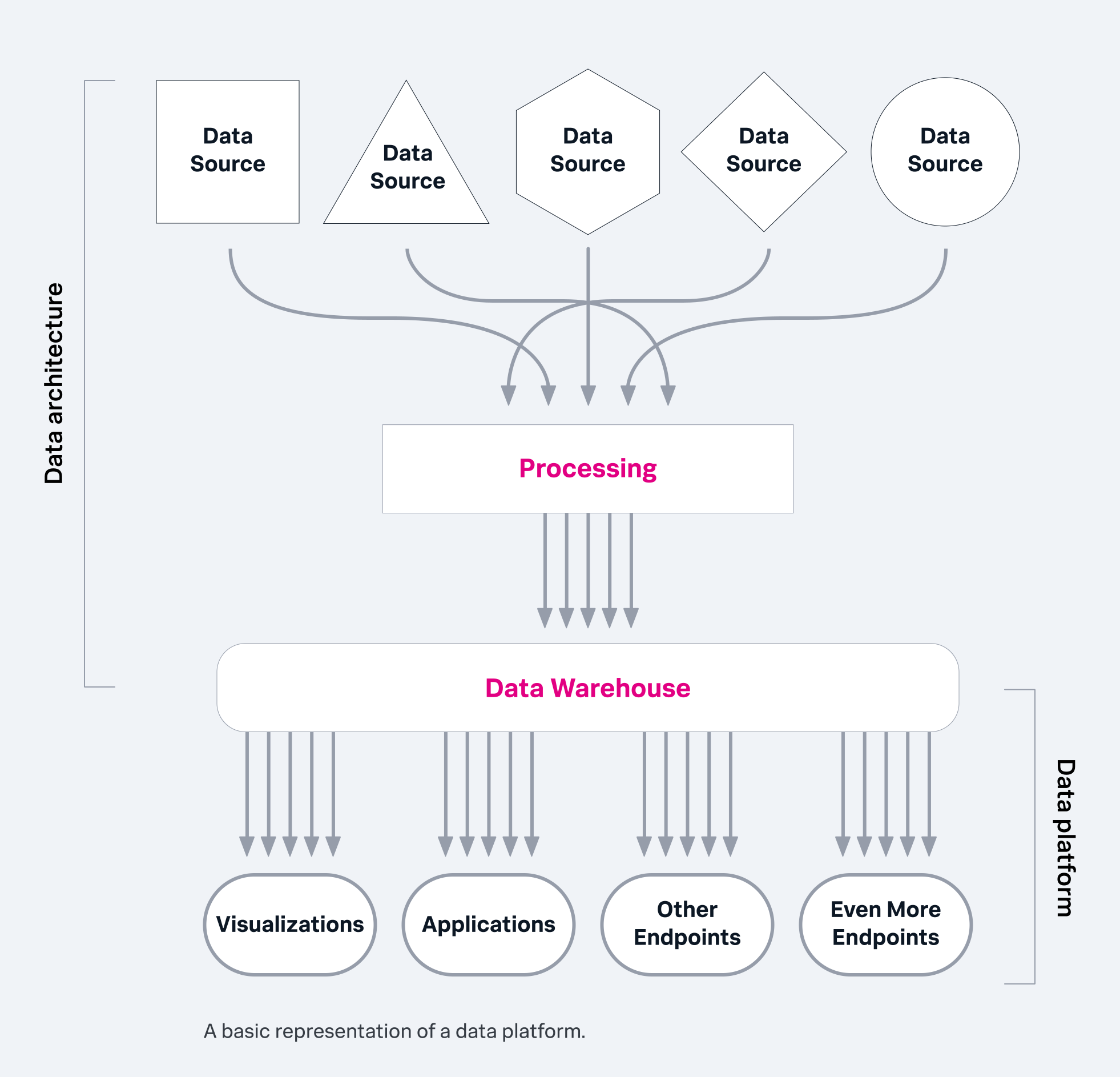
Foundational pillars of a modern data platform includes versatility, intelligence, security and scalability
Data techniques used in pipelines
As we mentioned earlier, there’s plenty of techniques that you may use either to process and transform the data or, later, to analyze and understand the data. Here are very common techniques.
- Data cleaning is when you, or automation, will remove duplicates, correct errors, and handling missing values to ensure data quality.
- Data transformation converts the (typically raw) data into the desired format. This can include normalization, aggregation, and encoding categorical variables.
- Data enrichment can enhance the dataset with additional information. Examples include merging with external data sources or adding calculated fields.
- Data filtering selects relevant subsets of data based on specific criteria to reduce noise and focus on important information.
- Data aggregation summarizes the data — for instance, calculating averages or totals — to provide higher-level insights.
- Data validation ensures that the data meets predefined standards and formats, often through rules and checks.
- Data transformation functions are specific functions applied to transform data, such as: mathematical operations, string manipulations, date conversions, etc.
- Data partitioning divides large datasets into smaller, manageable segments for more efficient processing and retrieval.
- Data shuffling or randomization will mix the data randomly. This is especially useful in machine learning to ensure unbiased model training.
- Data anonymization masks or removes personally identifiable information (PII) to protect privacy, while still being able to use the data.
Challenges in managing data pipelines
Managing a data pipeline means reading and processing from diversified data sources. And all this work moving and processing data can easily become quite complex.
Here are some common challenges that occur with handling data from multiple sources:
More data = more surfaces
Due to the extensive "surface area" of these systems, there are more places where things can go wrong. Data coming in have different formats, structures, and types. Transforming this data to make it compatible with the destination system before integration is complicated and time-consuming.
Beyond this challenge, though, is a more important point: Processing this poor-quality data threatens the entire pipeline and can lead to faulty analytics and corrupt results downstream.
More systems & apps = more complexity
Our systems become more complex. Organizations rely on multiple interdependent components — maintained by different teams with varying skill levels and engineering expertise. Their approach leads to miscommunication and coordination problems when different capabilities are involved. This increases the chances of errors and inefficiencies in the data pipeline.
Improving data pipeline efficiency
Data pipelines have been around for years. Increasingly, teams are looking to make these more efficient to reduce costs, improve overall productivity, and get the work done that needs to get done.
Obviously, with the issues we’ve discussed here, a pipeline can have many areas of inefficiency.
Why efficiency matters
In a data-driven business environment, achieving data pipeline efficiency can be the crucial factor that gives your company a competitive edge in making informed business decisions.
The speed of efficient data pipelines, such as fraud detection, is a priority when real-time or near-real-time analysis is critical . Plus, an efficient data pipeline has strong error-checking and data-cleaning mechanisms to ensure high quality data. These both help boost productivity so teams can spend more time on high-value tasks rather than cleaning data or dealing with pipeline issues.
Inefficient data pipelines can use up unnecessary resources, leading to higher costs. Focusing on efficiency will help you reduce costs, especially if you work in a cloud-based environment.
Compliance is also a significant concern for many companies with the rise of GDPR, CCPA, and other data privacy regulations. Efficient pipelines have better data tracking and auditing capabilities, which is essential for meeting regulatory compliance requirements, particularly for data privacy and security regulations.
(Related reading: continuous compliance & compliance as a service.)
Characteristics of an efficiency data pipeline
An efficient data pipeline that ensures high performance, reliability, and cost-effectiveness has several key characteristics. Here are the top features that define an efficient data pipeline.
- Speed. It should process and transfer data quickly.
- Scalability. Your pipeline should be able to efficiently scale up to handle load increases without significant degradation in performance.
- Reliability. Errors and problems happen. Your pipeline should be robust enough to handle them without causing data loss or significant downtime.
- Automation. An efficient pipeline will automate repetitive tasks, reducing the need for manual intervention.
- Visibility. You need to be able to track data progress as it moves through the pipeline to identify bottlenecks and improve efficiency.
- Security. An efficient pipeline needs robust security measures in place with the sensitive data.
- Flexibility. Your pipeline should be adaptable and flexible to handle changes in data sources, formats, and destination requirements with minimal disruption.
All these characteristics contribute to a data pipeline that not only performs its primary function of moving data but does it in a reliable, scalable, and cost-efficient manner.
(These pipeline characteristics can help to bolster data observability & data resilience.)
How to optimize for data pipeline efficiency
If your pipeline isn’t matching up with our characteristics, or you just want to get some more efficiency from your pipeline, here are some ways to increase its effectiveness:
Leverage data partitioning and bucketing
Data partitioning and bucketing are critical strategies that improve data efficiency, especially in data storage and retrieval.
Data partitioning involves dividing a large table or dataset into smaller, more manageable parts called partitions. Each partition is stored separately and can be queried independently, greatly speeding up data retrieval times. Partitioning is most effective when it aligns with the most common query patterns. However, it can speed up data ingestion and extraction, as well as analytical queries.
Bucketing, also called clustering, uses groups of related data together based on a hash function of certain columns into a fixed number of buckets or clusters. Each bucket contains a portion of the data, making navigating through large datasets easier. It can significantly speed up data retrieval for specific queries, especially those involving large amounts of data. It can also help reduce data skew in the pipeline.
Streamline data transformation
Data transformation is a critical stage in the data pipeline where raw data is converted into a format suitable for analysis. Improving efficiency in this stage significantly enhances overall pipeline performance.
There are many tools and libraries that are designed to handle large-scale data transformation efficiency. Libraries for big data processing can handle large-scale data transformation efficiently, such as:
- Pandas for Python
- SQL for database transformation
- Apache Spark
Also, be mindful of the order and nature of the transformation. Certain operations are resource-intensive and could slow down the transformation process. A good practice is to filter data early in the process, reducing the volume of data to be transformed and consequently improving efficiency.
Use pipeline orchestration tools
Typically, one task in a data pipeline depends on others. Orchestration tools ensure these dependencies are managed effectively, executing tasks in the correct order and eliminating potential errors or inefficiencies.
Pipeline orchestration tools are critical to helping manage the sequence of tasks in a data pipeline because they can:
- Handle job scheduling
- Monitor progress
- Manage task dependencies
- Provide error-handling mechanisms
With these tools, you can schedule tasks to run at specific times or in response to certain triggers, reducing the need for manual intervention and ensuring timely execution.
Robust error handling and recovery mechanisms are also part of these orchestration tools. They can automatically respond to errors or failures, retrying tasks, send alerts, and ensure a smooth recovery. Visibility into the pipeline’s operations is another advantage provided by these tools. They offer monitoring and logging capabilities that:
- Track job progress
- Record details for future reference
Provide valuable insights for troubleshooting and optimization.
Data pipeline trends
Let’s look at the outlook for data pipelines going forward.
Automation and AI-driven development in data pipelines
Automation in data pipelines reduces manual errors and improves efficiency. A well-defined structure within data pipelines ensures a smooth and reliable data flow and lays the groundwork for efficient data management. This way, businesses can extract maximum value from their information reservoirs.
That’s why the acceptance rate of AI-driven development solutions in the data pipeline is predicted to grow substantially in the next few years.
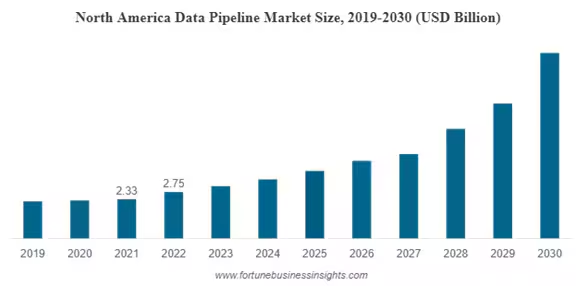
The graph shows the growing acceptance rates of ML and Data Analytics solutions. The global data pipeline market size is projected to grow from $8.22 billion in 2023 to $33.87 billion by 2030, at a CAGR of 22.4% during the forecast period.
Data pipeline automation now employs more intelligent, efficient, and flexible systems, streamlining data processing workflows and broadening data utilization and management possibilities. It has evolved through three eras:
- In the first era, data was directly dumped into warehouses and queried, resulting in high resource and processing costs.
- The second era introduced materialized views to cut costs, reducing the need for querying raw data but still carrying high rebuilding costs for each data change.
- The current third era focuses on incremental processing — where only new or changed data is processed—significantly increasing efficiency and reducing operational costs.
Indeed, its this current era that leverages intelligent controllers in data pipelines, which understand data flows and relationships between datasets and their processing code.
In this era, the distinction between batch and streaming data processing is blurring due to the rise of micro-batch processing. Micro-batch processing processes small data batches quickly — bridging the gap between traditional batch processing and real-time streaming.
Summarizing efficient data pipelines
Always remember: data pipeline optimization is not a one-size-fits-all process. You must continually monitor and adjust the pipeline based on changing needs and emerging technologies. With data coming in non-stop, having an efficient and robust data pipeline is no longer a competitive advantage but a necessity for any business aiming to thrive in this data-intensive era.
Our prediction? Roles like data analysts and data engineers will only become more important.
FAQs about Data Pipelines & Optimizing Pipeline Efficiency
Related Articles

What Are Machine Learning Models? The Most Important ML Models to Know

What is Customer Data Management? Its Importance, Challenges and Best Practices

Using ISO/IEC 27001 for Information Security Management Systems (ISMS) Excellence

Top LLMs To Use in 2026: Our Best Picks

Internet Trends in 2026: Stats, Predictions, AI Growth & Mary Meeker

Agentic AI Explained: Key Features, Benefits, and Real-World Impact

How Chain of Thought (CoT) Prompting Helps LLMs Reason More Like Humans

Ransomware in 2026: Biggest Threats and Trends