AI Data Management: Strategies, Tools, and Trends
Artificial Intelligence (AI) is revolutionizing businesses across industries. From personalized customer experiences to predictive analytics and process automation, there are hardly any sectors untouched by AI's impact.
Its applications in data management aren't left behind. In fact, AI has the potential to transform traditional data management practices.
In this article, we'll explore the challenges of AI data management, offer actionable strategies, and introduce tools, best practices, and future trends that every business should know.
What is AI data management?
AI data management is the process of using artificial intelligence (AI) techniques and tools for data management to manage, store, analyze, and use large amounts of data.
It involves automating and streamlining tasks related to data collection, cleaning, organization, storage, retrieval, and analysis. AI is used to enhance human capabilities in managing vast amounts of data more efficiently and effectively.
By leveraging machine learning and advanced algorithms, AI data management can uncover patterns, provide actionable insights, and optimize data workflows. Additionally, it supports decision-making processes by enabling real-time data processing and predictive analytics, which are crucial in today’s data driven environments.
(Related reading: data management.)
Common use cases for AI data management
AI data management has a wide range of use cases across various industries and sectors, such as healthcare, finance, retail, manufacturing, and more. Applications can be found in each stage of the data management lifecycle.
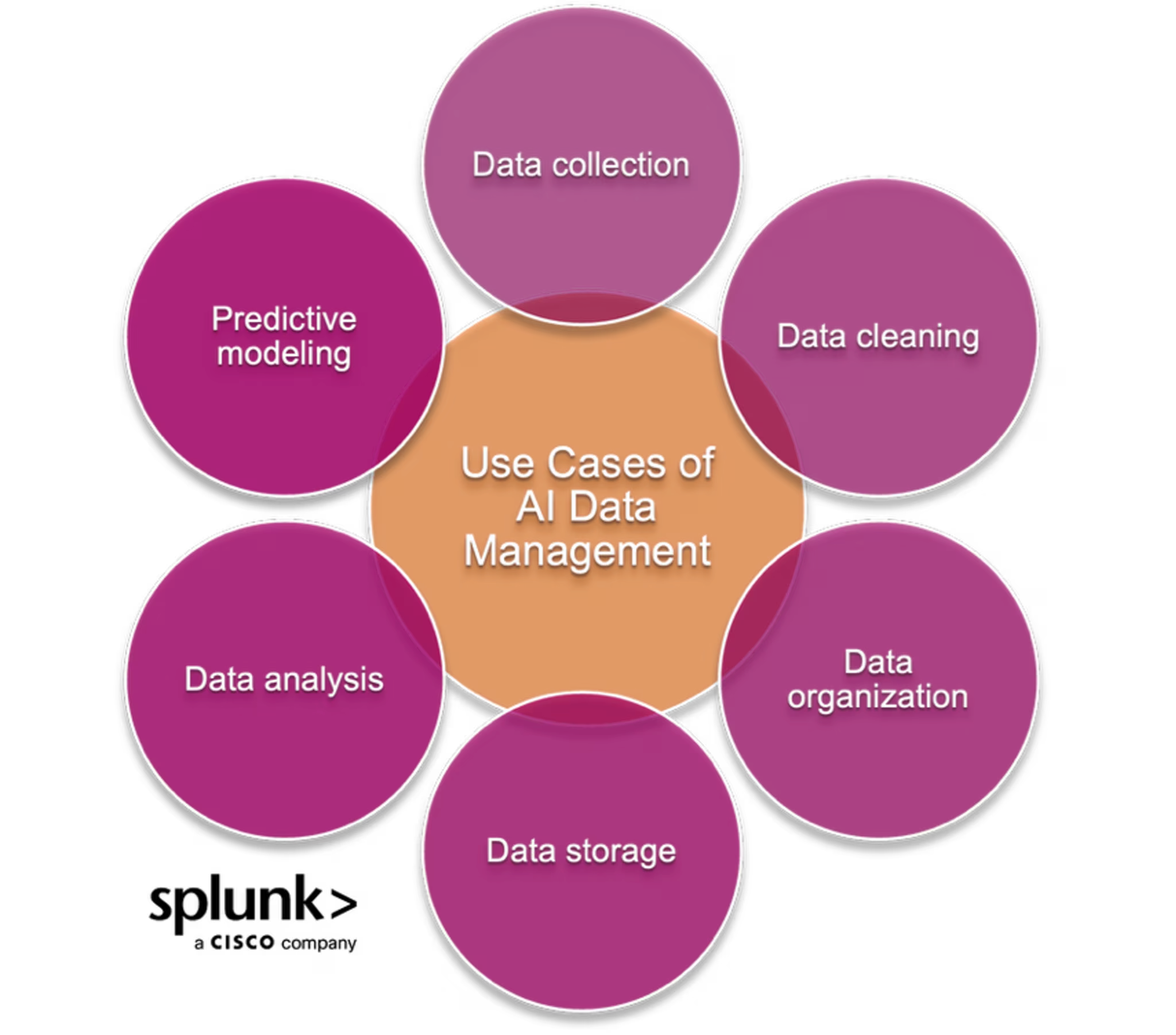
Some of the common use cases for AI data management include:
- Data collection: Using AI algorithms to collect and gather large amounts of data from different sources, such as social media platforms, customer interactions, web scraping tools, etc.
- Data cleaning: Using natural language processing (NLP) techniques to clean and standardize unstructured data collected from various sources.
- Data organization: Utilizing machine learning (ML) algorithms to categorize and organize large datasets into meaningful groups or categories.
- Data storage: Data management systems, such as data warehouses or cloud storage, are employed to store and manage large amounts of structured and unstructured data.
- Data analysis: Leveraging AI algorithms to analyze and extract insights from large datasets in a timely and efficient manner.
- Predictive modeling: Using ML techniques to build predictive models that can forecast future trends and patterns based on historical data.
Challenges faced in AI data management
Using AI has the potential to transform data management practices, but it also comes with its own set of challenges.
Some of the major challenges faced in using AI for data management include:
- Data quality: AI algorithms heavily rely on the quality of data used for training and analysis. If the data is inaccurate, incomplete, or biased, it can lead to erroneous results and decisions.
- Data privacy and security: With the increasing use of AI in data management, ensuring the privacy and security of sensitive information has become a major concern. Organizations must implement robust security measures to protect their data from cyber threats.
- Lack of skilled workforce: Building and maintaining AI systems requires specialized skills and expertise. However, there is a shortage of skilled professionals with knowledge in both AI and data management, making it challenging for organizations to leverage AI effectively.
- Ethical concerns: With the increasing use of AI in various industries, ethical considerations have become a crucial aspect. Organizations must ensure that their AI systems adhere to ethical guidelines and do not discriminate against any group or individual.
- Integration with existing systems: Implementing AI systems also requires integration with existing systems in an organization. This can involve additional costs and challenges, but it is necessary for the seamless functioning of AI technology within an organization.
(Related reading: AI risk management.)
Key strategies for effective AI data management
To tackle these challenges, businesses can deploy purposeful strategies:
Data centralization
Break down silos by creating a centralized data repository. This unified access ensures that data is managed efficiently and used effectively across the organization. This repository makes it easier for AI to be applied directly on, without having to combine datasets across platforms.
Centralized data repositories can come in the form of:
- Data lakes: A large, centralized repository that stores both structured and unstructured data for analysis.
- Data warehouses: A database designed to store and manage large volumes of data from various sources.
- Data lake houses: A hybrid approach that combines the features of data lakes and warehouses.
These centralized repositories can also provide security measures to protect sensitive data, as well as tools for data governance and compliance. With a centralized repository, organizations can have greater control over their data and ensure consistency across different departments and systems.
For example, you can use data lakes or data warehouses equipped with AI functionalities like Snowflake or Google BigQuery to store and manage large datasets seamlessly.
Annotation and labeling
High-quality labeled data is the foundation of good AI training. When working with AI systems for use in data management, data labeling is an essential step in the process. It involves identifying and tagging specific data elements with relevant categories or attributes to make them easily recognizable by AI algorithms.
There are several types of data labeling, each suited for different purposes and datasets:
- Supervised labeling: This type of labeling is used when there is a pre-defined set of labels or categories that the data needs to be classified into. Human annotators manually assign these labels to the data, providing a ground truth for the AI system to learn from.
- Semi-supervised labeling: In semi-supervised labeling, only a subset of the dataset is labeled, while the rest is left unlabeled. This approach is useful when there is a large amount of data to be labeled, and manually labeling all of it would be time-consuming and expensive.
- Unsupervised labeling: Also known as self-labeling or automatic labeling, this type of labeling involves using algorithms to automatically assign labels to the data based on patterns and similarities in the dataset. It does not require human annotation, making it a cost-effective option for large datasets.
- Active learning labeling: Active learning combines elements of supervised and unsupervised labeling by allowing human annotators to interact with the AI system during training.
These annotations and labels will help boost AI performance, leading to better data quality.
Tools and technologies for AI data management
Implementing an AI strategy for your data team can be too much to handle manually. To execute these strategies effectively, you'll need the right tools to assist you.
Here are some popular platforms to consider:
Data storage solutions
Firstly, where you store your data is crucial in enabling proper use of data
- Google Cloud BigQuery: A fully managed, serverless data warehouse ideal for storing and analyzing AI-ready datasets.
- AWS S3: Robust storage for large datasets with AI-friendly integrations.
Annotation platforms
- Labelbox: Provides collaborative labeling workflows for training datasets.
- Scale AI: Automates labeling for computer vision, NLP, and more.
Data governance tools
- Alation: Focuses on cataloging and governing enterprise data.
- Collibra: Ensures security and compliance for enterprise-scale operations.
Best practices for AI data governance and compliance
AI data management isn’t purely technical but requires adherence to governance and ethical standards. Here are the crucial best practices:
Establish clear data ownership
Firstly, always begin by defining who owns the data across your organization. This creates accountability and ensures data is handled responsibly. Data governance frameworks should be established to assign data roles, responsibilities, and access levels.
Some data roles include:
- Data owners: Responsible for the data itself.
- Data stewards: Responsible for the quality and integrity of the data.
- Data custodians: Responsible for managing and safeguarding the data.
Prioritize data bias evaluation
When working with AI models to manage your data, make sure that you analyze AI outputs to detect unintended biases in models. Techniques like fairness-aware model assessments can ensure good outcomes.
Implement role-based access
Use role-based access control (RBAC) systems to restrict unnecessary access. Role-based access control assigns permissions to data based on the user's role or job function within an organization.
This ensures that only authorized personnel have access to sensitive data which strengthens data security and mitigates insider threats.
The future of AI data management
Looking ahead, the field of AI data management is set to evolve dramatically. Here are some emerging trends:
Self-healing databases
Self-healing databases and AI-driven monitoring tools will handle anomalies or bottlenecks without human intervention, improving efficiency and reducing downtime. AI-powered data management systems will also make it easier to handle massive amounts of data and identify patterns, insights, and anomalies that humans may not be able to detect.
Federated learning
Privacy-preserving methods like federated learning will enable secure data-sharing across organizations while maintaining compliance. Federated learning allows multiple entities to train machine learning models collaboratively while keeping their data decentralized and private.
Final thoughts
Wrapping up, AI in data management has proved to be a game-changer in the way organizations handle their data. From automating manual tasks to gaining valuable insights, AI has revolutionized the data management process. With continued advancements and innovations in AI technology, it is safe to say that its impact will only continue to grow in the future.
Related Articles

How to Use LLMs for Log File Analysis: Examples, Workflows, and Best Practices

Beyond Deepfakes: Why Digital Provenance is Critical Now

The Best IT/Tech Conferences & Events of 2026

The Best Artificial Intelligence Conferences & Events of 2026

The Best Blockchain & Crypto Conferences in 2026

Log Analytics: How To Turn Log Data into Actionable Insights

The Best Security Conferences & Events 2026

Top Ransomware Attack Types in 2026 and How to Defend