ITOM vs. ITSM: IT Operations Management & IT Service Management
Learn Joseph NduhiuFor IT to deliver tangible value to the enterprise, there must be clear evidence that:
- The IT-provided services meet business needs effectively and run smoothly.
- Any issues with the IT services are addressed quickly and comprehensively.
The technology’s function operating model has to align the roles, processes, technology, and vendors to deliver this value, and justify the investment the organization has made. Adopting proven guidance in how IT plans and operates is a key ingredient in enabling the demonstration of value.
IT Operations Management (ITOM) and IT Service Management (ITSM) are two examples of frameworks that can equip technology teams to better manage IT services and their underlying components.
- IT Operations Management is a practice that oversees the provisioning, capacity, performance, and availability of IT infrastructure and resources, with a focus on processes and tools required to manage the associated technology.
- IT Service Management is a broad set of capabilities, practices, and processes that direct and control an IT service delivery organization’s activities and resources for the planning, design, transition, delivery, and improvement of IT services to deliver value.
A cursory look at these definitions reveals a significant overlap. So, where’s the dividing line?
In this article, we will consider the subtle differences in terms of scope, value proposition, tools approach, and reference frameworks.
The scope of ITOM vs. ITSM
- ITSM is the broader of the two frameworks and covers the entire lifecycle of services.
- ITOM is a subset of ITSM, and it is centered on the operational aspects of the technology used to deliver these services.
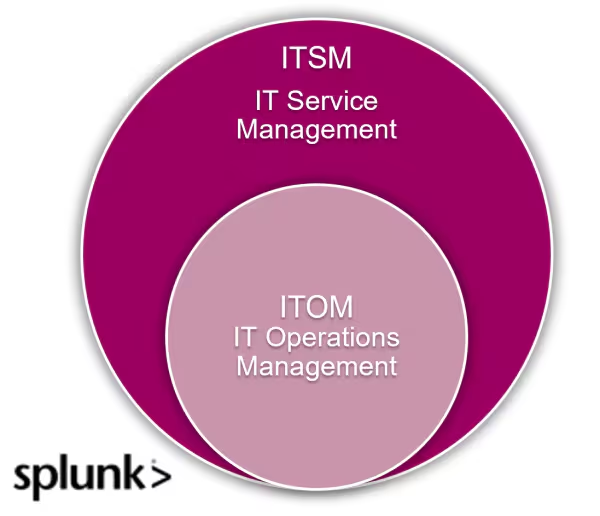
Scope of IT Operations Management
The scope of ITOM is what you might call “IT Support” i.e. behind the scenes administration of an organization’s hardware, network, applications.
ITOM helps establish processes that IT uses to deploy, implement and support services throughout their lifecycles, making sure that business services, IT systems, and applications are available and operating properly through three main tasks:
- Network infrastructure management: This involves the administration of network hardware, software, and services such as routers and switches. This involves capacity optimization, troubleshooting issues, and configuration management.
- Help desk operations: This involves the handling of incidents and requests that affect users of technology, and associated activities such as user account management and systems access management.
- Server and device management: This involves the monitoring and maintenance of servers, storage, and endpoint devices. It also includes activities such as patching, disaster recovery planning, configuration management, security compliance, and capacity planning.
(Read our complete ITOM introduction.)
Scope of IT Service Management
ITSM is involved in the entire lifecycle of planning, design, building, deploying, and maintaining IT services and their constituent elements.
The scope of ITSM covers four major stages as per ITSM.express guidance:
- Define: This is where the foundations for a service management system are established, and includes processes for governance, risk management, and customer interaction.
- Produce: In this stage, the organization develops the service by building, implementing and testing it. Activities such as service design, change management, and release and deployment management are involved in translating ideas into actual services ready for consumption.
- Provide: This stage involves delivering the produced services, while ensuring they are protected, measured, and enhanced. Activities include information security, measurement, and improvement.
- Respond: Here, the service providers communicate with customers and users to address their concerns and provide required information. This is facilitated by the service desks and includes processes such as request management, incident management, problem management, alert management, and service reporting.
(Check out our ITSM explainer.)
Value proposition
ITOM generates value for the business through the maintenance of a service provider’s technology components and computing requirements. IT Operations Management helps organizations improve workflows and increase the availability, proficiency and performance of IT operations, processes and services. By addressing how IT service issues are resolved in a faster manner, ITOM helps the business to:
- Reduce service outages.
- Improve user experience.
ITSM’s value is generated across the service lifecycle — when the organization produces outputs that help its consumers achieve certain outcomes, within expected and reasonable cost and risk constraints. It is only when the consumer reports that they are satisfied with the service, that value is recognized.
Unlike ITOM, where value is in the operational condition of the underlying systems, ITSM’s value is understood from an outside-in approach where the users of an IT service achieve required outcomes such as executing an e-commerce transaction successfully. According to ITIL guidance, value in ITSM can be evaluated by assessing the utility (functionality) and warranty (performance) of a service.
Tools approach
Let’s look at the various tools deployed for ITOM and ITSM.
ITOM tooling
ITOM tools are primarily used to manage the provisioning, capacity, performance, and availability of computing, networking, and application resources. They include systems that facilitate:
- Modern application development
- Continuous deployment and delivery
- Digital employee experience management
- Value stream delivery platform management
- Service and network orchestration
- Automation platform management
According to Gartner, additional capabilities for ITOM tools include application performance monitoring (APM) and network performance monitoring and diagnostics.
(Related reading: application vs. network performance monitoring.)
ITSM tooling
ITSM tools are software platforms that offers workflow capability to support processes across the service lifecycle. The main capabilities include:
- Processing of requests captured from self-service portals, service catalogues, or emails sent to the service desk.
- Handling incidents, problems, and change requests that logged manually or automatically when interfaced with monitoring and observability systems.
- Discovery and tracking of IT assets and configurations.
- Management of associated service management information such as service levels, vendor contracts, and knowledge.
Integrating the tools
It is not uncommon to find organizations investing in both types of tools, since by nature of their overlapping activities, interfacing ITOM and ITSM tools brings the best of both worlds to a common ground. For example:
- Monitoring data from an ITOM solution can generate incident tickets in an ITSM tool.
- Changes made to infrastructure using ITOM tools can be promoted to an ITSM’s solution change management module.
Reference frameworks
While there is no official ITOM framework, the scope it covers can point us to approaches that are relevant to the activities involved in managing of technology infrastructure. These would include DevOps, SRE, and other IT operations management guidance.
In stark contrast, ITSM has a plethora of associated frameworks, both old and new. They include:
- ITIL 4. The most recent version of the age old ITIL framework for IT service management that has been a textbook guidance for over 30 years. It addresses ITSM from the basis of value streams and the service value system.
- ISO/IEC 20000. This family of international standards for service management facilitates organizations to have their service management systems certified against the ISO/IEC 20000-1 standard.
- FitSM is a lightweight ITSM framework whose development was funded by the European Commission.
- VeriSM is a service management approach that helps service providers to create a flexible operating model to meet desired business outcomes.
As ITOM is a subset of ITSM, it borrows heavily from ITSM frameworks in the areas of technology infrastructure operations and management, as well as the helpdesk.
Final thoughts: You should optimize both
While it is understandable that IT practitioners may use the two terms interchangeably, there are marked differences given that the scope of ITSM is much broader. That doesn’t mean that ITOM is inferior — rather that the focus is narrower and as such it is more relevant to IT functions whose day-to-day operational activities are centered on maintaining IT servers, network elements, and endpoint devices.
Without the reliability, quality, and continuity that ITOM practices contribute to IT infrastructure, it is impossible for ITSM to create and deliver value across the service lifecycle.
Related Articles
Inside Kubernetes: A Practical Guide to K8s Architecture and Operational Challenges

What Is Detection Engineering? A Complete Guide to Modern Threat Detection