Reducing the Carbon Footprint of the Manufacturing Industry with the Power of Data
*Credit to co-author: Clara Lemaire.
As the world watches the UN Climate Conference unfold in Glasgow, the manufacturing industry is under increased pressure to reduce its CO2 emissions. Companies are stepping up to the challenge, but much more remains to be done to keep climate change under control. Digitalization is part of the solution. The Power of Data has much to offer such as environmentally friendly manufacturing, efficient logistics, improved building and energy management and optimized renewable energy production.
All Eyes are Now on the Climate Conference in Glasgow
COP26, the UN Climate Conference currently taking place in Glasgow, is a crucial event if climate change is to be brought under control. Ahead of the Conference, 200 countries have been asked for their plans to cut emissions by 2030. In 2015, as part of the Paris Agreement, they had agreed to make commitments to keep global warming "well below" 2 degrees Celsius (but preferably 1.5) compared to pre-industrial levels. In Glasgow, countries need to collectively deliver larger emissions cuts, to reach ‘net zero’ emissions in 2050.
The Manufacturing Sector is Facing Hefty CO2 Reduction Targets
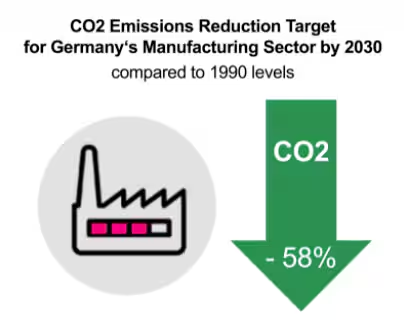
Carbon Footprint Reduction and Carbon Neutrality are Top of the Agenda in the Manufacturing Sector
Gone are the days of lofty “green-washing” announcements when many manufacturers demonstrated their sustainability efforts through high-level PR campaigns. Now, this industry is expected to deliver concrete results and take active steps to address its high carbon footprint. Climate action is no longer a “nice to have”.
Concrete KPIs, carbon reduction targets and carbon neutrality objectives are now an important part of companies’ strategies. The investor community is looking at these with increased scrutiny.
Unsurprisingly, early studies suggest that companies' efforts to protect the climate are very well received by their own workforce, their customers and also the capital markets. The EU will be making large funds available to subsidize new, climate-friendly technologies and production processes that manufacturers can turn to their advantage.
The road is still long, and manufacturers will need to work even harder to contribute their fair share in the fight against climate change. They will have to rely on a variety of solutions, including leveraging the power of data.
Manufacturing Bears a Particular Responsibility
Immense efforts will be needed to achieve Europe's climate targets for 2050.
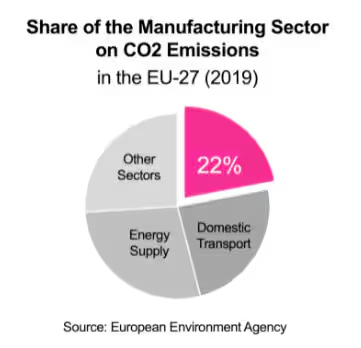
With a 22% share of Europe's total CO2 emissions, manufacturing is the third largest emitter after energy and transport.
Therefore, this industry has a particular responsibility to reduce emissions. It is also further encouraged by stricter environmental regulations and increasing public pressure.
Digitalization of Manufacturing Has the Highest Potential to Contribute to CO2 Reduction - Example German Manufacturing Industry
A study by Bitkom, conducted by Accenture, recently looked at the impact of digitalization on the carbon reduction potential of four sectors in Germany by 2030: Manufacturing, Mobility, Buildings and Work & Business.
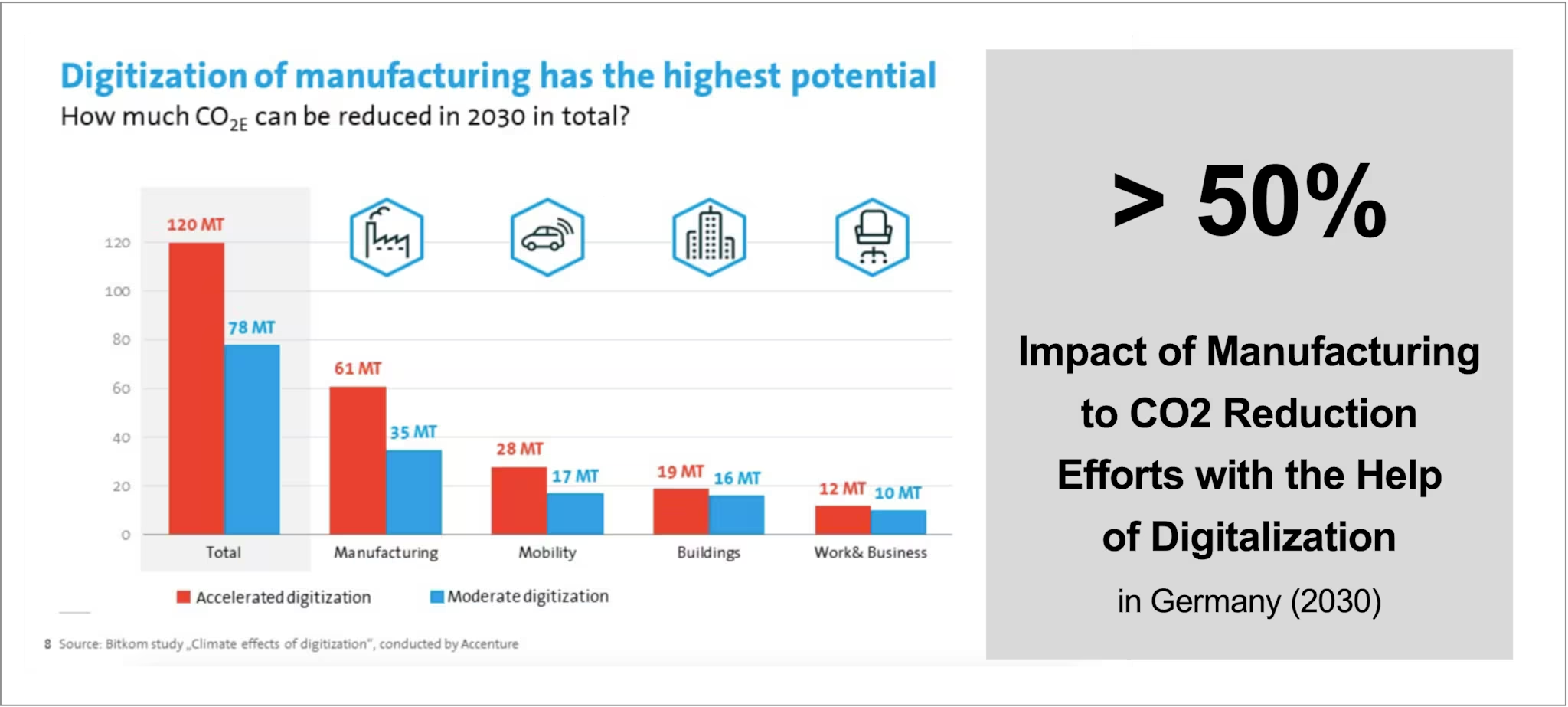
The study concluded that total CO2 emissions in Germany can be reduced by as much as 120Mt in 2030 through targeted and accelerated deployment of digital solutions.
The impact of digitalization on the manufacturing industry in Germany, Europe’s most industrialized country is particularly significant: With accelerated digitalization, emission cuts in manufacturing would represent more than 50% (61Mt) of total CO2 reduction efforts (see chart).
The Manufacturing Industry Moves Ahead with Key Initiatives
The Initiative 50 Climate Leaders is the response from the international business community which demonstrates the desire, the leadership and the will to take effective action in the fight against climate change. Obviously, key European manufacturers are part of this initiative such as Schaeffler, Zeiss, Jungheinrich, Sulzer and Johnson Matthey.
We are also seeing other corporate initiatives emerging in the run-up to COP26, such as Science-Based Targets with 1,000 companies onboard including Continental, Volkswagen and Deutsche Post DHL or We Mean Business involving major industrial companies like Michelin, Siemens and Holcim.
In Germany almost 70 companies including manufacturers such as ThyssenKrupp, Infineon and Bayer addressed the upcoming new government with a request to start an “Implementation Plan for Climate Neutrality” within the first 100 days.
Produktion, one of Germany’s largest publishers on manufacturing topics is reflecting these developments with recent in-depth reports on “CO2 Neutral Manufacturing”.
How Splunk Can Help with the Power of Data
To start, Splunk itself is committed to avoiding, minimizing, mitigating and/or when appropriate, offsetting our impacts on the environment as outlined in our Environmental, Social and Governance (ESG) Position Statement.
Splunk can help manufacturers achieve their decarbonisation targets in many different ways, leveraging the power of data. Improved operational efficiency or optimized energy management may only be a few of many possible steps such as gaining visibility over one's actual carbon footprint as a basis for decisions. Here are 10 selected concrete examples on how Splunk can help.
Environmentally Friendly Manufacturing:
Splunk is helping manufacturers to correlate multiple data sources in complex production environments to save energy and protect the environment.
- Honda: Armed with Splunk’s machine learning technology, teams now use pre-built models and predictive analytics for everything from equipment reliability to environmental impact. They now manage to exceed environmental standards by correlating machine, equipment, power and IoT data.
- Continental: Developed an energy transformation framework with the help of Splunk to tackle rising energy costs due to energy-intensive manufacturing operations.
- Honda: Proactively optimized the business-critical regenerative thermal oven in the paint department to better protect the environment with the help of the Splunk Machine Learning Toolkit.
Efficient logistics:
Splunk is helping pioneering efforts within automobile and aircraft manufacturers, helping increase logistics efficiencies and introduce ground-breaking new technologies.
- Porsche: Used Splunk to deliver intelligent performance but also sustainability for the new all-electric Porsche Taycan. Splunk is not only being utilised for the car but also for the charging infrastructure that is critical to successfully operating electric vehicles.
- Airbus: Increased supply chain efficiencies with Splunk global dashboards of their warehouses to get alerted with real-time critical issues
Improved Building and Energy Management:
Splunk is helping large property asset operators use data to be more efficient with people and natural resources.
- Gatwick Airport: Reduced both the noise and carbon footprint around the airport – and it saved fuel.
- Trane: Leading HVAC manufacturer upheld green building practices, to create comfortable, eco-friendly homes and commercial buildings.
- Dubai Airport: Applied technology on customer-centric processes and used data and a platform like Splunk to give them real-time insights to drive efficiency across the airport.
Optimized Renewable Energy Production:
Splunk helps the renewable energy industry do more to ensure their assets are running as expected and the systems they depend upon are performant and reliable. Splunk enables energy efficiency activities like demand response to shed load during grid events.
- Splunking Wind Farms: Learn how you can analyze real-time and historic sensor data generated by wind turbines at wind farms. Apply machine learning to find anomalous sensors and improve operations.
- Infigen: Australian wind farm operator optimized monitoring and alert consolidation of the wind energy production from SCADA systems with Splunk.
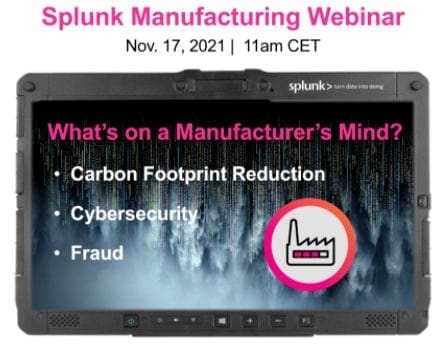
Watch it on demand here.
Our customer, the Danish engineering company FLSmidth will highlight how Splunk helps them with the power of data on their mission towards zero emissions in mining and cement to bring these industries into a sustainable future.
Don’t miss the live demo with the Splunk CO2 dashboards!
Ready to reduce your carbon footprint? Then get in touch now!
And if you want to read on about the power of data, we got you covered, too. Check out the below resources:
- The State of Data Innovation 2021 Organizations thrive when they use data in complex and innovative ways. Innovation Leaders — those with the best data practices and innovation cultures — have increased productivity by 16% last year.
- Why Your Cloud Strategy Needs a Data Strategy Discover how you can leverage the right data platform to ensure a data-first strategy, especially when taking cloud challenges into account.
Related Articles

How Splunk is Helping Shape the Future of Higher Education IT by Tackling EDUCAUSE 2026 Top Issues

Enhancing Government Resilience: How AI and Automation Empower Public Sector Missions

Solving Manual Mayhem in Telecom with Agentic AI

Upgrading to Splunk Enterprise 10.0 and Splunk Cloud Platform 10.0: Key Resources for Public Sector Customers

Building the Next Generation of Defenders: From the Classroom to the SOC of the Future

Analytics That Work: 3 Approaches for the Future of Contact Centers

Observability + Security: Real-Time Digital Resilience for SLED

Digital Resilience for State and Local Governments (Part Two)