What Is SecOps? Security Operations Defined
Key Takeaways
- SecOps merges security and IT operations into a unified practice, ensuring teams share data, workflows, and responsibilities to detect and respond to threats more effectively.
- Leveraging analytics, automation, and cross-team collaboration accelerates threat detection, investigation, and response‚ helping organizations stay resilient and maintain compliance.
- Overcoming challenges such as cultural barriers, tool integration issues, and resource constraints is essential for successful SecOps adoption and robust organizational security.
Security operations aka SecOps is an organizational approach that helps businesses safeguard against escalating and complex cyber threats. These threats pose risk to your organizational cybersecurity. Indeed, cybercrime costs are expected to:
- Reach $10.29 trillion by 2025.
- Grow to $15.63 trillion by 2029.
Why such expensive costs? Cyberattacks increased by 10% globally in 2024 alone. Organizations need a proactive way to prevent and mitigate these threats.
So, in this article, we are going to discuss about Security Operations, SOCs, and how to improve your organization’s security posture.
Understanding Security Operations
Security Operations (or SecOps) combines security teams and IT operations teams. IT operations continue to grow exponentially as businesses increasingly rely on data and automation to fill crucial roles. However, IT operations and security can often contradict one another.
For example, let's look at the goals of two different teams within an organization:
- IT operations will likely focus on optimizing and smoothing deployment when implementing a software or system update.
- However, security will emphasize rigorous testing, validation, and risk reduction within that same update.
Conflicts arise when IT operations aim for speed and agility, potentially compromising thorough security measures.
Finding balance requires effective collaboration and communication. You'll also need to establish proper processes that address both operational efficiency and security considerations.
SecOps provides this compromise by bridging the gap between security and IT operations to meet both objectives effectively. It ensures the safety of its IT infrastructure, systems, network, and data by leveraging tools and processes to detect, prevent, and respond to security incidents and threats.
Objectives & goals of Security Operations
The primary goal of SecOps is establishing a proactive and robust security posture in order to:
- Mitigate risks.
- Safeguard critical assets.
- Manage the confidentiality, integrity and availability of business systems and critical data.
SecOps is about more than just enforcing security measures and facilitating seamless development cycles. Instead, it should establish clear goals — such as ensuring all employees leverage security best practices, improving security collaboration, and implementing milestones for SecOps implementation.
Some of the key roles and responsibilities of Security Operations in an organization’s overall security strategy include:
- Proactive security monitoring
- Assessment and investigation
- Threat intelligence
- Incidence response
- Underlying cause analysis
Once you have a clear understanding of the roles and responsibilities, you will embark on the path of implementing a security-first approach in SecOps.
Security-first mindset in SecOps
We need a security-first mindset in SecOps to proactively address cyber threats and maintain a strong security posture. (This approach is sometimes captured in the term "shift left" security.) A security-first approach emphasizes on:
- Mitigating incident risk.
- Inducing security awareness.
- Preventive measures for incoming threats.
- Continuous improvement over existing security model.
If organizations start prioritizing security at all the stages, they can promptly respond to threats and seamlessly integrate security into DevOps practices. Embracing security-first approach assures security to be a foundational principle in every activity. Its main goal, of course, is enabling companies to safeguard their assets. An important knock-on effect of this is building the trust of stakeholders, both inside and beyond your organization.
Let's discuss the core elements that will help you in implementing a robust security strategy.
Key components of Security Operations
OK, so what exactly goes into SecOps? Let’s look at its core components.
Threat intelligence
SecOps generates threat intelligence to help organizations find, prevent and mitigate security threats. This requires gathering, analyzing, and sharing information about potential threats. It involves monitoring threat actors, assessing their capabilities and keeping informed about emerging attack techniques and vulnerabilities.
(Related reading: OSINT open-source intelligence.)
Incident response
A well-defined incident response plan is crucial to responding to and mitigating security incidents. It involves:
- Collaborating efforts.
- Collecting evidence.
- Conducting forensic analysis.
- Implementing remediation measures.
Also known as incident management, incident response is how companies manage and mitigate a security incident, such as a malware or ransomware attack. These events lead to significant business operations disruptions, impacting productivity, business continuity and brand reputation.
Incident response teams will leverage an incident response plan to mitigate attacks, contain data leaks, and implement processes to keep the threat from continuing or returning. A plan should include incident identification, containment, eradication and recovery.
(Check out the most important incident metrics to track.)
Security monitoring
Proactive monitoring is non-negotiable with business software and data. Considering that 34% of security professionals said their companies experience 25 to 50 security incidents each day, with some handling twice that number, remaining vigilant is critical to ensuring security and mitigating threats.
Monitoring an organization’s systems, networks, and applications requires deploying security monitoring tools, log analysis, intrusion detection and prevention strategies and real-time threat detection processes to find and manage potential threats quickly.
(Power your SOC with full visibility and security monitoring from Splunk.)
Vulnerability management
Vulnerabilities are pervasive — every organization has them. In fact, Synopsys researchers found at least one open-source vulnerability in 84% of code bases.
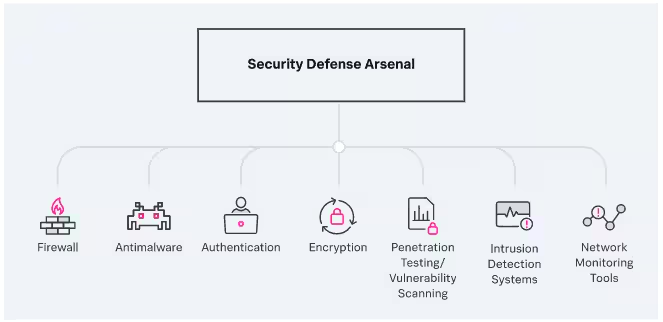
A key aspect of SecOps is finding, analyzing, and addressing these and other potential exposures in the organization’s systems, applications and infrastructure. It requires conducting regular vulnerability scans and assessments, patch management and penetration testing to triage and remediate vulnerabilities.
(Related reading: vulnerability management.)
Security automation and orchestration (SOAR)
A significant challenge for many SecOp teams is their struggle to parse, analyze, normalize, contextualize, and correlate their data daily because of the sheer volume. One survey found that almost half of SOC teams felt “inundated by a never-ending stream of cyber-attacks.”
Security automation is critical to ensure that SecOps manages all threats without becoming overwhelmed or dropping the ball.
Automating routine security tasks and integrating security systems and technologies is crucial to maintaining a proactive threat response. This component is valuable for streamlining security operations, enhancing efficiency, and enabling faster incident response by automating repetitive processes, orchestrating security tools, and integrating security workflows. This is where SOAR solutions come into play.
Building an effective SecOps function
Many organizations invest in a dedicated security operations center (SOC) that provides SecOps team members a place to collaborate on security activities. The SOC is a central hub of a company’s IT security efforts, and SecOps ensures that their SOCs are efficient, automated and integrated with all aspects of the organization.
In the past, this hub was a physical location where SecOps professionals could meet. However, with the rise of remote work and global teams, SOCs have undergone a significant transformation.
Now, SOCs have shifted to virtual or distrusted spaces where security professionals operate from many locations, leveraging cloud-based technologies, collaborative tools and remote access capabilities — all to monitor and respond to threats.
Exploring an effective SecOps foundation eventually leads to the question: what is the relationship between DevOps, SecOps, DevSecOps?
SecOps, DevOps, and DevSecOps
In IT operations, DevOps, SecOps and DevSecOps can easily be interconnected. DevOps focuses on automation and collaboration between ops and dev team, SecOps focuses on security. On the other hand, DevSecOps looks after security integration in the DevOps pipeline.
If you align these practices, you will be able to ensure a holistic approach to efficiency, security and collaboration across the entire SDLC.
Now, let's discuss what we need while setting up an SOC.
Must-haves features of modern Security Operations Centers (SOCs)
When establishing a SOC, it’s critical to take several key considerations into account:
Defining SOC’s mission and scope. Define your SOC’s mission and scope based on your specific security needs and objectives. This will help you determine whether it needs to handle security, monitoring, incident response, threat intelligence, or a combination of functions.
Staffing and skill requirements for the SOC team. Assess your staffing needs, including what skill sets and expertise are required. Determine the number of security analysts, incident responders, threat intelligence specialists, and other roles to operate your SOC effectively.
Consider training and hiring plans to ensure your team has all the necessary skills and knowledge.
Infrastructure and technology requirements. Determine the necessary infrastructure and technology to facilitate SOC operations. This should include deciding on and implementing solutions like:
- Security monitoring tools
- Incident management platforms
- Log management systems
- Threat intelligence platforms
- Other technologies for effective security monitoring and incident response
(Splunk supports all of this: explore the Splunk product portfolio.)
Collaboration with other teams and stakeholders. Insights from other teams and stakeholders are key. Establish communication channels, coordination mechanisms, and escalation procedures for effective cooperation between SOC, IT operations, C-suite, compliance and legal.
Determining these key aspects will help you lay a strong foundation for effective and resilient SecOps.
Best practices for managing SecOps
Your organization should implement best practices to manage SecOps function and effectively enhance your overall security posture. Some essential best practices include:
Develop a comprehensive security incident response plan
Outline the roles, responsibilities and procedures for detecting, analyzing, containing and mitigating security incidents. Regularly review and update your plan as needed based on:
- Lessons learned
- Evolving threats
Stay current on emerging threats and technologies
Cyber threats continue to evolve and grow each day. Stay updated on the threat landscape and emerging security technologies. Regularly review and study threat intelligence sources, go to security conferences, and join security communities to stay informed about vulnerabilities, attack techniques and security solutions.
This effort will help you proactively mitigate threats and adopt adequate security measures.
Implement robust security monitoring and alerting mechanisms
Implement advanced security monitoring tools to continuously monitor your networks, applications, and systems for security events and anomalies. Configure your alerting mechanisms to notify SecOps teams immediately when potential threats are detected.
Continuously improve through feedback and metrics
Implement measurable metrics and key performance indicators to assess SecOps’ effectiveness and efficiency. Analyze these metrics, and actively seek input from team members, stakeholders and incident post-mortems to find what areas need improvement.
Safeguarding data & assets in an evolving threat landscape
Security Operations play a crucial role in the ever-changing threat landscape. SecOps helps organizations detect, prevent and respond to security threats continuously and effectively. Teams establish a proactive security posture to safeguard business assets and critical data through collaboration, clear roles and robust processes.
To manage SecOps successfully, organizations should embrace best practices such as establishing comprehensive incident response plans, delegating clear roles and responsibilities, performing robust security monitoring, and improving through metrics and feedback. In today’s interconnected and threat-prone world, investing in and prioritizing SecOps is paramount to safeguarding digital assets and maintaining your organization's and stakeholders' trust and security.
Related Articles

How to Use LLMs for Log File Analysis: Examples, Workflows, and Best Practices

Beyond Deepfakes: Why Digital Provenance is Critical Now

The Best IT/Tech Conferences & Events of 2026

The Best Artificial Intelligence Conferences & Events of 2026

The Best Blockchain & Crypto Conferences in 2026

Log Analytics: How To Turn Log Data into Actionable Insights

The Best Security Conferences & Events 2026

Top Ransomware Attack Types in 2026 and How to Defend