Sustainable Technology in 2026
Key Takeaways
- Sustainable technology reduces environmental impact by optimizing energy use, minimizing waste, and promoting resource efficiency in IT systems and operations.
- Implementing sustainable tech practices drives cost savings, supports compliance, and enhances brand reputation while meeting growing consumer demand for eco-friendly solutions.
- Solutions like Splunk can centralize and normalize environmental data, enabling real-time visibility, ML-driven forecasting, and continuous tracking of IT's carbon footprint for ongoing optimization.
Sustainable technology. Green IT. Web and IT sustainability.
On any given day, you can expect news on technology advancement as well as dire warnings about weather and climate change. The two often seem at odds. Is our tech-enabled way of life good for sustainable living? Technology can enable a more sustainable approach to living and working — it also hogs non-renewable resources.
Unsurprisingly, this topic isn’t straightforward, but it is increasingly imperative for doing business today. So, let’s explore sustainable IT to see if this concept is even in the realm of possibility.
What is sustainable tech?
Defining sustainable IT isn’t the most straightforward thing. What do we mean by it? Tech analyst Gartner attempted to formalize what “sustainable technology” means, defining it as:
“A framework of solutions that increases the energy and efficiency of IT services; enables enterprise sustainability through technologies like traceability, analytics, emissions management software and AI; and helps customers achieve their own sustainability objectives.”
The topic of Sustainable Technology has moved from #10 on the Top 10 Strategic Technology Trends for 2023...all the way up to #3 on the 2024 list. Gartner believes that organizations who invest in sustainable tech could unlock the potential to increase operational resilience and financial performance — while uncovering new paths to growth. They even estimate that within three years, 50% of CIOs will have their performance metrics/goals tied to the sustainability of the IT organization.
Does this mean that only the IT part of an organization should pay attention to sustainable efforts? I argue no.
Another definition: Accenture calls sustainable technology a “twofold imperative”. This is the right way to think about it. The imperative, summed up, is this:
Technology has changed our lives, but that technology consumes unsustainable amounts of energy. That volume will only grow as tech like AI, blockchain and quantum computing grow. So, we must use technology to become more sustainable. Where can technology finally make us work in new ways — the ways that PCs were supposed to free up our working lives, the things we have all been promised?
(Read about internet trends, generative AI & AI TRiSM.)
Moving towards sustainable ways of working
Still, these definitions remain vague. Businesses need to look at specific areas of improvement. That could mean:
- Consolidating compute resources
- Switching to more sustainable suppliers
- Using technology to solve sustainability challenges
- Aiming to achieve carbon neutral tech use
- Minimizing your reliance on non-renewable resources, often for more renewable options
- Transitioning to a closed-loop supply chain
Reducing the carbon footprint is at the heart of all these approaches. We know that energy powers our laptops, monitors, cell phones and other devices. Play that out over the server rooms and global data centers that power small and multi-national companies. Assuming no changes to current laws, some estimates project that CO2 emissions from only the United States will reach 4.7 billion metric tons by 2050.
Still, it isn’t enough only to minimize energy usage. The manufacturing of devices actually accounts for over two-thirds of the greenhouse gases (GHGs) that a device will contribute over its entire lifecycle. We need to produce less.
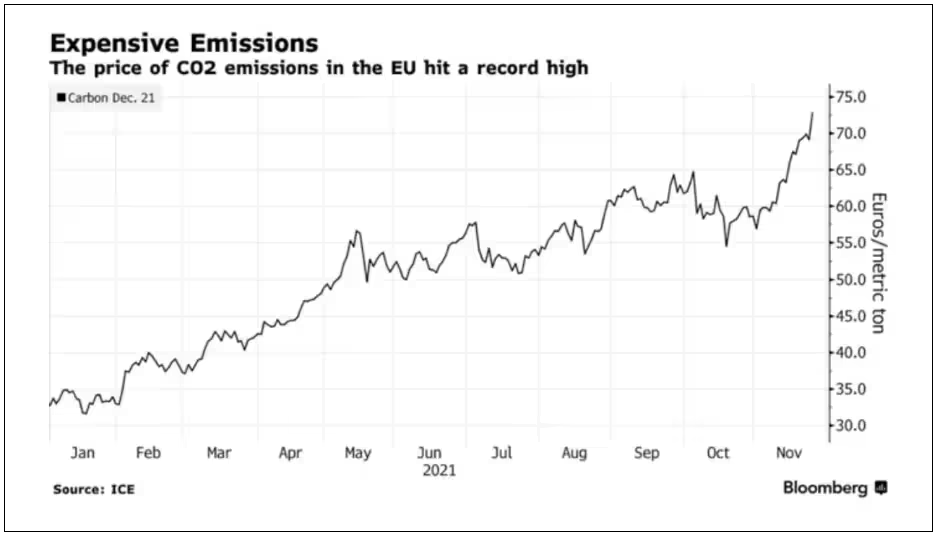
So, when we talk about sustainable technology, the answer could be sweeping change or something that is much more specific and easier to implement and measure. For some organizations, this pursuit might be optional. Others might have to adhere to industry regulations or government-mandated efficiency standards, like those that result from committing to the Paris Agreement.
It’s going to require a lot of work — work that cannot all be farmed out to consultants, work that is ongoing and requires a way of changing how we think about work, too.
Challenges with achieving IT sustainability
Achieving sustainability in tech can feel impossible. There’s many reasons for this. Let’s look at a few challenges.
The digital myth
For decades, we’ve been taught that green is using less paper, cutting down fewer trees. Implied in this was the idea that digital is better: storage has become nearly infinite, and software makes it easy to avoid using paper, even for the most mundane or straightforward tasks.
What we know now is that every single time you’re using a computer, you’re using carbon resources. Every time you load a new web page, you contribute to the carbon footprint. Indeed, digital is physical.
Hardware and software sprawl
Hardware manufacturing, and all the software that relies on hardware, overwhelm anyone exploring this topic. With millions of computers, servers, internet cables and more sprawling the earth, cutting back on any of this feels impossible.
(See how Splunk can help you achieve emission reduction goals.)
The (lack of) right to repair
For decades, consumers did not have the legal right to fix certain items that they owned. In the U.S., most computer hardware providers were able to limit users from fixing their own hardware via legislation and regulations that meant high risk to users. (Fix your stuff yourself? Out of warranty.)
This wasn’t limited to tech companies — manufacturing was another offender — but it was intentional. Instead of fixing hardware, users have been encouraged to buy new options. A new computer every few years, a phone every two years. Picture all the old monitors, CPUs, keyboards and more than perhaps could have been saved If only we had the legal right to repair.
Today, this is beginning to change, at least in the U.S., where some legislation is starting to require manufacturers to provide consumers with tools and documentation that enables them to fix tech that they own.
Data waste
Today, companies obsess over data. We all ask questions like “Does the data point this way or that?” We think that we can answer everything with data — so we collect as much data as possible. The problem? Practically all that data is wasted. Gerry McGovern estimates that up to 90% of digital data is not used.
That means we are wasting the vast, vast resources that it takes to collect and store this data.
Digital transformation
Digital transformation is the notion that by transforming your company digitally, you’ll work more efficiently. The core principle certainly has merit: examining your ways of working to consolidate tech stacks and make processes more efficient. Still, today’s digital transformation is often treated as some mandate to throw out every single workload and process that isn’t cloud-based.
A smarter and less resource-intense approach is to migrate intelligently, understanding your true business needs and customer expectations.
How companies can promote sustainability
You might hear about companies who are attempting to lower their carbon footprint or become carbon neutral. Some of this might be greenwashing, yes, but some organizations certainly are using this opportunity to examine and consolidate workloads in a way that reduces compute needs and simplifies workloads and data storage. Saying a company needs to reduce its carbon footprint is one thing — but here are some actionable ways to have an affect on this.
Reduce data cooling
Data centers and server rooms are the IT backbone of any company. Though most workers don’t even consider this area, it is consistently one of the most expensive operating costs for any organization.
Follow data center optimization best practices, including the primary goal of reducing your power usage effectiveness (PUE) to 1.2 or lower. (Google famously uses 1.1 or less in theirs.) Ways to reduce this number include:
- Consolidating servers and retiring zombie servers.
- Harnessing natural air cooling, cooling only to the minimum temperature.
- Automate controls for lights, security, and outdoor cooling.
- Separate server aisles based on hot and cold temperatures.
Migrate intelligently
Cloud migration is sometimes conflated with reducing power. That stems out of, arguably, two main areas:
- Greenwashing (aka marketing that overstates the “green” angle).
- Conflating simpler on-site infrastructure on-site with cloud simplicity.
Migrating to the cloud absolutely offers plenty of business benefits but be weary of claims that it’s inherently better for the environment. All computing runs off some data center, somewhere, so you might simply be shifting the carbon footprint from your organization to another. With less control inherent in many cloud models, you might also have less opportunity to consolidate and reduce compute workloads and storage.
Promote sustainable websites
Don’t forget one of the most important ways people engage with your brand: through your website. By reducing the footprint of your brand’s website, you’ll likely see other benefits too, such as:
- Faster page load times
- Improved customer experience – fewer, better planned pages makes the customer journey clearer
- Fewer opportunities to cause downstream bugs and other errors
- A better understanding of complex products and corporate structures
So, how can you build leaner, less resource-intense websites? Here are a few ways:
- Ensure every web page has a clear and intentional purpose. Consolidate content that sprawls across many pages.
- Retire rotten web pages, aka pages that are redundant, outdated or trivial.
- Minimize the use of graphics and videos; text is up to 90% lighter on page load.
- Deliver only the cleanest and leanest code.
- Stop redesigning entire swathes of a website. Instead, move to iterative improvements that are less resource-intensive (and also easier to measure the change effect).
- Develop regular routines for fixing broken links, reviewing old redirects and retiring content.
Consolidate tooling
Just as you consolidate your website, you also want to consolidate tooling. In today’s SaaS world, apps and software and data varies widely across all teams. Unfortunately this leads to not only wasted spend, but wasted resources, as often there is overlap in functionality.
Get involved, educate your workforce
Trade groups like Sustainable IT.org offer ways for leadership to take a stand for sustainability. For industry-specific guidance and tangible ways to reduce your footprint, check out TCO Certification and EnergyStar. Just as you educate your workforce on cybersecurity threats, you can empower and promote sustainability in a few ways:
- Purchase equipment that are rated for their energy efficiency and sustainable products.
- Schedule high-power and high-compute activities so that they don’t overlap.
- Offer rewards or increased budget to teams who effectively employ sustainable tactics.
- Explore long-term solutions to reducing computer usage. Consider a shorter work week or condensed working hours.
Whether through education and thought leadership or via organization-specific assessments, you can start to incorporate real changes into your long-term strategic planning.
What you can do
An important message with sustainable IT is that it isn’t just the big groups that can make change. Small changes from individuals are easier to put into place, turn them into habits, and talk about with others when you talk about workplace productivity.
Re-consider (minimize) tech stacks
Consider how you use technology in your daily life—is it improving the way your work? Is it actually delivering what you need? If not, simplifying the way you work might not only help the environment, it might also help you focus on the right stuff.
Consider the web sustainability
Though we talked about web sustainability from an organizational standpoint, let’s think about it this way, too: every web page we visit, every app we re-load throughout the day, and every Google search we perform contributes to our carbon footprint.
Follow best practices
With devices around us all day long, keep these best practices in mind.
- Turn computers off. Especially in this work from home era, remember that even if you’re not using your computer, if it’s plugged in, it’s using resources.
- Switch to smart power strips, which reduce power usage by turning off power to any products that are in standby mode (printers, audio equipment, monitors, etc.)
- Use technology intentionally. Every time you pick up your phone and check your email, you’re using resources. Only check apps when you need to. (It’s good for your sanity, too.)
Achieving sustainability
It certainly isn’t easy, but there are ways to smartly engage with technology. We have to first understand where we are, and then we can develop a plan for making a difference. Sharing knowledge is just the start.
Related Articles

How to Use LLMs for Log File Analysis: Examples, Workflows, and Best Practices

Beyond Deepfakes: Why Digital Provenance is Critical Now

The Best IT/Tech Conferences & Events of 2026

The Best Artificial Intelligence Conferences & Events of 2026

The Best Blockchain & Crypto Conferences in 2026

Log Analytics: How To Turn Log Data into Actionable Insights

The Best Security Conferences & Events 2026

Top Ransomware Attack Types in 2026 and How to Defend