Network Optimization: How To Optimize Network Performance
Learn Laiba Siddiqui , Muhammad RazaNetwork performance is a critical part of any business, organization, or enterprise today.
After the COVID pandemic, many businesses adopted hybrid and remote work models — and this was significant shift in their IT and networking requirements. To adapt to this new reality and stay competitive, organizations must modernize and optimize their networks.
- Network modernization involves upgrading and enhancing existing network infrastructure to support emerging technologies, like automation and AI, and meet sophisticated security requirements.
- Network optimization ensures that the available network resources are utilized efficiently. This is an iterative process: optimization never stops.
In this article, we'll see how businesses can benefit from modernizing and optimizing their existing networks by adopting these initiatives. These concepts are especially important, as over 30% of organizations will automate a majority of networking activities by 2026, in order to achieve network performance optimization targets. This is a three-fold increase since 2023.
Let’s start with a quick primer on…
How networks work
Here’s a simplistic overview of how networks work: Computer networks allow users to share technology resources and to access information, applications, and services hosted in disparate locations. (This concept is known as distributed systems.)
User requests and computing services are routed over wired and wireless networking devices — such as switches, routers, and modems — between the end-user (you) and a hosting server. As new users are enrolled into a networking service, the number of traffic requests increases exponentially.
Similarly, network complexity increases exponentially when the network is scaled to meet these rising traffic demands.
(Related reading: how network traffic works.)
What is network modernization?
Network modernization involves upgrading existing network infrastructure to meet modern technological demands. To modernize networks, organizations should shift towards hybrid multi-cloud models so they can have infrastructure nearer users' locations.
The cloud adoption shift — from on-premises systems to cloud-based solutions — has highlighted the need for seamless integration across multiple cloud environments. Security is a crucial factor, as outdated networks are vulnerable to increasingly sophisticated attacks, with the average cost of a data breach reaching $4.35 million.
Organizations who rely on outdated network technologies may be more susceptible to severe security attacks, both from insider threats and external threat actors. Modernizing networks mitigates these risks and enhances data protection.
(Related reading: how a NOC works.)
How to modernize networks
There are different ways to modernize existing networks. It’s a costly and resource-heavy process, so you must choose the way that best aligns with your needs. Here are common ways to modernize your current network:
- Network function virtualization (NFV): Replace costly hardware with virtualized solutions to deploy and scale services faster and cost-effectively.
- SD-WAN: Transition from hardware-based WAN to software-defined WAN for scalable, efficient multisite connectivity and reduced costs.
- Network slicing: Design multiple networks on shared infrastructure to cater to diverse needs, such as varying latency requirements.
Now, let’s say you already have modern networking in your organization, or you’re moving towards it soon — that’s great! However, modern networks still don’t solve all your network and IT problems. Indeed, you’ll still want (need) to optimize your network for performance.
What is network optimization?
Optimizing your network involves employing tools, techniques, and best practices to maintain and improve the performance of your existing network infrastructure. Consider it an ongoing practice: maximizing the performance and utilization of networking resources to meet business goals, given your organization’s unique constraints.
By optimizing your networks, organizations can ensure that data travels smoothly across networks without interruptions or bottlenecks, even with the increased demands of a remote workforce.
Effective network optimization strategies allow organizations to adapt to their employees' changing needs, ensuring seamless connectivity and optimal performance regardless of their location or the devices they use.
Optimizing network performance is not easy, and that’s because networks are inherently complicated. And they’re likely to stay complicated, as long as we rely on globally distributed digital services and systems — as so many businesses today do.
Improving and optimizing network performance is iterative
Network optmization is not a one-and-done activity. Instead, it's an ongoing, iterative practice that requires expertise. This is because network complexity increases exponentially, as noted earlier, that requires organizations to iteratively improve network performance optimization:
- Continuously measuring and managing network performance.
- Analyzing the cost and outcome of scaling resources.
- Adopting a suite of networking technologies, strategies, and processes.
To deliver the promised end-user experience (setting you apart from your competition), you need to anticipate and model the traffic demands — that way, no network issues prevent the flow of traffic and information.
Network optimization metrics
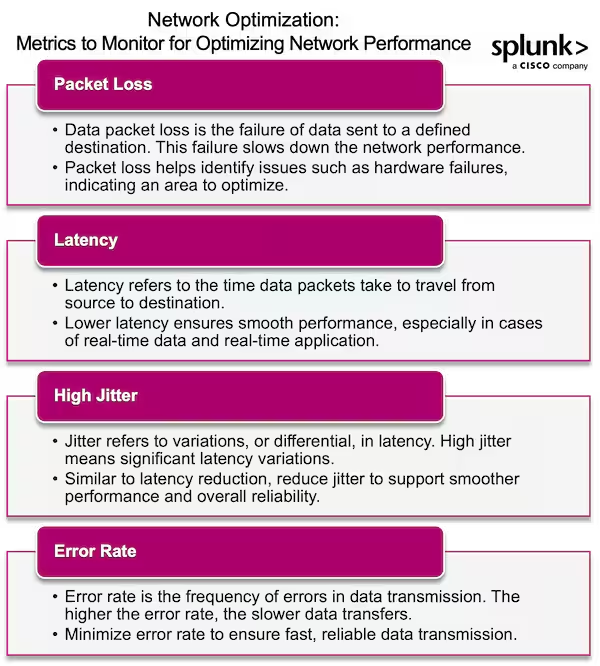
Optimizing an existing network is only possible when you can reliably identify the problems in your network. How? By monitoring key metrics:
- Packet loss is the failure of data sent to a defined destination which slows down the network performance. It allows you to identify issues such as hardware failures and optimize that area.
- Latency is the time data packets take to travel from source to destination. It helps optimize networks for real-time applications like games. Lower latency ensures smooth performance.
- High jitter refers to significant variations in latency. Sometimes, network devices fail to handle the traffic, which delays packet delivery. Monitoring this metric allows you to maintain network reliability.
- A high error rate is the increased frequency of errors in data transmission, which slows down data transfer. Optimize your existing error rate to keep it as low as possible because a low error rate ensures fast and reliable data transmission.
(Related reading: SRE metrics to know.)
Benefits of network modernization and optimization
Modernizing and optimizing networks enhances user engagement, security, operational efficiency, and workforce productivity. A 100-millisecond delay in website load time can reduce conversion rates by 7% — that’s something to avoid! And optimization can help.
Key benefits include:
- Scalability: Upgrading networks for scalability supports growth by expanding network capacity, accommodating new users seamlessly, and integrating new technologies seamlessly.
- Reduced downtime: Real-time alerts and insights prevent costly outages, no matter if the cause of that downtime is hardware failure, network congestion, or threats. (Find out how much downtime costs your org.)
- Stronger security: Network modernization and optimization strengthens your cyber defenses for both cloud and on-premises network ops and data. Modern networks can also be automated for the bulk of certain activities, such as vulnerability identification and management.
- Improved productivity: Optimized networks minimize latency and eliminate bottlenecks. The result of these improvements? Faster, more effective collaboration and decision-making.
How to optimize network performance: best practices
As technology advances and business demands evolve, teams should follow the best networking practices to:
- Futureproof your network.
- Reduce operational costs.
- Enhance overall efficiency.
So how do you optimize your network performance? Let’s look at some of the most important aspects and considerations:
Design and optimize the network topology
- Audit the network. Map the existing network topology to understand traffic flow, bottlenecks, and underutilized resources. Identify where you can adjust the network layout (physical and logical) for optimal data flow. Different configurations have their own limitations and advantages. Minimize latency by reducing data travel distances and using high-speed transmission media (e.g., fiber optics).
- Segment the network. Implement subnetting or VLANs (Virtual LANs) to improve performance and security by isolating traffic.
Anticipate network traffic
Network performance can be optimized by deploying the right set of hardware resources in the right topological configurations based on the expected network traffic demands.
How do you know what to expect?
Understand current and historic trends. Measure various parameters in the network’s current (always-changing) state and pull in historical data trends to predict future demands. For this, you need network visibility. This isn’t guesswork, but rather it is informed decision making based on well-established principles of mathematical modeling.
Start using AI. With AI, you don’t have to model the system exactly — you can instead train an AI model to replicate network system behavior within an acceptable measure of accuracy.
Be flexible and adaptable. Remember: some of the most impactful decision criteria are not entirely predictable. User expectations, business goals, and market trends can and do change without notice and in response to uncontrollable external situations and parameters.
Prioritize and optimize for the user experience (UX)
Prioritize optimizations that directly improve UX. Not all network operations or improvements affect the user.
For example, reducing network latency by 100ms for users in another content, who rely on resource-constrained CDNs and low-speed local internet, may not noticeably improve page load time — external factors, like local infrastructure, are still bottlenecks.
Instead, you can invest in developing a lightweight and high-performance app for internal use within a wired networked system, where latency is rarely a problem. These environments offer more control and ensure tangible benefits, as latency is less of an issue.
The key is to align optimization efforts with areas where meaningful improvements can be achieved, rather than addressing factors outside your control. Specifically consider how new networking components, configuration changes, network topologies, and processes all contribute to changes in:
- Traffic behaviors
- Risk exposure (especially cybersecurity)
- Business improvement
- End-user satisfaction
Improve internet speed and bandwidth
Since a network consists of various access points, good-speed internet is required to connect those points. And, because your network transmits lots of data, you should aim for higher bandwidth. If not, bandwidth limitations will:
- Affect the speed and efficiency of a network.
- Impact data integrity and security: data packets may be dropped or compromised in an overloaded networking channel without adequate security protocols.
Here's how to boost internet speed and bandwidth:
- Install signal repeaters to strengthen wireless connections.
- Optimize access points for better coverage and connectivity.
- Ensure sufficient bandwidth for data-intensive operations.
Perform regular maintenance
Regularly maintaining and updating your networks should become regular practices in support of network optimization.
- Resolve regular network problems.
- Install and configure new hardware and software.
- Plan for future network expansion (futureproofing).
- Protect the network from security incidents.
Begin with small pilot projects
Start with small-scale trials, a low-risk approach, to:
- Test new technologies or configurations.
- Identify and address potential issues before full deployment.
- Optimize processes incrementally with minimal risk.
And remember that the work of network optimization requires teams of people. Invest in your team's skills as you modernize and develop.
Tools & solutions for enterprise network optimization
Here are the sorts of tools support networking optimization. The industry is chock-full of solutions, so always do your research and understand the context of your own environment.
- Network monitoring tools identify bottlenecks and track performance metrics in real time.
- Automation, network management tools, and cloud-based integrations offer scalability and flexibility in managing traffic surges.
- Edge computing on edge devices will reduce latency and improve response times for geographically dispersed users.
- Cybersecurity tools, like SIEM and SOAR, can harness network data to minimize cybersecurity incidents and threats.
(Splunk can help with all your monitoring, observability, and cybersecurity needs. Learn more about our solutions.)
AI for network optimization
AI is beginning to radically alter how we optimize networks. AI enables dynamic, efficient, and scalable solutions — so you can adapt to anything.
How AI is used for network optimization
AI is already being rolled out for a variety of network functions:
- AI models can perform predictive analytics to forecast peak usage times and potential outages, then dynamically allocate resources to prevent bottlenecks.
- AI helps automate resource management — via load balancing, routing decisions, bandwidth allocation — to help with dynamic scaling, for example.
- ML can detect anomalies that may indicate network issues or incidents, like latency spikes or threat detection.
- AI enables self-healing capabilities. Networks can detect faults and automatically reroute traffic or fix issues without human intervention.
- AI can optimize network configurations based on predefined policies and real-time conditions. For example, adjusting Quality of Service (QoS) settings to prioritize critical applications.
- AI can improve the UX in many ways, like minimizing buffering on streaming platforms, for a higher quality viewing experience.
AI is already being rolled out for a variety of industries and use cases. Obvious areas include telecommunications, cloud service providers and content delivery networks, and all stripes of IT and enterprise organizations, including Splunk and Cisco.
Challenges with AI
Always remember that, as an emerging technology, AI will have unpredictable issues in the short-term and perhaps real-world consequences in the longer-term. For example, here are some challenges:
- Data requirements: AI needs large volumes of high-quality data for effective training.
- Complexity: Implementing AI solutions can be complex and may require skilled personnel.
- Ethical concerns: Ensuring unbiased and secure AI decision-making is critical.
Prepare your network for future unknowns
Modern networks are the foundation of futureproofing your organization. Continue to optimize your networks by layering on intent-based networking, AI/ML analytics, and other emerging innovations.
The result? A secure and cost-efficient network that's prepared for whatever the future may bring.
FAQs about Network Optimization
Related Articles

Open Source vs. Closed Source Software

Data Aggregation: How It Works