What’s EDR? Endpoint Detection & Response
Learn Laiba SiddiquiEndpoints in a network — mobile phones, laptops, tablets, etc. — are the most vulnerable points of entry for cyberattacks. As these threats become more sophisticated, traditional antivirus solutions are inadequate for effective mitigation.
That’s why organizations incorporate endpoint detection and response (EDR) tools into their network: to identify and mitigate severe cyber threats.
So, let's take a look at what endpoint detection and response is, its limitations, and some best practices.
Defining endpoint detection and response (EDR)
EDR detects and responds to attacks before they infect an entire system. Organizations have multiple security layers, with antivirus as the first layer and EDR as the second. If the antivirus fails to prevent malware execution, EDR gives protection. Here’s how:
- The EDR blocks or isolates detected abnormalities.
- Then, it sends alerts to the concerned teams.
- Teams propose a remediation action to restore the affected system.
Managing EDR systems does require trained operators. That may make EDR solutions a costly option for small-sized companies.
(Related reading: EDR, XDR, MDR: what’s the difference?)
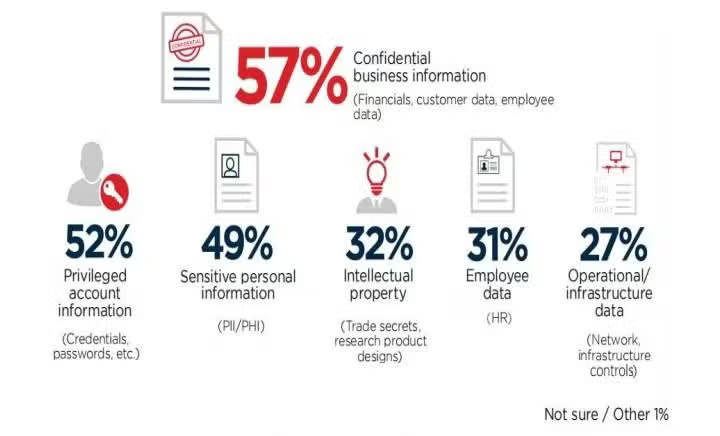
Different data sources on hackers’ radars
Type of threats EDR detects
Since EDR tools identify both known and unknown threats, let's look at the most common threats they’re likely to detect:
- Malware attacks occur when hackers try to steal personal information or financial data. EDR tools detect the signs of these attacks on endpoints, and then next steps can be taken as appropriate.
- Ransomware attacks lock devices and prevents people from accessing data on endpoints. Then, organizations pay a heavy ransom to gain access. Incorporating EDR into your system helps detect these threats early.
- Insider threats may result in the loss of sensitive data. That’s because sometimes the “insider” is intentionally trying to sabotage the organization and misuse intellectual property for its benefit. Other insider threats, however, can be accidental, like when an employee mistakenly exposes data inappropriately.
Components of endpoint detection and response (EDR)
EDR components vary according to the business requirements. But we've listed the standard components below:
Cyber threat intelligence
Cybercrimes are the most severe threats businesses face. The market is estimated to hit $15.63 trillion by 2029. With these growing numbers, responding to incidents isn't enough.
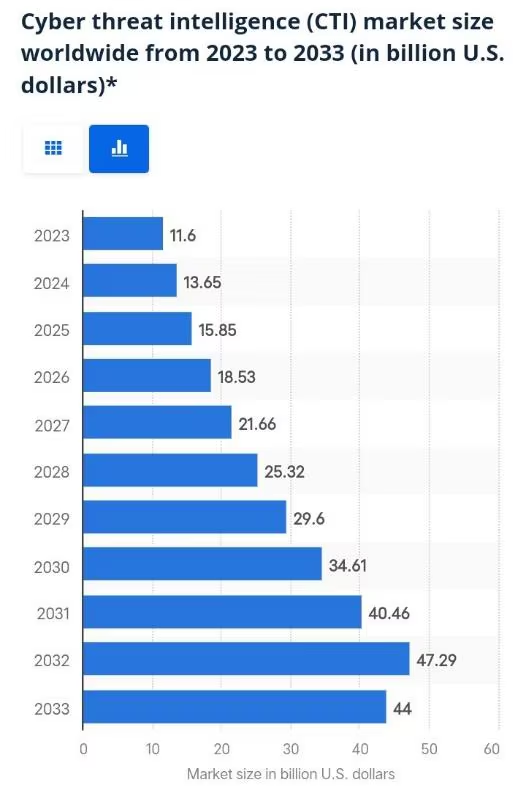
That's why organizations are embracing the art of threat intelligence: to gain insights into potential and current incidents. By analyzing the data from past incidents and current threat patterns, EDR can deter future threats.
(Read our full threat intelligence explainer.)
Monitoring
A critical part of EDR is its monitoring capabilities. EDR continuously monitors any abnormalities in endpoints to avoid side effects. Here's how:
- The EDR receives alerts when there's a sign of infection.
- Next, it detects the type of threat.
- Finally, the EDR isolates the threat so it doesn't spread throughout the network.
(Learn more about monitoring: IT monitoring & security monitoring.)
Cleanup and remediation
Threats may slip past the initial monitoring layer. However, internal network scanning enables the EDR to detect any lingering virus residues. Detection at different layers may disrupt network performance, so a central endpoint scans all connected endpoints.
Machine learning (ML) enabled
Machine learning (ML) provides an extra defense against cyber threats. There's no doubt why the AI cybersecurity market is valued at $31 billion USD in 2024 and will continue to grow.
Endpoint detection and response incorporates deep learning to detect and respond to threats. It uses statistical methods to learn from the data and train the system to block unseen attacks.
Easily customizable
Every organization has a different network architecture and specific needs. Some businesses might need root scanning, while others may want to scan a particular folder. So, the best EDR tools should be able to adapt to your company's environment.
Limitations of EDR
As mentioned earlier, EDR solutions aren’t for every organization out there. For some it may be a matter of cost and for others, inherent limitations might be the issue.
Here are common limitations of endpoint detection and response (EDR):
- Difficult to set up. If you want to capture more data and all abnormalities, you need expert help installing EDR agents on the endpoints. Also, some EDR solutions do not support specific iOS and Android devices.
- Significant investment. Deploying EDR software is expensive and that’s because of two nig costs. One is the upfront capital expenditure: you must invest in the software. Then, you have ongoing costs of training your staff on how to operate and maintain the EDR tools.
- May detect false positives. The biggest problem with EDR is that it may trigger threats that are false positives. This false alerting affects the productivity of the security team because they will waste hours investigating an activity that's ultimately not suspicious.
- Cannot detect zero-day attacks. EDR detects both signature and non-signature based threats. But some zero-day attacks can stay undetected for months. Attackers use these threats to exploit vulnerabilities before the security team discovers them and the team has zero days to address the issues.
- Lack of visibility. EDR only protects endpoints, while most threats are in the external network or cloud area. So, EDRs are hyper focused on endpoints — and there's a lack of visibility for distributed networks.
Best practices for endpoint detection and response (EDR)
Follow these best practices to improve your endpoint security and optimize your EDR implementation:
Choose the right EDR solution
You must provide vendors with a list of capabilities you want in your EDR solution. One factor you must look for is real-time monitoring, which helps you detect the threats in the first layer.
Here are some other factors to consider:
- The complexity of your network.
- Your budget for endpoint detection and response.
- 24/7 customer support from the provider to resolve the issues on the customer's end.
Try small pilot groups
When you implement a change to the entire network, it can affect the whole enterprise—for better or worse! So, you should test out new settings on small pilot groups.
For example, you can start with a department that is more vulnerable to threats. And keep 60 days as the ideal timeline for these tests so you can monitor the results as soon as possible.
Create BYOD policies
BYOD (bring your own device) adoption showed a 68% increase in employee productivity. That's why most companies now allow their employees to bring their gadgets to the workplace.
However, this exposes the company's personal data to risk. So, organizations must create BYOD policies to protect both the enterprise's and employees' data.
Integrate EDR tools with SIEM
Since EDR only provides endpoint security, organizations rely on SIEM for network monitoring. For that reason, they must combine these tools to enhance defense against cyber attacks.
(Splunk is a 10-time Leader in the Gartner Magic Quadrant for SIEM — see why!)
Regularly patch and update
Your EDR provider will regularly release updates to improve your system's ability to detect and respond to new threats. These updates can include patches for vulnerabilities that hackers might exploit. So, automating these updates ensures your system is always running the latest version with the strongest defenses.
(Related reading: patch management.)
XDR is the future of EDR
EDR provides a more improved solution to protect confidential data over traditional methods. However, its biggest drawback is that it only protects endpoints. In the real world, that’s just not enough. Businesses need an all-in-one solution to protect endpoints, cloud servers, and email.
That’s why XDR — Extended Detection and Response — may serve as a replacement for EDR today and certainly in the future.
FAQs about Endpoint Detection & Response
Related Articles

Centralized Logging & Centralized Log Management (CLM)

12 Must-Have Data Analysis Tools for 2026 | Python, SQL & AI