Data Normalization Explained: The Complete Guide
Learn Chrissy KiddKey Takeaways
- Data normalization standardizes data formats and removes redundancies, delivering consistent, structured, and easily queryable data within databases.
- Benefits outweigh challenges: Despite complexities like slower query responses or scaling difficulties, data normalization enhances data integrity, reduces anomalies, and improves system efficiency across organizations.
- Foundational for AI, machine learning, and business growth: Normalized data provides clean, structured inputs crucial for automation, AI, and machine learning models, while also supporting faster database queries, better decision-making, and sustainable business growth.
Every business today uses some form of data collection. That’s because the value of data collection and analysis is enormous when it comes to:
- Informing business decisions.
- Driving sustainable growth.
Today, in the era of Big Data — and now AI — we have more data-driven insights available to us than ever. Most enterprises already collect and manage data using databases, CRM platforms, or automation systems, but data in its many forms and entry types can lead to inconsistent or duplicate (redundant) information.
More efficient data collection requires a more streamlined process of data management. That’s where data normalization comes in.
In simple terms, data normalization is the practice of organizing data entries to ensure they appear similar across all fields and records, making information easier to find, group and analyze. There are many data normalization techniques and rules.
In this article, let’s cover the basics and provide some tips for how you can improve the organization and management of your data.
Defining data normalization
Data normalization is one of many processes you might apply to data. It is simply a way to reorganize or ‘spring clean’ the data, so that it’s easier for users to work with and query it — and analyze the outputs.
When you normalize a data set, you are reorganizing it to remove any unstructured data or redundant data to enable a superior, more logical means of storing that data.
The main goal of data normalization is to achieve a standardized data format across your entire system. This allows the data to be queried and analyzed more easily — leading to smarter business decisions.
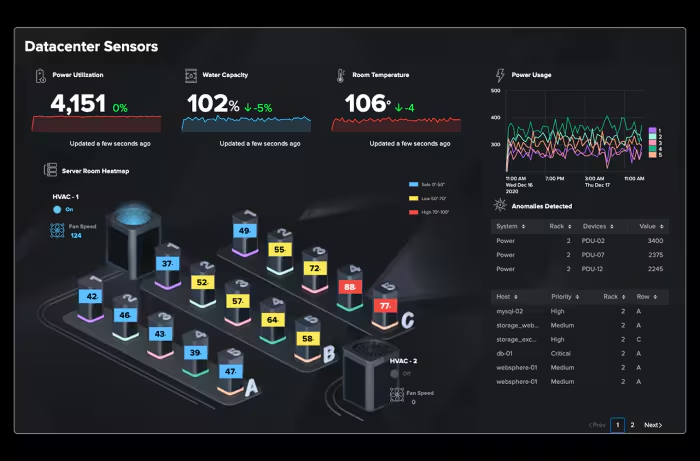
Importance of normalized data in databases
Data normalization could be included in your data pipeline, which supports overall visibility into your data, a concept known as data observability.
Ultimately, normalizing your data is one step towards optimizing your data, or maximizing the value you can get from it.
Unfortunately, for many, data optimization is a far-off goal: the data that organizations collect is enormous, but most of that data, in its current form, is rarely useful or valuable on its own. Today, we’re living through the early days of AI. If there’s one thing we know, it’s that All The Data is needed for AI to succeed.
(Of course, AI needs a lot more than just data: there must be governance, ethics, and frameworks — at bare minimum — to ensure we’re getting benefit from AI while reducing harm that we already know it can cause.)
There are many other benefits of normalizing data that we’ll explore later on, but first, it’s important to explore some key data normalization techniques.
(Related reading: data platforms & database monitoring.)
How do you normalize data?
In a fundamental sense, data normalization is achieved by creating a default (standardized) format for all data in your company database. Normalization will look different depending on the type of data used. Here are some examples of normalized data:
- Miss ANNA will be written Ms. Anna
- 4158488400 will be written 415-848-8400
- 37 buttercup AVE will be written 37 Buttercup Avenue
- Amazon will be written Amazon.com, Inc.
- VP product will be written Vice President of Product
Knowing how to normalize data en masse is a more complicated matter. It is typically done by a process of building tables and linking them together, all while following a set of practices to protect the data and reduce data anomalies. These data normalization techniques and practices take many different forms — let’s take a look now.
(Related reading: database management systems, aka DBMS.)
Types of data normalization forms
Data normalization follows a specific set of rules, known as “normal forms”. These data normalization forms are categorized by tiers, and each rule builds on the one before — that is, you can only apply the second tier of rules if your data meets the first tier of rules, and so on.
Many types of data normalization forms exist, but here are four of the most common and widely used normal forms that apply to most data sets.
- First Normal Form (1NF)
- Second Normal Form (2NF)
- Third Normal Form (3NF)
- Boyce and Codd Normal Form (3.5NF)
Let's discuss them in detail.
Rules of data normalization
In order to achieve a specific normal form, you must follow a specific set of principles or guidelines. The key rules we are going to discuss dictates how data needs to be related and structured in order to maintain integrity.
1. First Normal Form (1NF)
The first normal form, aka 1NF, is the most basic form of data normalization. The core outcome of this rule ensures that there are no repeating entries in a group. This means:
- Every cell should only have one single value.
- Every record should be unique.
An example would be a table that documents a person’s name, address, gender, and if they ordered a Splunk T-shirt.
2. Second Normal Form (2NF)
2NF is the second normal form that builds on the rules of the first normal form. Again, the goal is to ensure that there are no repeating entries in a dataset. Entries with this data normalization rule applied must:
- Adhere to all the 1NF requirements.
- Have one primary key applied.
The application of one primary key essentially means that a separate table needs to be created for subsets of data that can be placed in multiple rows. The data in each table can then be linked with foreign key labels (numbers in this case).
If a primary key such as ‘Customer Number’ applies to our T-shirt example, then subsets of data that require multiple rows (different T-shirt orders) need placement in a new table with a corresponding foreign key.
Example of data in the second normal form:
3. Third Normal Form (3NF)
The 3rd normal form data model includes the following rules:
- It should adhere to all the 2NF requirements.
- It should only be dependent on the primary key (no transitive functional dependencies).
This means that if any changes to the primary key occur, all impacted data must go into a new table.
In our example, if you’re documenting someone’s name, address and gender, but later go back to change the name, the gender might change as well. Therefore, gender is given a foreign key and all data on gender is placed in a new table.
Example of data in the third normal form:
4. Boyce and Codd Normal Form (3.5NF)
The Boyce Codd Normal Form, known as the BCNF or 3.5NF, is a developed version of the 3rd normal form data model (3NF). A 3.5NF is a 3NF table that doesn’t have candidate keys that overlap. This normal form includes these rules:
- It should be in 3NF.
- X should be a super key for every functional dependency (X → Y).
Essentially, this means that for a dependency X→ Y, X can’t be a non-prime attribute, if B is a prime attribute.
What happens if you violate one of the first 3 rules of normalization?
If you violate the normalization rules, the following data anomalies may occur:
- Update anomalies. You will need multiple updates to change the data in one place.
- Delete anomalies. You may face unwanted loss of related data.
- Insert anomalies. In this type of anomaly, it may be difficult to add data without redundant information.
Any of these anomalies can ultimately result in increased redundancy and inconsistent data, thereby compromising the integrity of your database.
Benefits of data normalization
Now that we’ve got the basic concepts down, let’s look at what normalized data can bring to your business. Referential integrity is enhanced by normalized data since it organizes related information into distinct tables. Thus using foreign key constraints to ensure consistent relationships.
As well as the obvious benefits of a better organized and well-structured database, there are plenty of other advantages of data normalization for businesses:
Freeing up space
Before normalizing your data, you might have had instances of repeated customer information across several locations in your database. By organizing and eliminating duplicate data, you can create valuable storage space while helping your system to run quicker and more efficiently.
(Related reading: customer data management.)
Improving query response time
The speed at which you can find data after normalization is a significant advantage for general query execution. Numerous teams within a business can find information in one place, as opposed to scattered across several data sets.
Reducing data anomalies
Another key advantage of data normalization is the elimination of data anomalies — i.e. data storage inconsistencies. You will find the problems with the structure of a database when there’s an error with adding, updating, or deleting information in a database.
The rules of data normalization help to ensure that you enter and update any new data is correctly, without duplication or false entry, while you can delete information without affecting any other related data.
(Related reading: anomaly detection.)
Maintaining accurate, consistent records
Data normalization improves data integrity and reduces redundancy, which, together, ensure that you can maintain accurate and consistent records. You can also seamlessly share data.
Plus, normalization facilitates interoperability among the different systems.
Enhancing cross-examination capabilities
Data normalization methods are useful for businesses that gather insights from a variety of sources, especially when they stream, collect and analyze data from SaaS platforms, as well as digital sources such as websites and social media.
Streamlining the sales process
Through data normalization, you can put your business is in the best position for growth. You can do it through tactics like lead segmentation. Data normal forms ensure that you can divide groups of contacts into comprehensive categories based on:
- Job titles
- Industry sector/vertical
- Location
- Other categories
All of this makes it easier to find information about a lead and eliminates many issues for commercial growth teams.
Challenges of data normalization
Now, it’s time for some truth. Yes, the advantages of data normalization for organizations are huge — but there are certainly drawbacks to recognize.
Expect slower query response rates
When normalizing data at a more complex level, some analytical queries may take your database longer to perform, especially those that need to pull through a large amount of data. Normalized data rules require the use of multiple data tables which databases take longer to scan.
The trade-off traditionally increases query performance time for reduced storage, though the cost of storage will likely decrease over time.
You will need accurate knowledge
You will need thorough and accurate foundation knowledge of the data normal forms and structures in order to properly standardize your data. If the initial process is incorrect, you will experience significant data anomalies like inconsistent dependency. This happens when two non-key attributes depend on each other, leading to integrity issues and potential anomalies.
Maintaining data connections on scaling up can be complex
When you are trying to scale up data connections, you should expect challenges like potential bottlenecks, increased latency, and the complexity inherent in managing distributed systems. Also, a higher load impacts performance and maintaining data consistency gets more difficult. And of course, scaling any process is easily complicated when you are trying to manage security across expanded connections while integrating diverse data sources.
Added complexities for teams
In addition to setting up the database, you must educate the right people on how to interpret it. Much of the data that follows the rules of normal forms saves as numerical values, meaning that tables contain codes instead of real information. This means that you must always reference the query table.
(Related reading: the data analyst role & data analytics certifications to earn.)
Denormalization as an alternative
Developers and data architects continue to design document-oriented NoSQL databases and non-relational systems that can be used without disk storage. Consequently, a balance of data normalization and data denormalization is becoming more common.
(Related reading: SQL vs. NoSQL.)
Data normalization: The verdict
The process of data normalization may take time and effort, but the advantages of data normalization far outweigh the drawbacks. Without normalizing the data you collect from various sources, most of that data will lack real meaning or purpose for your organization.
While databases and systems may evolve to enable less storage, it’s still important to consider a standardized format for your data to avoid any data duplication, anomalies or redundancies to improve the overall integrity of your data. Data normalization unlocks business potential, enhancing the functionality and growth possibilities of any organization.
For this reason, data normalization is one of the best things you can do for your enterprise today.
Related Articles

Cloud Automation Explained

Individual Contributors vs Managers: Differences in Roles