Attribute Coding Agent Usage, Spend, and Adoption With Tokenomics
Observability Dayna LordAI coding agents are expensive and running away with the bill. Agentic workloads can spawn multiple agents, driving unpredictable usage patterns that differ significantly from human-centric question-and-answer interactions. As a result, cost visibility and attribution remain difficult to understand – even when the bill arrives. As organizations wake up to this reality, a new one is dawning: AI spend does not always equate to ROI.
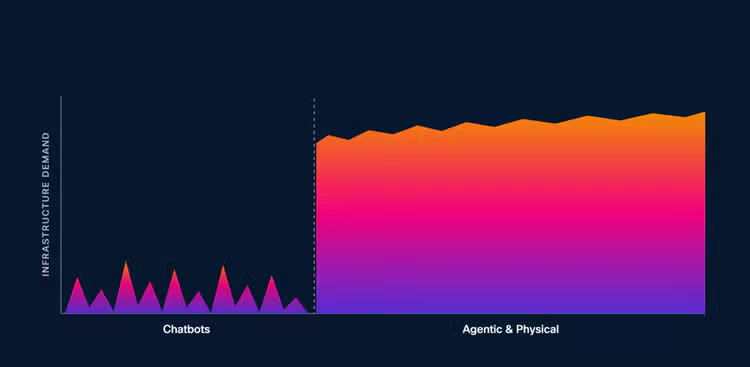
Not since the advent of the cloud have IT teams had to deal with such unpredictable cost for such an essential service. It has driven some spectacular overages.
In a push to increase agent adoption and productivity, some leaders have encouraged “tokenmaxxing,” which can mistake high AI activity for high business impact and ROI. Many leaders have also limited general consumption well below productive thresholds to manage spend.
Without visibility, there is a clear misunderstanding of which agents, workflows, models, or users are responsible for this cost. This means teams struggle to find out whether that consumption is driving business value and impact. As a result, organizations seeking financial security are forced to impose arbitrary spending limits on their highest-impact teams and individuals. These limits often fail to reflect actual usage, business value, or return on investment.
That’s why we’re introducing Tokenomics in Agent Observabilityto help teams turn their AI spend into defensible ROI at scale. Tokenomics provides finance and engineering leaders with complete visibility into coding agent usage and cost alongside productivity metrics. This single pane of glass gives managers the insights needed to correctly allocate budget where it’s needed, and manage runaway costs before the bill arrives.
Accurate forecasting also mitigates the need for usage limits and helps prevent surprise bills. With all of this spend data in Agent Observability, teams can correlate costs with quality and impact data to identify ROI at every level.
That way, organizations move beyond simply knowing where AI spend is going to understanding who and what is driving that spend, if usage is efficient. This visibility lets teams optimize consumption before waste scales and understand if AI investments are delivering enough value to justify their cost.
This feature is available on premises, in Observability Cloud, and in Cisco Cloud Control later this month. Key integrations will include Claude Code, Codex, Cursor, Windsurf, and GitHub Copilot.
Understand Agent Usage and Cost in One Place
AI adoption rarely happens through a single tool, provider, or team. As organizations scale coding agents, fragmented provider consoles, and delayed invoices can make it difficult to understand who is consuming what—and who owns the cost.
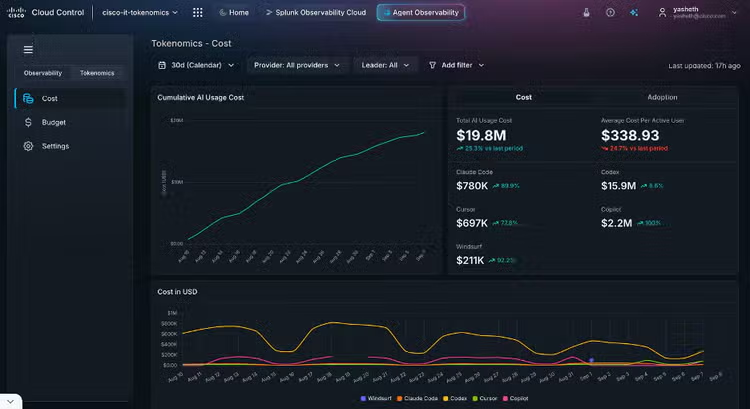
Tokenomics brings agent usage, cost, and adoption insights together so that teams can trace consumption across active users, teams, models, providers, and tools. Finance and leadership views help different stakeholders explore the same underlying data through the lens most relevant to them, while organizational hierarchy enables visibility by team.
Instead of joining data across an ever-growing number of API portals, LLM gateways, ERPs, and HRM systems with homegrown data pipelines and spreadsheets, leaders gain shared visibility and clearer attribution. This helps transform fragmented individual consumption into organizational accountability—and makes it easier to investigate unexpected changes in spend before they become bigger problems.
Optimize Consumption Before the Bill Arrives
Visibility tells teams what happened. Effective AI cost management also requires understanding what is likely to happen next.
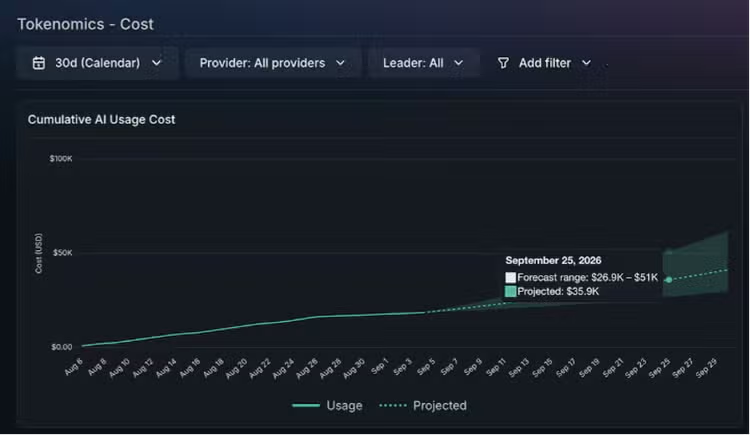
Tokenomics helps teams examine historical and current consumption patterns, establish budgets, identify unusual usage, and in the future, forecast consumption. This feedback loop helps organizations move from reacting to AI bills after the fact to proactively managing usage while there is still time to act.
Budgeting: Tokenomics soon will bring greater control to AI spend by helping teams set budgets and thresholds for specific time periods and teams. Anomaly alerting will flag unexpected or unforecasted usage that could put those budgets at risk so that teams can act before costs escalate. This insight will strengthen accountability, reduce surprise spend, and make AI costs more predictable as agent adoption scales.
Forecasting: Tokenomics in Agent Observability will soon leverage the Cisco Deep Time Series Model (CDTSM), a foundation model built to predict consumption patterns and provide out-of-the-box "zero-shot" forecasting capabilities. Thus, customers will be able to forecast consumption across their teams, projects, and providers before the billing period ends. CDTSM will generate an accurate forecast for a specific team or project without initially requiring weeks of historical training data. On internal benchmark evaluations, CDTSM has exceeded the accuracy of the industry's leading time-series forecasting models. Each forecast includes a confidence interval so that teams know the reliability of the projection.
The result: No more waiting until the end of the month to discover an unexpectedly large AI bill. Teams can anticipate consumption, identify potential overruns earlier, and make informed adjustments before costs are incurred.
Move From Cost Management to AI Value
Managing cost is only half of the equation. The cheapest AI tool is not necessarily the most valuable—and high consumption may be entirely justified if it produces meaningful outcomes.
Token counts alone cannot tell leaders whether an AI investment is working. Organizations need to evaluate cost alongside adoption, productivity, quality, and ultimately the outcomes AI helps produce.
Tokenomics is designed to help teams make that connection. By bringing adoption, usage, cost, and productivity signals together, organizations can begin identifying where AI is being adopted effectively, where consumption may be inefficient, and which investments deserve to scale. The goal is to shift conversations from “How do we spend less?” to “How do we get more value from every dollar we spend on AI?”
This shift complements the broader capabilities of Agent Observability, where teams can evaluate AI quality alongside token consumption, cost, agent behavior, and the infrastructure supporting AI workloads. Together, these signals can help teams make evidence-based tradeoffs between cost, quality, and performance rather than optimizing any one metric in isolation.
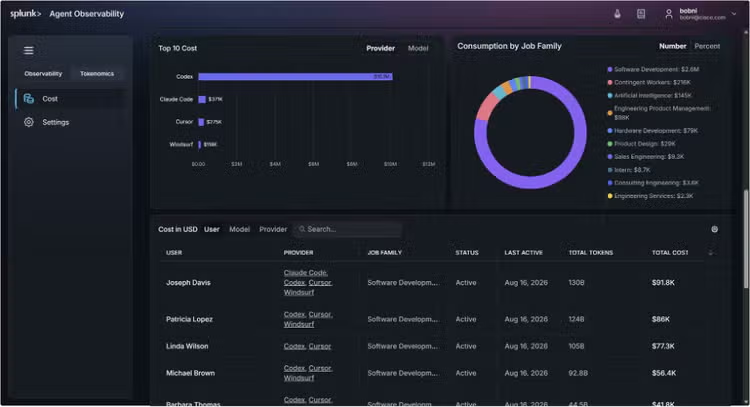
Bring Financial Accountability to Agentic AI
AI spend is becoming highly granular, variable, and distributed across providers, teams, tools, and users. Traditional monthly cost reviews weren't designed for that operating model. Organizations increasingly need the same disciplines that FinOps brought to cloud—allocation, forecasting, optimization, accountability, and governance—adapted for AI.
Tokenomics brings those disciplines into Agent Observability. By unifying visibility and cost attribution across the AI stack, teams can make smarter, data-driven decisions about where to invest, where to optimize, and where to scale.
Because ultimately, the goal isn't simply to use fewer tokens. It's to make every token—and every dollar invested in AI—work harder for the business.
Get Started with Tokenomics
Check out our website and explore the documentation to learn more about how Agent Observability can help you understand your coding agent usage and costs, optimize consumption, and begin connecting AI investment to measurable value. Get hands-on with the Splunk Observability Cloud Free Edition today.
Related Articles
Detect Faster, Rapidly Scope an Incident, and Streamline Security Workflows with Splunk Enterprise Security 7.1

Modifying the Incident Review Page