The Eval Engineering Lifecycle and How to Implement It
Learn Pratik BhavsarKey takeaways
- Trust is the primary bottleneck: Most AI projects fail not due to technical limitations, but because teams cannot prove their systems work reliably at scale.
- The lifecycle is a continuous flywheel: Eval engineering is not a one-time setup; it is a five-stage system that adapts to data drift and model updates to ensure long-term reliability.
- Governance over measurement: The transition from measurement (knowing an output is bad) to governance (blocking bad outputs via inline guardrails) is what separates a debugging tool from a production-grade system.
Most teams do not fail at building AI. They fail at trusting what they built. A prototype demos well, then nobody can say whether it holds up under real traffic, so it stays a pilot forever. The research on abandoned AI projects keeps landing on the same gap, and it is not talent, models, or frameworks. The gap is not in what these teams build. It is in what they can prove.
And that’s where eval engineering comes in.
(This article is part of our Eval Engineering Series. Explore related topics and tutorials using the right-hand links.)
Common pitfalls with AI project deployments
Before diving into the eval engineering lifecycle, it is critical to understand the common pitfalls that cause teams to fail with deploying or scaling AI:
- Starting with too many evals. Teams end up with 15 different metrics and no clear path forward, leading to analysis paralysis.
- Relying solely on generic LLM judges. Without human refinement, teams plateau at 70% accuracy and mistakenly blame the model rather than the lack of domain-specific criteria.
- Building elaborate evaluation dashboards but failing to integrate them into the deployment pipeline. Evals that don't become guardrails are just expensive documentation of your problems.
- Treating evaluation as a one-time project. Production data drifts and model providers update; an eval system that isn't continuous is, within months, mostly theater.
- Focusing only on the LLM output while ignoring the systemic failures that occur in the orchestration, tool-calling, and retrieval layers.
Understanding system decay: Drift vs. regression
To maintain reliability, you must distinguish between the two primary forces that cause eval systems to decay:
- Data drift: As user behavior evolves and production inputs change, your existing evaluation criteria may become less relevant. This requires ongoing monitoring and a recurring cadence of SME review to ensure your definitions of "good" stay aligned with reality.
- Model regression: Model providers frequently push updates that can inadvertently change output behavior. This requires a robust regression suite that you run against every model update to confirm that your agent’s capabilities haven't regressed.
Understanding these two forces explains why eval engineering is a continuous lifecycle rather than a one-time setup. You are building a defense against both the shifting nature of your data and the unpredictable updates of your model providers.
To combat these forces, you need a structured framework that manages quality at every stage of the development process: the eval engineering lifecycle.
How to implement eval engineering: The five-stage lifecycle
Each stage of this lifecycle builds on the previous one. Before you begin, remember that your unit of evaluation is the entire agentic workflow, including the prompt, tool-calling logic, RAG retrieval, and final response. If you only test the model, you miss the systemic failures that occur in the orchestration layer.
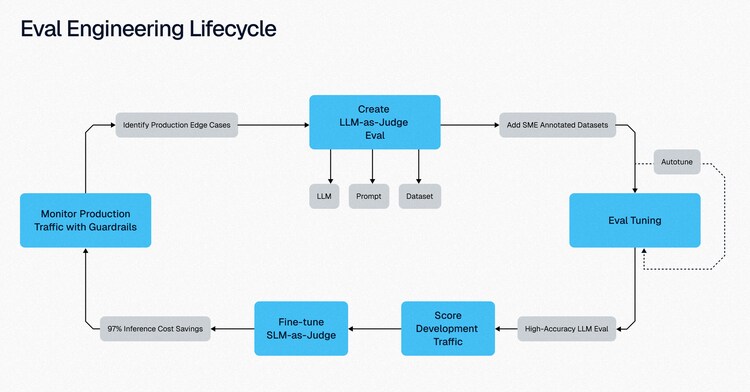
Phase 1. LLM-as-judge: 60–70% accuracy
Start by using an LLM to evaluate your AI's outputs. Write a prompt that defines what "good" means for your use case, run it against a test dataset, and measure agreement with human judgment.
While this is fast to set up, it typically achieves only 60–70% accuracy, which is a starting point, not a destination. To succeed here, start with your top three failure modes and get those to 95% accuracy before expanding your scope; depth beats breadth in these early stages.
Phase 2. SME refinement: 90–95% accuracy
Generic LLM judges are seductively convenient, but they lack the domain-specific nuance required for high-stakes production. Bring in subject matter experts (SMEs) — the people who actually know what "good" looks like in your domain — to review the failures your LLM judge missed.
Your senior customer service rep who's handled 10,000 tickets. Your compliance officer who knows which phrasings trigger regulatory issues. Your clinical expert who can spot medically questionable advice.
They will help you articulate criteria that were previously invisible to the model. This stage pushes accuracy to 90–95%, and there is no shortcut: the gap between 70% and 95% is where domain expertise lives.
Phase 3. SLM fine-tuning: 100× cheaper
Once you have established a high-accuracy baseline, the next challenge is operational scale. Running heavy LLMs on every production interaction is prohibitively expensive, often forcing teams to sample only 10% of traffic.
Instead, fine-tune a small language model (SLM) on your SME-validated labels and failure patterns. This allows you to run your evaluation 100x cheaper and 10x faster, making 100% coverage economically viable. You are no longer sampling; you are seeing everything.
Instead, fine-tune a small language model (SLM) on your SME-validated labels and failure patterns. This allows you to run your evaluation 100x cheaper and 10x faster, making 100% coverage economically viable. You are no longer sampling; you are seeing everything.
Phase 4. Production guardrails: 100% inline enforcement
This stage separates eval engineering from traditional evaluation: why measure bad behavior if you are going to let it through anyway?
Transform your evals into guardrails that run inline at inference time. When a score drops below a threshold, the system should block the response, trigger a fallback, or escalate to a human. Your evaluation system stops being a measurement tool and becomes a governance system.
As you transition these evals into runtime guardrails, treat them as version-controlled code within your CI/CD pipeline. This ensures that safety infrastructure receives the same rigor as model code, allowing you to test policies against historical datasets before deployment. Furthermore, enforcement demands auditability: every block, rewrite, or escalation must be logged with metadata—detector version, threshold, and confidence score—to provide the transparency required for regulatory compliance reporting.
Do not fall into the trap of building elaborate pipelines only to let bad outputs through; evals that don't become guardrails are merely expensive documentation of your problems. Measure to act, not to admire.
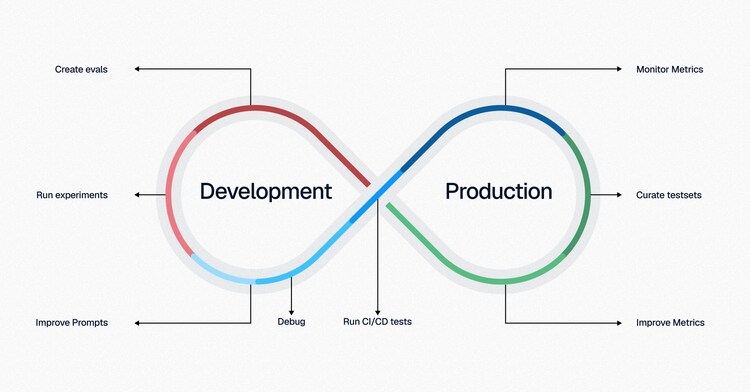
Phase 5. Continuous adaptation: ∞ self-improving
Production data is constantly changing, user behavior evolves, and model providers push updates. Static evals decay within weeks.
Close the loop by monitoring guardrail trigger rates and feeding production failures back into a permanent SME review cycle. As you identify new patterns, retrain your SLMs and update your guardrail thresholds. Evaluation becomes a flywheel that improves itself over time, ensuring your system remains a living, human-in-the-loop capability that evolves alongside your users.
Establishing guardrail governance
Effective guardrail management requires clear ownership across the organization. While data science teams typically build and refine the detectors, security teams often define the compliance thresholds, and product teams manage the user experience impact. Establishing a cross-functional governance framework ensures that when a guardrail triggers, the team responsible for tuning the threshold is clearly identified, preventing the bottlenecking of production incidents.
Strategic implementation: Build vs. buy
As you plan your eval engineering roadmap, you will face the build-vs-buy calculation. You can build the components yourself: LLM-as-judge is API calls, SME workflows can be managed in spreadsheets, and guardrails are inference-time checks.
However, ask yourself: do you want your engineers building evaluation plumbing, or building your actual product? The most successful teams treat evaluation infrastructure as a commodity to be bought or leveraged, allowing their engineers to focus entirely on the domain-specific customization that actually differentiates their AI.
When to invest in eval engineering
Not every AI project needs the full lifecycle on day one. Match the investment to the risk:
- Low stakes + low volume: Basic evals are sufficient.
- High stakes + any volume: Customer-facing agents, regulated industries, decisions with legal or financial consequences. Start the Eval Engineering lifecycle as soon as possible.
- High volume + any stakes: At scale, even "minor" failures add up. You need cost-effective evaluation, which means SLMs. You need coverage, which means guardrails.
Get started with eval engineering
Moving from pilot to production requires more than just better models; it requires a systematic approach to quality. Adopt the eval engineering lifecycle to move beyond "hope-based" development and start shipping AI you can prove works.
Sign up for our event series on Splunk Agent Observability:
Office Hours
Agent Observability & Tokenomics: Real World Questions, Use Cases, and Insights
September 24th 2026 | 11:00am – 12:00pm PT
FAQs
Related Articles

Risk Register Explained: Key Components, Benefits, and Managing Business Risks

Brute Force Attacks: Techniques, Types & Prevention