Scaling Laws of AI Tokenomics
Artificial Intelligence Pratik BhavsarKey takeaways
- Token spend has a productive middle. Extra compute helps only while accepted results improve faster than cost and review time.
- Discovery and execution need different budgets. Search needs distinct paths and a stopping rule. Execution needs convergence and cheap checks.
- Engineering can change the curve. Evals, retrieval, prompts, and reusable skills can make later runs cheaper or more reliable.
Tokenomics isn’t about reducing tokens. It’s about understanding the marginal return of inference.
Imagine two agents solving the same task. One spends 5,000 tokens while the other spends 50,000. Sometimes they produce exactly the same answer. Sometimes the latter with larger inference budget uncovers a better solution, catches a subtle error, or eliminates human review. Which agent is better?
Teams try to answer that question by looking at API cost. Cost matters a lot, but it tells you only what you spent, not what you gained. The real question is what those extra 45,000 tokens bought. Did they improve quality? Save reviewer time? Or did they simply burn more compute without changing the outcome?
Every step of retrieval, reasoning, tool call, and verification is an investment made with the expectation that it will improve the result. Some investments pay off. Others simply make the model repeat the same mistake in greater detail. The engineering challenge is not minimizing inference but understanding when additional inference creates value.
That’s the central idea behind AI tokenomics. Rather than treating tokens as a cost to reduce, tokenomics studies the marginal return of inference: how additional computation changes outcomes, when it improves quality, and when it becomes overhead. Like any investment, inference follows scaling laws. Some additional computation produces dramatic gains. Some yield only marginal improvements. Some produce none. Understanding where those returns accelerate, plateau, and eventually diminish is becoming one of the fundamental engineering problems in building AI.
Curves of Scaling Laws
Doubling the number of tokens doesn’t necessarily double the quality. Every additional unit of computation can be spent on different kinds of work. Here are five scaling laws that provide a practical framework for understanding where additional inference creates value and where returns begin to diminish.
1. Scaling Law of Context
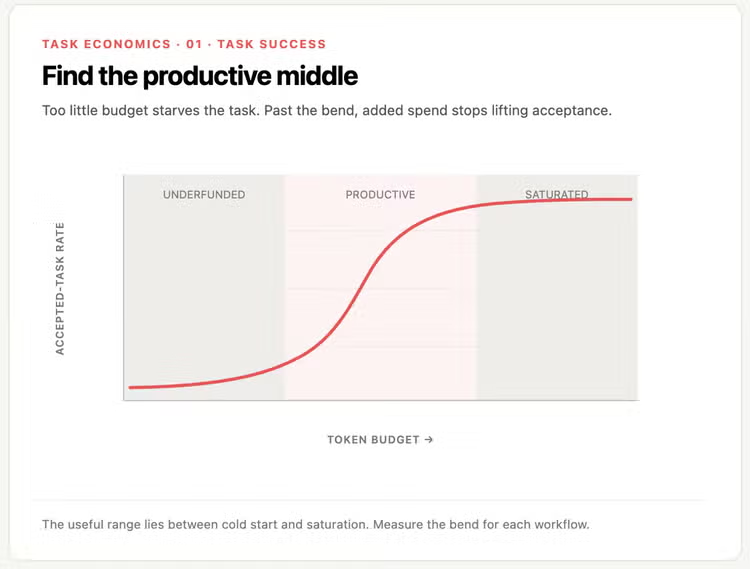
A model cannot reason about information it never sees. Early increases in context therefore produce large gains by supplying missing information. But the relationship is not linear. As context grows, additional tokens increasingly repeat information the model can already infer, introduce noise, or bury the relevant signal. The objective is not to maximize context but to maximize useful context.
This pattern appears repeatedly in retrieval research. Retrieval-Augmented Generation (RAG) demonstrated that selectively retrieving relevant evidence is substantially more effective than relying entirely on model parameters, while Lost in the Middle showed that simply increasing context windows does not guarantee better performance because models often fail to use information buried deep within long prompts. Better retrieval, ranking, and context organization frequently outperform simply adding more tokens.
2. Scaling Law of Reasoning
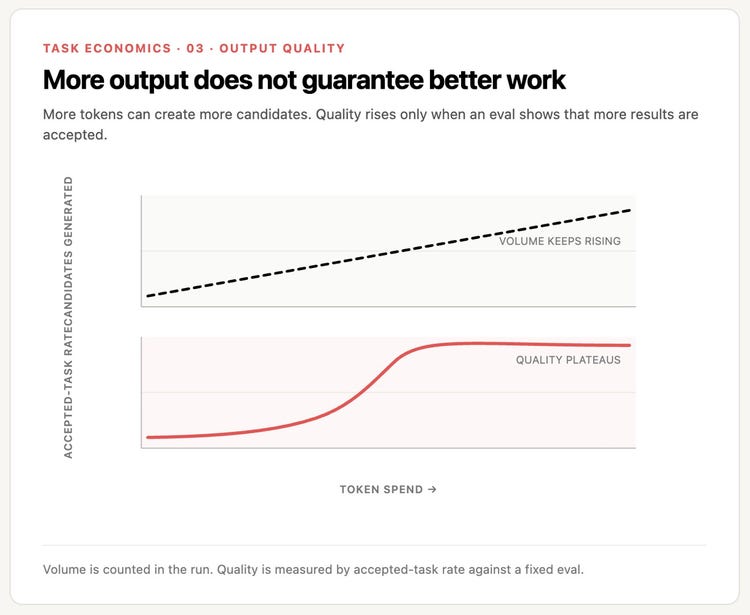
Additional inference only creates value when it performs productive computation. A model that spends more tokens repeating the same argument is simply consuming compute. A model that spends those tokens decomposing a problem, testing assumptions, revising intermediate conclusions, or evaluating alternatives is performing useful reasoning.
This distinction has become one of the defining ideas behind modern reasoning models. Recent work ontest-time scaling shows that intelligently allocating additional inference at runtime can improve capability as much as—or even more than—scaling model parameters, provided compute is directed toward productive reasoning rather than uniformly extended thinking.
More importantly, reasoning itself follows a response curve. Additional thinking initially improves performance, but its marginal returns diminish and can even reverse through overthinking, making adaptive allocation of inference more effective than simply thinking longer on every problem.
3. Scaling Law of Verification
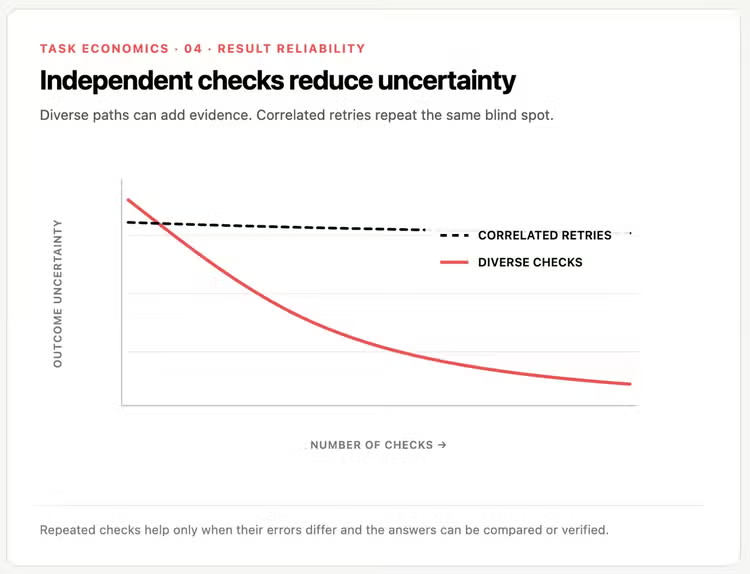
Reasoning produces candidates. Verification determines whether they are trustworthy.
A single reasoning trajectory can easily converge on the wrong answer. Self-consistency showed independent reasoning paths that arrive at the same conclusion provide much stronger evidence than one long chain of thought. The objective is therefore not simply to generate more reasoning, but to verify it as cheaply as possible.
Recent work ontest-time scaling increasingly treats verification as a first-class allocation of inference rather than an afterthought. Instead of spending every additional token generating longer reasoning traces, newer approaches invest part of the inference budget in evaluating candidate solutions, guiding search, or deciding where additional computation should be spent. Under larger compute budgets, these verifier-guided approaches consistently scale more efficiently than verification-free methods.
4. Scaling Law of Search
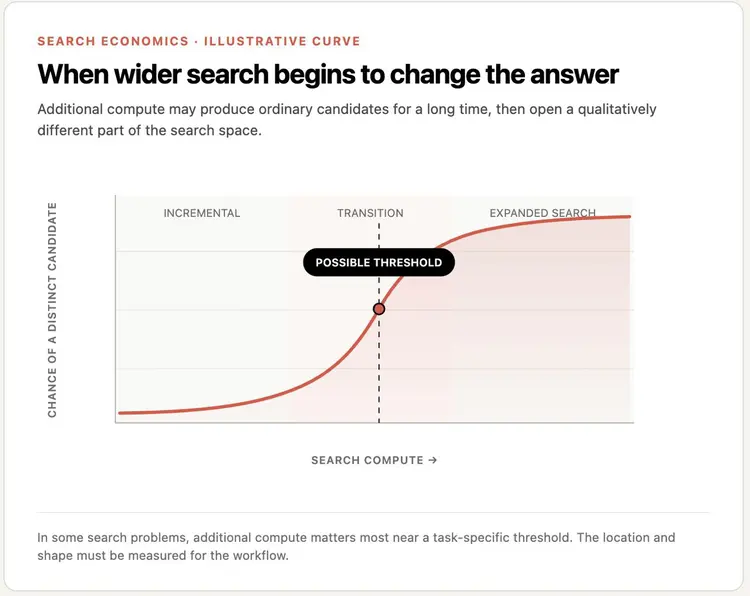
Raising the sampling temperature or rerunning the same prompt does not guarantee a new result. Productive search requires genuinely different trajectories through the solution space.
This idea appears repeatedly throughout modern AI research. Tree of Thoughts demonstrated that exploring multiple reasoning branches can outperform a single chain of thought. More recent work on compute-optimal test-time scaling shows that the best inference strategies adapt search depth to the difficulty of the problem instead of applying a fixed reasoning budget everywhere. Search therefore becomes another resource that should be allocated intelligently rather than maximized indiscriminately.
Breakthroughs follow their own response curve. Early exploration may produce nothing but ordinary candidates, making additional inference appear wasteful. Then, after crossing a search threshold, an unexpectedly strong solution emerges. Search alone, however, is insufficient. Every search process requires an evaluator capable of recognizing novelty when it appears. Without verification, more search simply produces more candidates.
5. Scaling Law of Automation
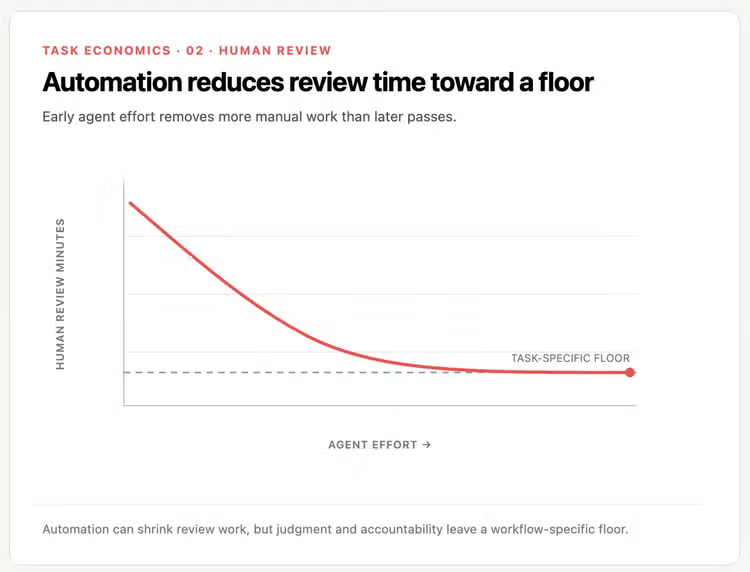
On a fixed, well-scoped task, the first increase in agent effort via longer runs, deeper reasoning and more tokens may remove a large portion of manual work. Later increases buy smaller reductions because human judgment, coordination, or accountability needs are constant on some tasks. The floor differs by application and role, but the curve is still useful for deciding when another agent pass has stopped earning its cost.
How To Find the Right AI Agent Token Budget
Response curves sound abstract until you measure one. Start with a high-volume workflow and collect a representative task set. Run it at the current setting, then again with higher reasoning and then with lower reasoning. Keep the model and tools fixed.
Measure the work, not just the run. Record the tokens, retries, wall time, and reviewer minutes. Then record whether the result was accepted. Plot cost per accepted task across the three budgets. The winning setting is rarely the cheapest run or the one with the highest raw quality. It is the point where extra quality stops paying its way.
Cut the budget when acceptance holds and review does not rise. Add budget when the quality gain pays for the extra compute. If repeated runs keep finding the same weak path, move budget into search. If the same failure appears across many tasks, fix the shared infrastructure instead of paying to rediscover it.
Every additional token is an investment.
Investments only make sense if their marginal return exceeds their marginal cost.
Check Your Own Tokenomics for Free
Token Meter brings Claude Code and Codex session costs into one dashboard. It follows the newest local agent log, parses usage as it lands, and combines live runs with cross-app history so you can compare tokens, estimated spend, models, and context usage without hopping between apps.
Open source. Local-only. Python standard library only. No API keys. No telemetry leaves your machine.
It helps answer questions such as:
- How is the context window growing during this session?
- How much have I spent on this session?
- How much have I spent on this project last week?
- Is token output getting faster or slower over time, and how does that compare across models?
- Which loaded tools or skills am I not using, and which user-installed skill packs should I review for disabling?
- What do the cost, token, execution, and speed numbers look like for each model?
- What did I spend and work on each day?
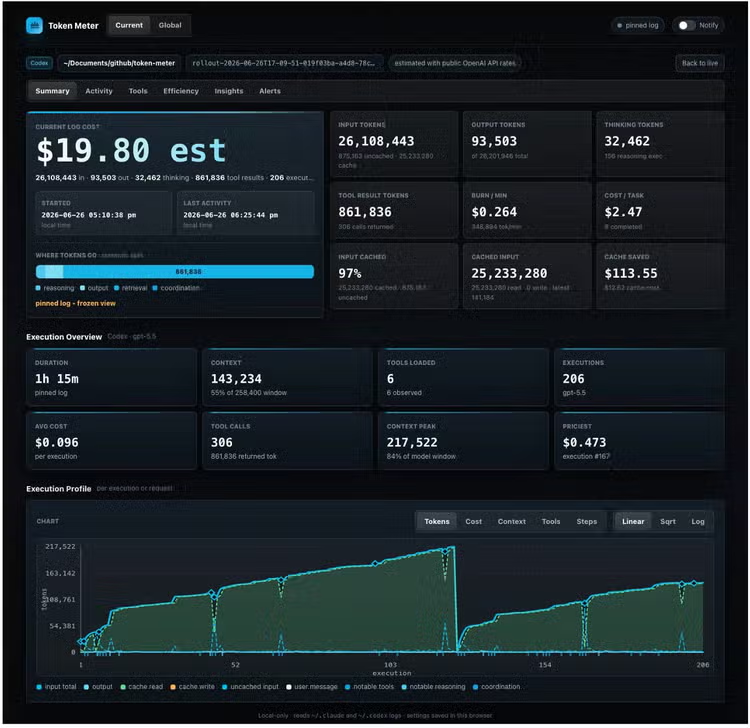
Figure 5. Token Meter shows what a session consumed and how cost moved over time.
Learn more about Splunk Agent Observability and get hands-on with the Splunk Observability Cloud Free Edition today.
Common Questions About AI Agent Token Budgets
Sign up for our event series on Splunk Agent Observability:
Workshop
Build Better, Spend Less: A Hands-On Workshop on Token Efficiency
August 27th 2026 | 10:00am – 11:30am PT
Office Hours
Agent Observability & Tokenomics: Real World Questions, Use Cases, and Insights
September 24th 2026 | 11:00am – 12:00pm PT
Related Articles

Security Advisories for Splunk 9.0
Between Two Alerts: Easy VPN Security Monitoring with Splunk Enterprise Security