How To Tune and Scale LLM Judges: The Complete Guide
Learn Pratik BhavsarKey takeaways
- Polling multiple judges turns a noisy opinion into a measurement. Run three to five judges, aggregate by majority vote or mean; variance drops while disagreement becomes a confidence signal.
- Judges carry predictable biases, so configuration is not a detail. Position, verbosity, self-preference, recency, and format skew verdicts; boolean outputs, trace-level scope, and mixed model families blunt them.
- What breaks at scale is operational, not conceptual. Rate limits, context overflow, cost, and version drift bite in production, so budget tokens, keep evaluation off the request path, version every prompt.
A working judge is not a finished judge. A single prompt, a single model, a single verdict is enough to start measuring and not enough to trust at scale. This post covers panels of judges, the biases that skew verdicts, the configuration choices, and the failures that only show up in production.
Why do single LLM judges fail?
Most LLM-as-Judge systems rely on a single strong evaluator, often GPT-5. This has fundamental problems:
- Intra-model bias. Judge models tend to recognize and favor outputs stylistically similar to their own generations. This self-preference effect inflates scores for same-family models.
- High variance. Small changes in prompt wording or formatting produce large swings in evaluation outcomes. A judge that was accurate yesterday might be inconsistent today.
- Cost at scale. Using a frontier model for every evaluation is expensive and slow.
What is multi-judge polling?
A single judge call has inherent variance. At production scale, this variance becomes noise that obscures real signal. How you aggregate a panel's verdicts depends on what your judge outputs:
- Binary (pass/fail). Majority vote — 3/5 judges say FAIL → FAIL.
- Binary with recall priority. Max pooling — any judge says PASS → PASS.
- Ordinal (1-5 scale). Mean — average of judge scores.
- Pairwise preference. Majority vote — 3/5 prefer A → A wins.
Panel size is the other dial:
- 3 judges. The minimum for meaningful aggregation. Majority vote determines the final verdict. Cost increases 3x but variance drops significantly.
- 5 judges. Provides more granularity. You can distinguish "5/5 agree it fails" from "3/5 agree it fails," which maps to confidence levels.
- Mixed model families. Reduce systematic bias. Use a panel of different models (GPT, Claude, Gemini) and aggregate their verdicts.
What is ChainPoll?
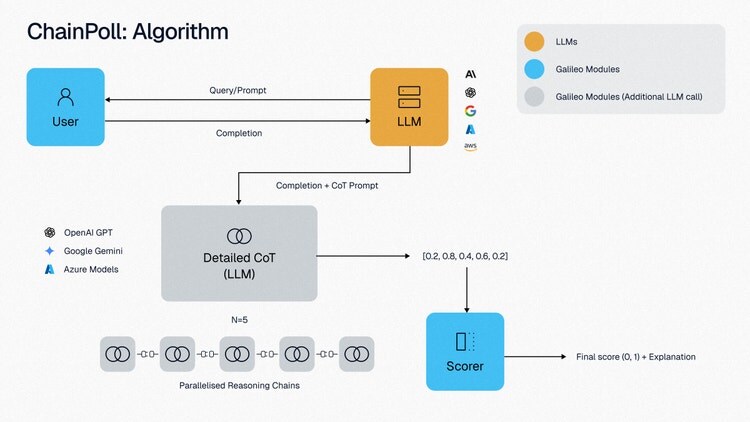
The ChainPoll approach, developed for hallucination detection, demonstrated this concretely. It combines two techniques to achieve high-accuracy hallucination detection.
First, it uses a carefully engineered chain-of-thought prompt that asks the LLM judge to write out step-by-step reasoning before rendering a verdict.
Second, it polls the model multiple times (typically three or fine) and aggregates the binary yes/no verdicts into a confidence score. If two out of three polls say "hallucinated," the score is 0.66. This aggregation captures uncertainty that a single judgment would miss.
The flow: query to the model, then the completion plus a chain-of-thought prompt fanned across five parallel chains, whose scores a scorer collapses into one 0-1 verdict.
Three design choices make ChainPoll particularly effective: it requests boolean judgments rather than numeric scores (which proved more reliable in testing), it places the reasoning before the verdict (so the answer can leverage the explanation), and it uses a smaller, faster model for the accuracy gap through multiple polls.
What biases affect LLM judges?
LLM judges have systematic biases. If you don't address them, your evaluations will be systematically wrong in predictable ways.
- Positional bias. Symptom: A/B results depend on presentation order. Mitigation: randomize position, average both orderings.
- Verbosity bias. Symptom: long responses always score higher. Mitigation: add explicit instruction that length does not equal quality.
- Self-preference. Symptom: same-family models score own outputs higher. Mitigation: use a different model family for the judge.
- Recency bias. Symptom: early conversation turns get ignored. Mitigation: evaluate the full conversation or score per turn.
- Format bias. Symptom: formatting changes affect scores. Mitigation: normalize format or add diverse examples.
How to configure an LLM judge
LLM judges have multiple configuration dimensions. Each involves tradeoffs.
Model selection: Reasoning vs. non-reasoning
Reasoning models produce more thorough evaluations but cost more and take longer. Rule of thumb: if your evaluation criteria can be stated in a single sentence, you don't need a reasoning model.
Scope: Where to apply the judge
Session level evaluates entire multi-turn conversations; trace level, single interactions; LLM span, individual model calls within a larger workflow; retriever span, RAG retrieval quality before generation; tool span, tool call correctness in agent systems. Start with trace-level evaluation for most use cases.
Output type: Choosing the right scale
Boolean for clear pass/fail criteria and compliance checks; categorical for multiple distinct outcomes (Correct / Partially Correct / Incorrect); discrete 0-5 when you need granularity but want a bounded scale; percentage 0.0-1.0 for confidence scores and partial credit. Boolean is almost always the right starting point.
Reasoning: Chain-of-thought vs. direct
Chain-of-thought (CoT) prompting asks the judge to explain its reasoning before the verdict. The cost: more tokens and higher latency. Use CoT for development; consider direct evaluation in production if you're confident in accuracy.
Precision vs. recall
Prioritize recall for safety and compliance, where you can't afford to miss real violations; precision for cost optimization, where you don't want false alarms triggering expensive reviews; and F1 for general quality, to balance between missing issues and over-flagging.
How to create custom evaluation metrics
One barrier to good evaluation is the perception that custom metrics are hard to build. They're not. Modern evaluation frameworks make it trivial to go from a prompt idea to a running metric.
from splunk_ao.evaluators import create_custom_llm_evaluator, OutputTypeEnum, StepType
evaluator = create_custom_llm_evaluator(
name="Financial Compliance Check",
user_prompt="""You are an impartial evaluator assessing whether AI responses
provide information without giving investment advice.
A response PASSES if it contains only factual information and does NOT
recommend buying, selling, or holding any specific investment.
A response FAILS if it recommends specific investments or timing.
Response to evaluate: {output}
First explain your reasoning, then provide your verdict (PASS/FAIL).""",
node_level=StepType.llm,
output_type=OutputTypeEnum.BOOLEAN,
model_name="gpt-4.1-mini",
cot_enabled=True,
num_judges=3
)
That's it. No infrastructure to set up. No models to fine-tune. No complex configuration.
Challenges when scaling LLM judges
Building LLM judges that work in demos is easy. Building ones that work in production is harder.
Rate limits at scale
With multi-judge polling, you hit rate limits 3x faster. Implement exponential backoff with jitter. Use separate API keys for evaluation vs. production traffic. Cache verdicts for identical inputs using content hashes. Set timeouts and handle partial failures gracefully rather than failing entire batches.
Long context overflow
Your system prompt, criteria, few-shot examples, and the content being evaluated can exceed the context limits of the model. Calculate your token budget upfront and reserve space for prompt, examples, and reasoning output. For long responses, summarize or chunk before evaluation.
Pipeline integration
The cardinal rule: never run evaluation in the request path. Evaluations should happen asynchronously via message queues, completely decoupled from production latency.
Cost management
Teams routinely find evaluation costs exceeding production inference costs. Use cheaper models for obvious cases and reserve expensive models for edge cases and disagreements. Set hard budget limits with alerts before you get surprised.
Version drift
Your judge prompts, models, and criteria evolve. Without discipline, historical metrics become incomparable. Version your judge config and prompt in git, not through ad-hoc edits. Log prompt version with every verdict.
Conclusion
LLM-as-Judge is Stage 1 of the eval engineering lifecycle. It gets you from no evaluation to 60-70% accuracy quickly. The techniques in this post can increase accuracy to 80%, which is not yet production-ready for most use cases. To reach 90%+ accuracy, you need human expertise in the loop. The next stage, SME Refinement, is where generic becomes domain-specific.
FAQs about LLM judges
Related Articles

Software Liability Explained

Metadata 101: Definition, Types & Examples