Managed Security Service Providers (MSSPs) Explained: Benefits, Core Services, and Industry Growth
Key Takeaways
- MSSPs provide 24/7 outsourced monitoring, management, and incident response to strengthen cybersecurity posture.
- Organizations rely on MSSPs to address cyber skill shortages, improve resilience, and maintain compliance with evolving regulations.
- The MSSP market continues to grow as AI-driven threats and digital transformation increase the demand for specialized security expertise.
With digitization and AI at the top of mind for every corporate leader, the cyber landscape has only become more complex—organizations often struggle to manage cyber risks effectively. This has been further compounded by cybercrime sophistication, cyber skills gaps, supply chain interdependencies, emerging technology and geopolitical tensions.
According to the World Economic Forum’s 2025 Global Cybersecurity Outlook, these factors have exacerbated cyber inequity:
- Some 35% of small organizations surveyed believing their cyber resilience is inadequate.
- Two out of three organizations reporting moderate-to-critical cyber skills gaps.
Managed Security Service Providers (MSSPs) have become one of the means by which organizations can cover these gaps: through external parties with the technical and human resource capabilities desperately needed.
What is a managed security service provider?
A Managed Security Service Provider (MSSP) is a third-party organization that offers outsourced monitoring and management of security systems and devices to businesses, aiming to enhance their cybersecurity capabilities.
Gartner defines MSSPs as specialized entities who provide outsourced monitoring and management of security devices and systems. This work is accomplished via 24/7 security operation centers (SOCs), and are designed to reduce the number of operational security personnel that would be hired.
An MSSP is seen as a cost effective option to offload cybersecurity operations to a partner who will:
- Keep up with the threat landscape.
- Provide required expertise during a cyberattack.
This allows the organization to focus on more strategic tasks such as product development, marketing and customer service, while leaving the operational tasks of continuous monitoring and response to various threat elements in the hands of experts.
Outsourcing services? Learn the difference between managed services and professional services >
Offerings and services from MSSPs
According to a 2025 ENISA analysis on the managed security service market, organizations (supply side) rely on MSSPs to mitigate a wide range of cyber threats, especially malware, phishing attacks, and advance persistent threats (APTs).
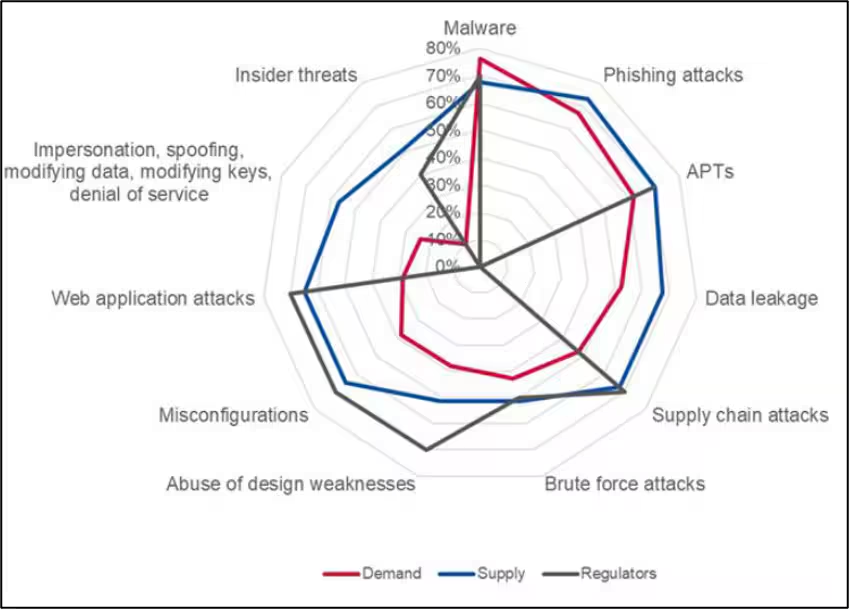
Relevant Threats Reduced through Managed Security Services (Source: ENISA)
While MSSPs come with many different capabilities, the primary demand from client organizations is in the form of cybersecurity monitoring and incident response services. Additionally, many offer a suite of other services that can augment the primary offerings. Let’s look at the most common options:
SOC services
This is a security operations center which is staffed by a team of IT security professionals dedicated to round-the clock monitoring of the client’s IT infrastructure and services, and responding to cybersecurity incidents.
The SOC teams use specialized tools to observe connections, transactions, accesses, and other areas of interest, detect and quickly respond to evolving vulnerabilities and threats. To do this, the SOC handles:
- Maintaining an inventory of the client’s IT environment, through automated and manual discovery,
- Deploying advanced security information enterprise management (SIEM) solutions to gather telemetry, aggregate the information for analysis, and set up automated triggers for response.
They use external feeds from information sources such as vendors and government agencies to gather intelligence on cyber threats and inform clients on proactive measures to counter them. They also support the client during a cyberattack to limit damage, collect evidence such as logs, restore services quickly, and investigate and address root causes.
Security controls management
Due to their specialized security skills, MSSPs can also provide security controls management in the form of advisory and technical support to identify, procure, implement, and manage security controls. This includes conducting cybersecurity risk assessments and identifying solutions to treat the identified risks.
Examples of controls that MSSPs can support their clients acquire and implement include mobile device management solutions, anti-malware solutions, perimeter defense solutions, and patch management solutions. The MSSP can typically either:
- Fully administer these security controls on behalf of their clients.
- Support the client’s IT teams to get the most out of them through knowledge sharing and handholding.
Staff augmentation
Staff augmentation is an outsourcing model where the MSSP provides specialized cybersecurity talent to the client on a short-term basis. They come in for particular assignments or events that the existing IT staff require higher-level expertise such as major projects, peak/critical business periods, or when there is a sophisticated cyberattack.
The MSSP staff typically have earned certifications such as CISSP and CEH, as well specialized knowledge such as digital forensics, cloud security, and threat intelligence, which the client’s staff may not have. These flexible resources can be used to help an organization to:
- Scale its competence level for a certain time when needed.
- Gauge the need to recruit such talent permanently.
VAPT services
Vulnerability assessment and penetration testing (VAPT) is a two pronged-approach to comprehensively evaluating the security posture of a client. An MSSP can offer this service as a trusted partner who understands the client’s security layers, and has experience dealing with different attack vectors and security control flaws.
A VAPT service will involve leveraging automated tools, configuration checks, and social engineering techniques to identify and exploit security vulnerabilities in the client’s infrastructure and applications, whether on-premises or in the cloud. The output from this exercise is a detailed, actionable report — recommendations that the MSSP can support in implementing.
Additional services: strategic, operational, educational, etc.
Apart from the listed services, the MSSP can also provide capacity in other cybersecurity related consultancy services such as:
- Cybersecurity strategy formulation.
- Guidance in security tools acquisition and implementation.
- IT security staff awareness on evolving cyber threats.
- Compliance support towards meeting regulatory requirements such as CMMC, ISO 27001, PCI-DSS, or GDPR among others.
These value-added services can be obtained as a package or customized to meet the specific needs of an organization.
MSSP industry trends
The MSSP industry is expected to continue growing, driven by digital transformation strategies, the evolving threat landscape, and stricter regulations regarding information security and data privacy.
As enterprises look for cost-effective solutions to address skill limitations, compliance pressures, insider threats, and AI powered cyberattacks, MSSPs can be considered as a valuable ally in aiding organizations to bolster their security posture and meet security stakeholder needs. But even as businesses consider onboarding MSSPs, they must remain cognizant of challenges involved including lack of clarity in aligning objectives, shortage of internal skills to comprehend the outputs from the MSSP, and integration challenges with MSSPs’ tools and processes.
There is need for organizations to put in place comprehensive governance measures to address these challenges and maximize the value that comes from improved IT service resilience attained from working with MSSPs.
FAQs about MSSPs
Related Articles

How to Use LLMs for Log File Analysis: Examples, Workflows, and Best Practices

Beyond Deepfakes: Why Digital Provenance is Critical Now

The Best IT/Tech Conferences & Events of 2026

The Best Artificial Intelligence Conferences & Events of 2026

The Best Blockchain & Crypto Conferences in 2026

Log Analytics: How To Turn Log Data into Actionable Insights

The Best Security Conferences & Events 2026

Top Ransomware Attack Types in 2026 and How to Defend