What Are IT Services? Defining, Designing, Delivering, & Supporting IT Services
Learn Joseph NduhiuThe modern enterprise grapples with twin challenges:
- Ensuring their organization stays ahead through innovation.
- All while maintaining their existing products and processes sustainably and efficiently.
Achieving this requires well-managed IT services that are now seen as critical enablers for organizational success, with most businesses firmly entrenching digital transformation as one of the priority strategic objectives.
In this article, we will explore what these IT services are, and what the most effective way to manage them is.
What are IT services?
Let’s start with a definition from Gartner:
IT services include the information created, managed, and used in the course of service delivery/ provision and service consumption, coupled with the technologies that support and enable that service, including but not limited to:
- Enterprise or personal systems and devices
- Cloud computing
- Artificial intelligence
Put simply, IT services are all the apps, software, and various pieces you use to accomplish a variety of tasks.
Nowadays, most business operations and services — customer service, transaction processing, and logistics — depend heavily on IT services. This reliance implies something very important: that IT service providers must have a keen understanding on:
- The business value being generated by new and existing services.
- How to deliver these services in an agile and cost-effective manner, while addressing any risks that may impact their availability and performance.
Categories of IT services
So, now we understand that businesses run on dozens, hundreds, maybe thousands of IT services. Surely, they are not all the same. Indeed, the manner in which you categorize IT services will vary widely across organizations (but should be clear within your organization). That’s because it all depends on various and unique parameters.
A typical categorization approach is defining the type of IT service by its constitution that is –the type of service it is: hardware, software, user support etc. Other approaches depend on:
- The mode of provision: insourced or outsourced).
- How the service is presented to users: enterprise application, mobile app, e-commerce site, etc.
The ITIL® 4 framework uses the term ‘service offering’. This is a formal description of services designed to address the needs of a target consumer group. Usually presented in a service catalog, the categorization of services includes: goods (like devices), access to resources (such as cloud subscriptions), and service actions (for example user support).
Separately, Garner identifies three categories of IT services:
Business process services
These IT services support core business activities such as e-commerce, financial management, product management, human resources, and others. They are usually hosted in workflow solutions such as ERP and CRM systems.
Application services
These IT services are productivity tools provided through software, which may be hosted locally or in the cloud, installed in end user devices and accessed over corporate networks or accessed via the internet. (Splunk is one of many examples of this.) Applications can be developed internally or be procured and customized as per need. These services often include communication, collaboration, office suites, file sharing, analytics, and other software.
Infrastructure services
These IT services are underlying components that support the previously mentioned two services. They include hardware, operating systems, system software, networks, data storage systems, and security controls.
Now we understand the variety of IT services out there — how do we build and design new ones?
Designing IT services: how to do it
When designing IT services, keep the goal of any IT service in mind: to deliver a fit-for-purpose solution that delivers value to both the providing organization and the customer in a cost-effective and resilient way.
While no solution can perfectly address all the requirements, you can use incremental and iterative approaches to ensure that an IT service is continually enhanced to adapt to evolving needs. A holistic approach to IT service design is paramount in supporting expected outcomes, and involves covering two primary areas:
- The functional elements.
- Management and operational requirements, including scalability, resilience, and compliance needs.
Using the service design package (SDP)
One common approach to holistic design is the use of a service design package (SDP). The SDP is a document defining:
- All aspects of an IT service.
- Its requirement through each stage of the service lifecycle (such as introduction, major changes, and retirement).
The SDP connects demand to value, and is independent of delivery methodology or scope of provision. It provides a clear statement of “what good looks like” to designers and consumers. An effective SDP will both:
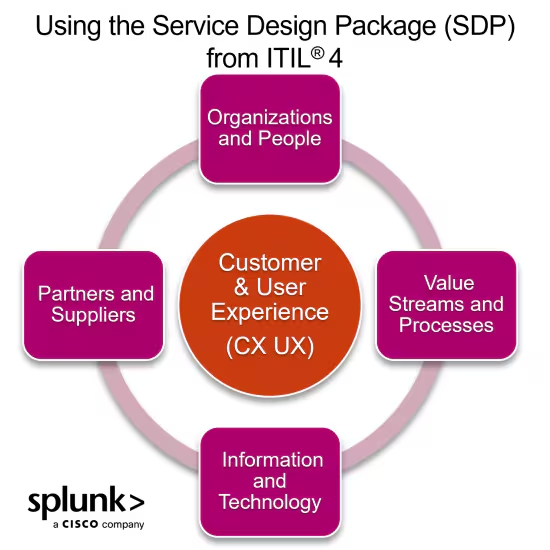
- Address all four ITIL dimensions of the service.
- Focus on the customer experience (CX) and the user experience (UX).
Let’s see what this really looks like:
- Dimension: Organizations and people. This includes the operating model and support matrix, and any training needs.
- Dimension: Information and technology. This is supported by tooling, monitoring, data management, and vulnerability management.
- Dimension: Partners and suppliers includes appropriate contracts, service integration, critical success factors, among others.
- Dimension: Value streams and processes includes the critical path analysis of IT service, and expedited processes.
Provisioning IT services
In the past, the IT function was solely responsible for provision and support of IT services for users. However, as we know, the internet, digital devices, and cloud services became available and affordable to the general populace. This led to the rise of shadow IT where employees acquire and deploy IT services that are not under the mandate of the IT function. Such IT services include alternative computing devices, for example:
- Preference for Mac OS vs. Windows
- Generative AI
- Preferred analytics tools
According to research by Cisco, 80% of end users use software not cleared by IT. And unsurprisingly 83% of IT staff admit to using unsanctioned software or services. What causes this?
The drivers for shadow IT are mainly driven by the users feeling that the IT department is an obstacle to agility, innovation, and personal preference. However, the IT function may be constrained by:
- Legacy systems
- Limited budgets
- Stringent compliance and governance requirements
This slowdown leads to business functions trying to chart their own way which comes with risks of support, compatibility, security and compliance issues arising.
Closer collaboration between IT and business users is the only way to address the friction that comes from such a dilemma. This way, you win in two areas: The IT services provided are relevant to the evolving needs of the users, and you ensure that your organization retains oversight over the IT systems and information from governance, risk, and compliance perspectives.
Supporting IT services
To effectively support users of IT services, whether internal employees or external customers, you need to create avenues to capture and fulfil user queries in convenient and actionable ways.
Customers may have questions about the existing services, desire new features, or raise complaints — knowing that, the IT service provider should provide mechanisms to handle such interactions. A common way is to deploy a request catalog.
What are request catalogs?
A subset of the service catalog, a request catalog provides details on service requests for new and existing services.
The request catalog is usually hosted as a form that is accessible via digital channels (email, mobile app, website) and managed as a workflow in a CRM or ITSM solution. The information that is usually provided in a request catalog includes:
- Description of the request
- The associated IT service to which the request belongs
- Prerequisites for request handling
- Approvals, if applicable
- Target fulfilment time (usually a function of prioritization)
Service providers may choose to capture both requests and issues using the same mechanisms. However, they should not be handled in the same fashion. As issues involve an IT service not performing or being perceived as not performing as per expectation, they require higher levels of urgency when compared to requests.
Despite this difference, providing effective support for IT services requires each user query to be logged and assigned to an owner for handling, and throughout the process there be transparency through timely and truthful communication of timeframes and status.
The state of IT services today
Somedays it seems every interaction you have relies on IT services: indeed, these are not going away any time soon. So, understanding IT services and how to categorize, design, delivery, and support then is a crucial skill for any IT/technology department today.
FAQs about IT Services
Related Articles

Snort Rules 101: Examples & Use Cases for Snort Network Defense

SQL vs. NoSQL Today: Databases, Differences & When To Use Which