What Is IoT Security? A Complete Overview
People all over the world use IoT devices for privacy-sensitive tasks, ranging from internet browsing to remote monitoring of personal assets. Just how many people? Well, an estimated 15.9 billion IoT devices are in use globally today, and the number is expected to reach 32.1 billion by 2030.
That’s why IoT security is a serious topic. Let’s examine this concern, which affects billions of users around the world who interact with or consume IoT services or use IoT devices.
What is IoT security?
IoT security is a threat protection mechanism and cybersecurity strategy that defends IoT devices connected to a network against vulnerabilities. Potential IoT security vulnerabilities include:
- Data theft (data exfiltration)
- Firmware and software exploits
- Physical tampering of devices
- Eavesdropping
(Related reading: common types of vulnerabilities.)
What does IoT security do?
The primary objective of IoT security is to preserve the integrity, confidentiality, and availability of the data, systems, and users interacting with these devices. Any security attributes apply on three levels of the technology stack:
- Tier 1: Low-level hardware or perception stack that involves data collection and measurement.
- Tier 2: Networking and communication layer stack that involves data transmission data and communication to external devices.
- Tier 3: The stack involved in interfacing and integrating with external services.
Most IoT devices operate as endpoint devices for data collection in the first tier. Thus, they can perform simplified tasks at scale. Naturally, any security loophole or defect at this level opens the door to cybersecurity threats at a minimum, or worse, a large-scale attack.
(Related reading: IoT monitoring.)
An example of IoT security
To understand the concept of IoT security better, let's take an example of a smart home security system and see what can go wrong. Such systems use various IoT devices — smart cameras, alarms, motion sensors, biometric sensors, Wi-Fi signals, smart locks — to monitor and secure your home.
But, what if any part of a given device has a vulnerability? Cyberattackers can exploit these security weaknesses and intercept the personal data that these systems transmit.
Attackers exploited a vulnerability in Amazon's Ring camera, gaining unauthorized access to several doorbell cameras and home monitoring systems. They were able to access live camera feeds, control the devices remotely, and communicate with the homeowners using speakers and microphones integrated into these devices. (Now that is scary.)
Why IoT security matters
How big is that threat, and what makes IoT security so important? Let’s take a quick look at the stats:
- The cybersecurity market: Estimated at $60 billion in 2024, the IoT cybersecurity market is expected to grow by 33.53% CAGR annually from 2024 to 2029.
- Digital wave: 18% of homes are classified as smart homes with the prevalence of advanced AI-driven voice-assistant devices, automation, and security systems.
- Industrial Digital Transformation: Industrial Internet of Things (IIoT) is leading investment trends and will influence the future of industrial businesses. IIoT has the potential to add $14.2 trillion to the global economy by 2030.
Existing IoT security standards and legislations
Governments have enacted several regulations and standards to enhance IoT security. These include:
- The EU cybersecurity act: This regulation, enacted in 2019, establishes a cybersecurity framework that manufacturers of ICT products, including IoT devices, must follow from designing to releasing the products into the market.
- The Product Security and Telecommunications Infrastructure (PSTI) Act: Enacted in 2024, this legislation requires that all connectable consumer devices sold in the UK be secured through at least the basic cybersecurity protection mechanisms.
- The Cyber Resilience Act (CRA): This mandates manufacturers to implement security standards for IoT devices.
- In the US, the National Institute of Standards and Technology (NIST) provides NISTIR 8425 standards for consumer IoT products. All IoT products that follow NIST cybersecurity standards get a label, as per the US Cyber Trust Mark program enacted in 2024.
- The Code of Practice for consumer IoT security ensures the security of IoT products by design.
- Provisions from data privacy and protection regulations, such as the General Data Protection Regulation (GDPR) and the California Consumer Privacy Act (CCPA), affect IoT.
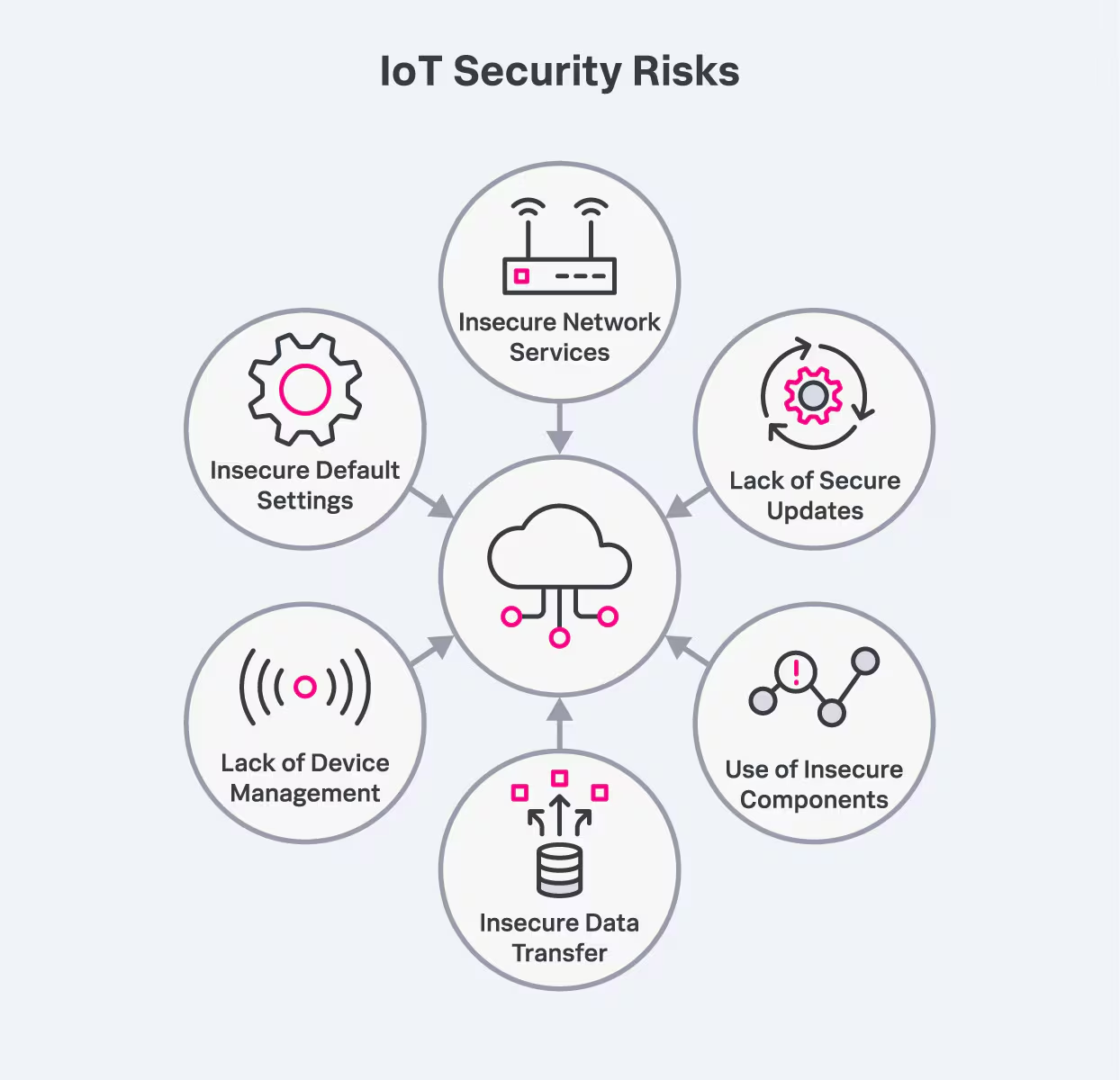
Security challenges for the IoT
Let’s evaluate IoT security challenges from the viewpoint of IoT architecture, digital transformation, and usage trends:
IoT as dumb terminals
Although a collection of IoT devices is used to discover hidden insights and unique patterns in complex real-world systems, the functionality of a single endpoint device tends to be simple, such as measuring repetitive intervals. This means that the underlying hardware and software system is also simple and not designed for any complex operation.
Exploiting a known vulnerability in these devices may not require sophisticated hacking capabilities, but the damage can affect many devices.
(Learn about endpoint monitoring.)
IoT as highly distributed and heterogeneous technologies
Due to the significant distribution of IoT devices, device manufacturers likely do not comply with universally acceptable security standards and best practices, which can lead to security vulnerabilities.
User awareness and IoT
End-users may need to be adequately aware of the consequences of sharing sensitive information via IoT devices. A user may also inadvertently transmit sensitive information over the network, especially when the devices and networks are hacked to collect information without user consent and knowledge.
Cost-benefit analysis
Business organizations may need more resources to periodically assess, monitor, and upgrade IoT devices for security improvements. Conversely, cybercriminals may exploit simple security vulnerabilities with off-the-shelf malware sold on the dark web.
An important perspective here is that the cost savings from postponing a security update that temporarily disrupts IoT network operations is far outweighed by an IoT network intrusion resulting from vulnerable IoT devices.
Market competition and IoT security
Many business organizations use real-time information as a key competitive differentiation. In doing so, they may stretch the boundaries of user privacy expectations and regulations.
Privacy by design vs. IoT security
The very thing that makes IoT devices great — they’re designed to collect information continuously and ubiquitously — is also what makes them reliable cybersecurity targets.
Unlike personal smart devices such as laptops and smartphones, which are protected by multiple layers of security at the hardware, software, and operating system levels, IoT devices are always on and can be accessed from anywhere, given access authorization.
In the case of IoT devices as dumb terminals, access controls may be limited to pin codes or network protocol verifications by interacting with external services. The endpoints themselves may fall short of the necessary features to enable privacy and security by design.
Securing the IoT: security best practices
To develop secure IoT systems, business organizations must reconsider a variety of controllable factors pertaining to IoT security.
First, consider the heterogeneous and distributed nature of IoT devices. All three tiers of the IoT technology stack — machine-level hardware, network communications, and service interfacing — should conform to the industry-proven security best practices and applicable security regulations.
Secondly, IoT data should be regulated by strict authentication and access controls, following the principle of least privilege access.
And perhaps most importantly, consider how you secure…
- Data at source— by enforcing strong access controls and regularly updating firmware for security performance improvements.
- Data in transit— using strong encryption schemes, for instance.
Below are some strategies you can use to mitigate IoT security risks.
Patch and update firmware
Firmware is commonly an insufficiently protected attack surface. Yet, cyber attackers are always looking to exploit these weak points in security to distribute malware and compromise data. Firmware updates and patches help you add new security features that fix new security vulnerabilities. By mitigating vulnerabilities, you reduce the attack surface. While you can update firmware manually, over-the-air (OTA) updates allow you to update code on connected IoT devices remotely.
(Related reading: attack surface management.)
Use digital certificates
One of the identity-first security mechanisms you can use for IoT is public key infrastructure (PKI). PKI provides digital certificates that you can use to secure device communication, code signing, and device authentication.
Specifically, you can use digital certificates to authenticate IoT devices during initial connection. This ensures that only validated devices can participate in an IoT ecosystem. You can also use these certificates to validate the authenticity of data packets transmitted in between IoT devices, preventing data tampering.
Encrypt data
IoT devices send and receive a lot of data, which enables them to work in real-time. Encryption helps prevent eavesdropping attacks by protecting this data when in transit and when stored on IoT devices. This happens with the use of encryption algorithms for IoT. They include:
- Transport Layer Security (TLS) and Advanced Encryption Standard (AES)
- Elliptical Curve Cryptography (ECC)
- Rivest-Shamir-Adleman (RSA)
- Blowfish
- Twofish
Use IoT detection services
These are subscription services that help you reduce the attack surface by monitoring and providing visibility into all devices connected to an IoT network, validating new devices joining the network, and enforcing appropriate security policies against them. These services analyze device activity patterns to detect anomalies.
Related Articles

Knowledge Graphs: What They Are and Why They Matter

Artificial Intelligence as a Service (AIaaS): What is Cloud AI & How Does it Work?

Understanding Application Lifecycle Management (ALM): Stages, Strategies, and Benefits

Top AI Trends for 2026: Key Technologies and Challenges and What They Mean

Hashing in Cryptography Explained: How It Works, Algorithms, and Real-World Uses

Understanding Network Traffic & Network Congestion: Metrics, Measurement, and Optimization

How To Monitor Data Storage Systems: Metrics, Tools, & Best Practices

Data Enrichment Strategies: How to Enhance Your Business Data for Better Insights