Load Balancing in Microservices: How It Works, Algorithms, and Modern Best Practices
Key Takeaways
- Load balancing distributes traffic across microservice instances to improve performance and reliability.
- Modern load balancers use container awareness, dynamic routing, and intelligent algorithms to adapt to changing workloads.
Modern applications rely on distributed systems that require efficiency, fault tolerance, and scalability. As organizations move away from monolithic designs, microservices introduce new challenges for managing traffic and maintaining performance.
Load balancing sits at the core of these systems — ensuring requests are intelligently routed, resources are optimized, and services remain resilient even under dynamic workloads. This article explores how load balancing works within microservices environments, the algorithms behind it, and what defines modern, intelligent approaches
What is load balancing in microservices?
Microservices are a software architecture style where applications are built as a collection of small, independent services that each handle a specific business function and communicate over lightweight protocols.
Load balancing in microservices refers to the process of distributing incoming network traffic requests evenly across multiple microservice instances to meet the required Quality of Service (QoS) standards, such as low latency, high availability, and consistent performance.
Learn more about load balancing in our complete introduction >
How load balancing in microservices works
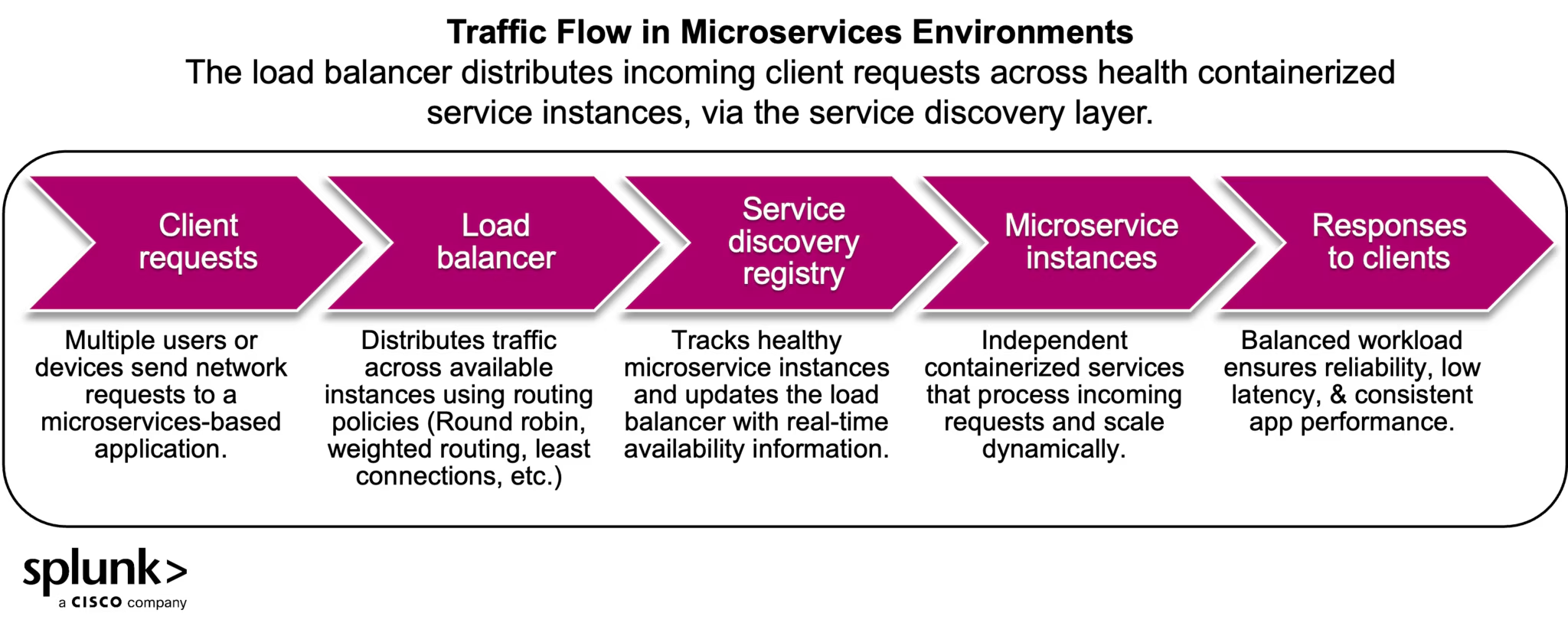
In a microservices architecture, network traffic traverses available microservice instances that may compete for workload assignment, aiming to optimize resource utilization, minimize response times, or ensure even distribution, depending on the choice of workload distribution algorithm.
Challenges of load balancing in dynamic container environments
When the QoS requirements and processing times of heterogeneous network requests are unknown, however, we’re in a challenging spot.
Traditional methods — such as DNS (which can suffer from caching delays) or hardware load balancers (which often lack the dynamic adaptability needed for ephemeral containers) — may not sufficiently balance out the workload. This can lead to a single instance becoming a bottleneck or failure point.
Containerization & the need for dynamic load balancing
In the context of microservices, virtual computing instances operate independently in containers. Containers are a standard unit of software that packages the code, dependencies, and all necessary elements to run an application component in isolation.
Containers scale dynamically. They require a fair and intelligent workload distribution mechanism, which can adapt to container churn and ephemeral lifetime.
Because containers can start and stop frequently, their network endpoints change dynamically. As a result, the load balancer must continuously update its routing tables through the service discovery layer to prevent requests from being sent to inactive or unhealthy instances. This tight integration between containers and service discovery ensures consistent performance and high availability in a constantly shifting environment.
Traditional load balancing controls struggle with the dynamic and short-lived nature of microservices container instances. This dynamic environment necessitates a more intelligent and adaptive approach, leading to the development of container-aware load balancing and service discovery.
Container-aware load balancing and service discovery
Modern microservices architectures require container-aware load balancers. Therefore, a load balancing mechanism can be introduced to continuously sync with service discovery layers (that refers to the ability to discover containers using a registry of healthy service endpoints).
A container-aware load balancer monitors in real-time and routes network requests to the healthy and available containers according to the chosen workload distribution policies.
Common load balancing algorithms in microservices
In essence, these policies may share the same fundamental distribution approach:
Round robin: Distributes requests sequentially across all healthy instances to ensure even traffic. –
- Use case: Ideal for stateless APIs or services where each request requires similar processing time.
Least connections: Routes each new request to the instance with the fewest active connections, balancing uneven workloads.
- Use case: Common for chat, streaming, or database-backed services with long-lived connections.
Resource-aware distribution: Uses metrics such as latency, CPU, memory, and failure rates to route traffic to optimal instances and remove unhealthy nodes.
- Use case: Effective for compute-intensive services like data analytics or machine learning inference workloads.
Topology-aware routing: Prioritizes the closest logical or physical container instance to minimize latency and reduce exposure to distant or malicious traffic.
- Use case: Frequently used in global applications or CDNs to improve response times for users in different regions.
Weighted service routing: Assigns configurable weights to services to gradually shift traffic, run A/B tests, or evaluate new models and routing strategies.
- Use case: Perfect for canary deployments or gradual rollouts of new versions.
IP hashing: Uses source and destination IP addresses to ensure users consistently connect to the same service instance when needed.
- Use case: Useful for session persistence in authentication or e-commerce systems.
Characteristics of modern load balancing for microservices
So, what makes a modern load balancing mechanism for microservices different? Consider the following key characteristics:
Enhanced awareness at the app layer
Traditional load balancing relies on static IP addresses or DNS and operates on the Layer 4 of the OSI model.
Load balancing in microservices operates at the Application Layer 7, using service names, HTTP/GRPC. It receives dynamic updates from the service discovery tools and can route traffic using real-time information such as paths, headers, metadata and request versions.
Policy-based and programmable routing
Modern load balancers support custom policies that account for parameters such as:
- Geographic location
- Service priority or importance
These rules can be dynamic and programmable, using simple YAML scripts or API calls by external monitoring tools.
Granular and continuous routing updates
The routing tables can continuously sync with live control systems that collect real-time updates at a very fine resolution. The collected data includes user information, IP paths and HTTP headers, service windows, individual zones.
These rules can be defined in Kubernetes, where the updates can be versioned, audited, and automated. (Think GitOps, where infrastructure and configurations are managed as code and versioned in a Git repository.)
Intelligent and observable routing
Traditional load balancing systems rely on limited metrics and fix threshold values. Load balancers in microservices, however, offer adaptive routing capabilities based on feedback loop using real-time instance parameters such as health, utilization and error rates, latency, and availability.
Typical observability metrics include request latency, error rates, instance uptime, and resource utilization. By aggregating these in monitoring tools (like Splunk Observability Cloud), teams can:
- Understand health and detect anomalies.
- Visualize trends.
- Automatically adjust routing policies based on live data.
The key idea is to route the network traffic informed with observations at runtime. This is especially suitable for microservices, as container instances run dynamically in an ephemeral state.
See all the benefits observability can deliver to your organization >
High resilience and failover mechanisms
Microservices load balancers ensure that any failure incident is isolated and recoverable. Features such as failover routing registers targets and routes the traffic only to healthy targets.
In the cloud environment, the load balancing system may register targets across zones and data centers. A fundamental routing algorithm such as a round-robin or weighted importance control system may be used to guide traffic to healthy nodes in real-time.
Future trends & innovations for load balancing microservices
Business organizations are increasingly switching from the traditional monolithic service architecture to microservices architecture. The global market for microservices architecture is expected to reach around $16 billion over the next five years. The key load balancing requirements for organizations switching to microservice design principles are focused on:
- Reliability
- Performance
- Scalability
- Cost efficiency
From an algorithmic perspective, a variety of statistical models and (relatively) simple machine learning models can significantly improve load balancing performance using data generated by the available predictive analytics and monitoring technologies.
In the near future, load balancers will increasingly use reinforcement learning (where systems learn optimal actions through trial and error) and predictive analytics to pre-empt traffic surges, automatically tune routing weights, and self-heal from anomalies without manual intervention.
Evolving to intelligent load balancing systems
As microservices ecosystems continue to expand, load balancing evolves from a static network function into an adaptive, data-driven control system.
Organizations that integrate observability, machine learning, and service discovery into their load balancing strategy gain higher reliability, lower latency, and more predictable scalability. Ultimately, intelligent load balancing is not just about distributing requests — it’s about enabling modern, resilient architectures that can adapt to change in real time.
FAQs about Microservices Load Balancing
Related Articles

How to Use LLMs for Log File Analysis: Examples, Workflows, and Best Practices

Beyond Deepfakes: Why Digital Provenance is Critical Now

The Best IT/Tech Conferences & Events of 2026

The Best Artificial Intelligence Conferences & Events of 2026

The Best Blockchain & Crypto Conferences in 2026

Log Analytics: How To Turn Log Data into Actionable Insights

The Best Security Conferences & Events 2026

Top Ransomware Attack Types in 2026 and How to Defend