Data Lake vs. Data Warehouse: Definitions, Key Differences, and How to Integrate Data Storage Solutions
Key Takeaways
- Data warehouses store structured, processed data using a schema-on-write approach for high-performance business analytics and reporting, while data lakes store raw, diverse data using schema-on-read for flexible big data analysis and machine learning.
- Data warehouses ensure consistency, reliability, and strict data quality, whereas data lakes offer scalability and flexibility to handle structured, semi-structured, and unstructured data at scale.
- Many organizations benefit from hybrid or "lakehouse" architectures that combine the governance and performance of data warehouses with the scalability and flexibility of data lakes to support a broad range of analytics use cases.
There is more data available to us than ever. Storing this data is important — but deciding on the right type of data storage solution is not so clear.
This article explores two primary types of big data storage: data lakes and data warehouses. We'll examine the benefits of each, then discuss the key differences between a data lake and a data warehouse, so you can decide on the best approach for your business.
TLDR: data lake vs. data warehouse
The general rule of thumb is in their names:
- Data warehouses are organized and more immediately useful to business needs, though with certain limitations.
- Data lakes are immense and could contain…all sorts of data, raw, unstructured — whatever!
- And we'll touch briefly on other storage, like data lakehouses, databases, and data marts.
Let’s get started!
Data lake, data warehouse, and beyond: key differences
Before we dive into the topic of data lakes and warehouses, it’s important to note that neither qualifies as a database. A database is a collection of structured data and is best utilized for storing and analyzing relatively small data sets. There can still be a lot of data (and information) stored in a database, but nothing on the scale of big data storage solutions.
Enter data lakes and data warehouses. Both solutions store a much larger amount of data than a database and both also support overall data management — but that’s about where the similarities end. There are fundamental differences between lakes and warehouses, including:
- Their overall purpose
- The types of data they collect
- How they're structured
- Who can use them
Let’s look at what each type involves...
What is a data lake?
A data lake is a large repository that stores huge amounts of raw data in its original format until you need to use it. There are no fixed limitations on data lake storage. That means that considerations — like format, file type, and specific purpose — do not apply. Data lakes can store any type of data from multiple sources, whether that data is structured, semi-structured, or unstructured.
As a result, data lakes are highly scalable, which makes them ideal for larger organizations that collect a vast amount of data. Data lake solutions are appealing as they act as a place to temporarily store data without the need to transform the data first. When specific data is needed, it can then be queried and analyzed in virtually any way you choose.
Data lakes across different industries
Being highly versatile, data lakes have a wide range of use cases across multiple industries. This includes:
- Retail: To personalize user experiences, data lakes can be used to collect data from supply chain operations, customer interactions, and point of sale systems.
- Healthcare: For research and patient data analysis, data lakes can store unstructured medical data, genomic data, and images.
- Entertainment: OTT platforms can use data lakes to manage huge volumes of audio, video, and metadata for recommendation engines.
- Finance: Data lakes are used in fraudulent transaction detection, financial risk management, and analyzing stock market trends.
- Manufacturing: Data from IoT devices can be monitored for optimizing processes and predictive maintenance.
Although data lakes and warehouses offer powerful storage solutions, for effective data management and extraction, we need robust operational practices. (This is where DataOps becomes useful.)

What is a data warehouse?
In contrast to the limitless realm of data lakes, data warehouses store large amounts of structured data that is filtered and organized for a specific purpose.
As with data lakes, data in a data warehouse is also collected from a variety of sources, but this typically takes the form of processed data from internal and external systems in an organization. This data consists of specific insights such as product, customer, or employee information.
With their rigid structure, the queries and analysis that can be performed using data warehouse information is fixed. Businesses have been traditionally drawn to data warehouses due to the ease of sharing department-specific data and content to guide decisions made by management teams. A well-known data warehouse is Snowflake, but there are several others including from the Big 3 cloud service providers.
Multi-tier data warehouse architecture
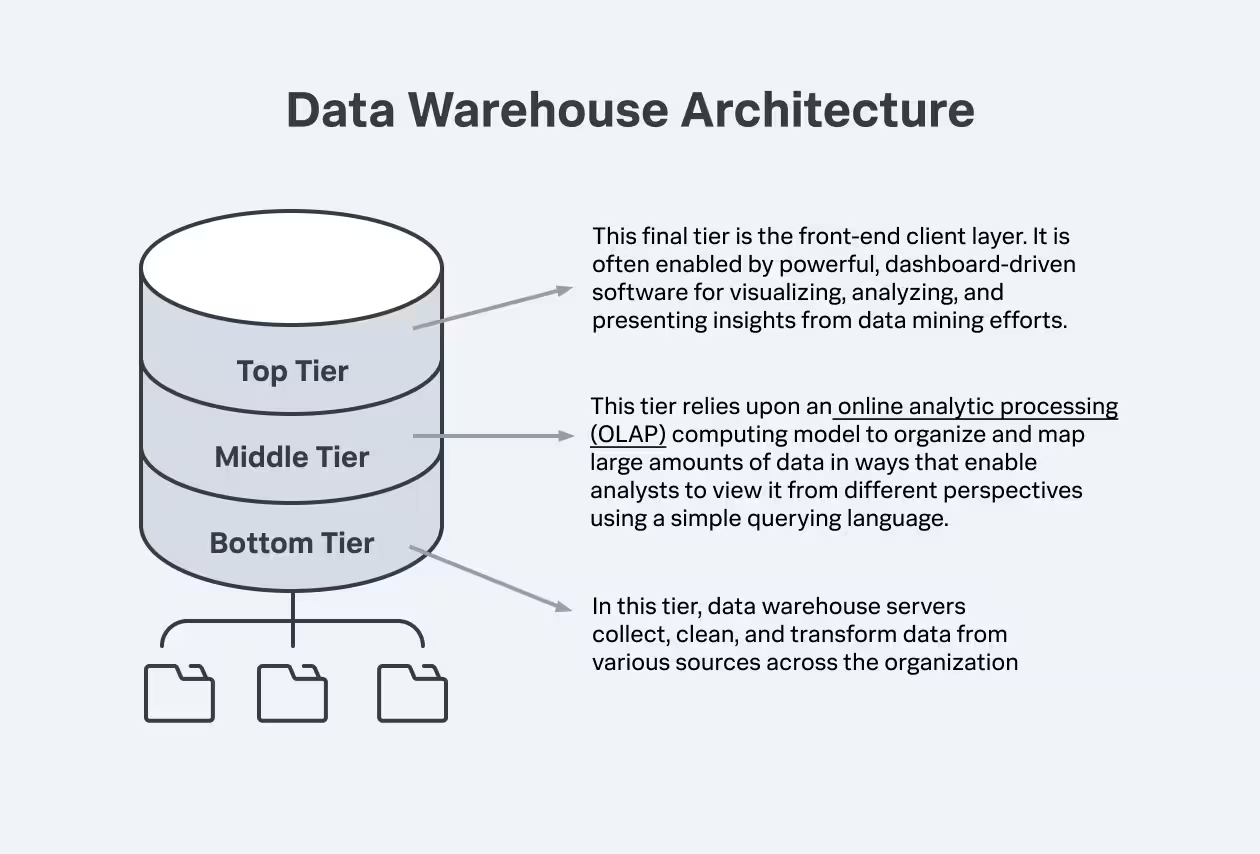
Typically, data warehouses utilize single-tier, two-tier or three-tier architectures. The objective of a single-tier approach is to minimize how much data is stored. A two-tier approach separates physically available sources from the data warehouse. Because it is not expandable and struggles to support large numbers of users, it is not commonly employed.
The most popular approach is the three-tier architecture, which includes:
- Bottom tier: In this tier, data warehouse servers collect, clean, and transform data from various sources across the organization. Metadata is created during transformation to speed search and query. Meanwhile, ETL processes help aggregate the processed data in standardized formats.
- Middle tier: This tier relies upon an online analytic processing (OLAP) computing model. OLAP organizes and maps large data volumes in ways that enable your data analysts to view it in different ways using a simple querying language. For instance, if a cyber insurance industry analyst asks a system to compare the number of cyberattack claims in Florida and Louisiana during May and October, this layer would make it possible to retrieve the data more quickly and efficiently.
- Top tier: This final tier is the front-end client layer. It is often enabled by powerful, dashboard-driven software for visualizing, analyzing, and presenting insights from data mining efforts.
What about data lakehouses & data marts?
Let's talk briefly about two more data storage options that are growing in use.
Data lakehouses: best of both worlds
Data lakehouses combine the management and performance capabilities of data warehouses with the scalability of data lakes. This hybrid approach that will enable you to:
- Handle diverse types of data, because lakehouses can support semi-structured, structured, and unstructured data.
- Reduce management and infrastructure costs since separate architectures are no longer required.
- Facilitate machine learning, AI, and analytics with advanced workloads and unified storage for big data.
By 2025, usage of data lakehouses is expected to dominate more than 50% of workloads related to analytics. Being driven by their ability to reduce costs and simplify data management. Platforms like Snowflake, Google BigQuery, and Databricks are leading innovations in this domain.
Data marts: specialized and focused
A subset of data warehouses that will allow your team to access relevant datasets without the pain of dealing with an entire complex warehouse. It is a great solution for you if you are looking to enable self-service analytics for individual departments. Like:
- Finance: Tracking expenses and forecasting budgets.
- Operations: Monitoring operational efficiency and supply chain.
- Marketing: Analyzing the behavior of audience, campaign effectiveness and insights from a customer's journey.
With all this data being stored, you might want to think about the observability of that data and the systems it supports. Observability answers the question: “What is happening inside this app or across a system?” Today, successful enterprises harness various data storage along with robust observability practices for cutting-edge, real-time data management.
Data lake vs. data warehouse: The 6 main differences
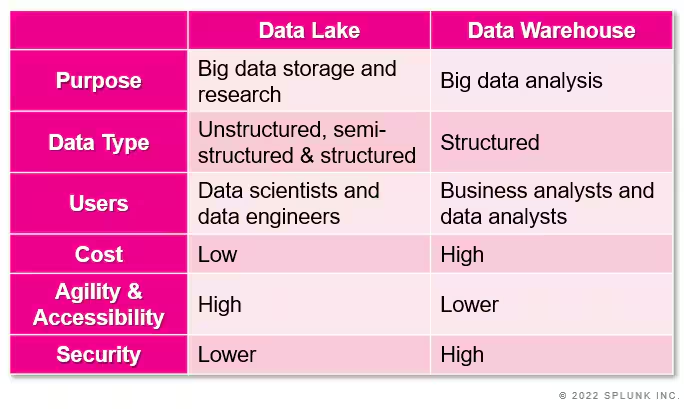
You’re probably seeing how the uses and practicalities of data warehouses versus data lakes can differ considerably. To help expand our understanding of the core differences between a data lake and a data warehouse, let’s break down each solution into six comparative points:
- Purpose
- Data structure & schema
- Users
- Cost
- Accessibility and agility
- Security
Purpose/use case
Data within a warehouse is refined in order to be used for a specific purpose — perhaps log and event management, sales reporting or security analysis. In contrast, raw data in a data lake does not yet have a particular purpose but is retained in case it is deemed relevant for future use. (This approach, however, does come with longer-term hazards about the cost and sustainability of storage, when we already know that only 10% of collected data is actually used and applied.)
There can be an overlap in how both solutions work together in a company’s data pipeline. Most enterprise data will end up in data lake storage, but if there is a specific business request, relevant data can be extracted, filtered, and refined. This new, processed data can then be exported into a data warehouse.
Data structure & schema
Data warehouses only store structured, refined data, whereas data lakes can store any form of raw data: unstructured, structured, and semi-structured.
More specifically: In data lakes, schema refers to the organization and structure of the data stored in the lake. That means a data lake does not impose a strict schema on the data it contains. Instead, data is stored in its native format, and the schema is applied when the data is queried or analyzed. This is known as schema-on-read, which allows for more flexibility and agility in data processing, as new data can be added to the lake without requiring a pre-defined schema.
In contrast, a data warehouse typically uses a pre-defined schema to organize and structure the data, known as schema-on-write. The schema is designed to optimize query performance and ensure data consistency.
Data is typically transformed and cleaned before being loaded into the warehouse to conform to the schema. This approach provides greater control over the data and can lead to better query performance, but it can also be more rigid and less adaptable to changing data requirements. Basically, when it comes to data structure, we can sum it up like this:
- A warehouse is a home for processed data.
- A data lake can house any type of unfiltered data from multiple sources.
(Read about ETL, data normalization and, yes, even data denormalization.)
Users
Another differentiating factor of data lakes vs. warehouses is the user. Who is using which storage?
- A data warehouse can usually be set up and interpreted by a data analyst or business analyst, providing that they have an awareness and knowledge of the functions/outcomes of that specific processed data set.
- Data lake solutions are more complex due to the vast quantities of unstructured data present, which requires the specialist knowledge of a data scientist or data engineer. These professionals are able to interpret and organize unprocessed data before it can be analyzed, which requires employing and/or outsourcing experts.
Cost
Data lakes are more cost-effective than data warehouses. By storing large amounts of data of any structure, they are more flexible and scalable due to the removed need for data to adhere to a fixed schema. Practically speaking, depositing huge quantities of data in one place takes away the need for filtration, which can amount to higher storage costs associated with data warehousing.
The trade-off of higher costs is the fact that structured data in a data warehouse can be analyzed more quickly and easily than data in a lake.
Accessibility/agility
As you may recognize, another difference between data warehouses and data lakes is their structural disparity:
- Data lakes are agile by nature, allowing data to be added and stored more easily. It also means that they're flexible enough for data scientists and developers to configure data models and applications, and enable tools for big data analytics.
- Data warehouses have a specific structure and are more difficult to alter. They typically have a ‘read only’ format which analysts can scan to garner insights from historical, clean data.
Security
Data lakes store petabytes of information — that’s 1,000 terabytes per unit! Their sheer size and their lack of selectivity on the data stored means that they're inherently less secure than a more compact, structured data warehouse.
In addition to this, data warehouse technology is a lot more established than the relatively new big data technologies. That is: data warehouse security is mature in comparison. Big data security measures are rapidly evolving however, so it’s likely that data lakes will eventually become more secure.
(Understand data security through the lens of cyber hygiene.)
Choosing a data lake or data warehouse
Data lakes and data warehouses are fundamentally very different storage solutions, each with their own pros and cons:
- Warehouses are more secure and easier to use, but more costly and less agile.
- Data lakes are flexible and less expensive, but they require expert interpretation and lack the same level of security.
When do you use which? Using the two in tandem is often a sensible strategy for businesses. If there’s an existing data warehouse in operation, then implementing a data lake to store new data sources could be the most valuable option. That way, a data lake can act as both an information bank and an archive repository of the data moved out of a warehouse.
Some enterprises choose a data lake over a warehouse model because of its increased capacity and agility but be considerate of this approach. As the newer of the two solutions, there is more scope for unprecedented errors than with a data warehouse, amidst other factors such as:
- Data latency
- Data overindulgence
- Regulatory issues
How data warehouses and lakes pair with enterprise technology
Another angle to consider when choosing data storage is to understand how the storage will or will not integrate with different types of technologies, tools, and platforms:
- Data warehouses are grouped with relational database technologies because of their ability to query structured data at a high speed. The evolution of relational database models (for both software and hardware) will enable data warehouses to be faster, more reliable, and ultimately more scalable.
- Data lakes benefit more from big data technologies, particularly those that can enhance data lake analytics. Programs like Hadoop can process large quantities of data in any format, promoting the adaptability and scalability of a data lake. In addition to this, Hadoop can apply structured views to unprocessed data in a warehouse.
- Cloud solutions also shape data storage methods. Organizations like Amazon S3, Google, and Azure Data Lake offer cloud management services for data lakes. Data warehouse companies are also improving the customer cloud experience which will facilitate a better way to buy and expand a warehouse at a much lower cost.
- Machine learning is improving data warehouse solutions. Because machine learning and AI rely on near-real-time data, which warehouses can provide, we can expect improvements in tandem technologies. When creating AI and ML models, the majority of time will be spent preparing data — the rest is execution. Data warehouses can eliminate the preparation step, which can save even more time and lead to better, more refined analytical results.
Technologies are constantly evolving and will continue to shape the role of data lakes and data warehouses, but deciding on a solution depends on your current capabilities, budget, resources, and long-term goals.
Use data wisely (we’re not all data experts)
At the end of the day, companies can only gain value from data if it drives smarter decisions. Fundamentally, any data storage strategy should address all stages of the supply chain. Specifically, it should address how to find, store, organize, aggregate, and transform data.
We should also consider our own interpretation of data. It is easy to believe numbers presented in slides or a presentation, but asking a few questions helps you evaluate the information and determine whether it deserves your trust.
The future of data storage will be shaped by innovative technologies like quantum computing, which can instantly process complex datasets. Security will also be enhanced as a result of using decentralized solutions like IPFS, which works by leveraging peer-to-peer networks. These advancements hold a great deal of transformative potential for data analytics and management.
There are advantages and disadvantages to both data warehouses and data lakes, but as we’ve explored, the best data storage solution for your organization balances efficiency with resources and requirements.
FAQs about Data Lake vs. Data Warehouse
Related Articles

How to Use LLMs for Log File Analysis: Examples, Workflows, and Best Practices

Beyond Deepfakes: Why Digital Provenance is Critical Now

The Best IT/Tech Conferences & Events of 2026

The Best Artificial Intelligence Conferences & Events of 2026

The Best Blockchain & Crypto Conferences in 2026

Log Analytics: How To Turn Log Data into Actionable Insights

The Best Security Conferences & Events 2026

Top Ransomware Attack Types in 2026 and How to Defend