Structured, Unstructured & Semi-Structured Data
Key Takeaways
- Structured data is highly organized and stored in predefined schemas (like relational databases), making it easily searchable and analyzable, but less flexible for diverse data types.
- Unstructured data lacks a predefined format or organization — examples include emails, images, videos, and social media posts — requiring specialized techniques for processing and analysis.
- Semi-structured data combines elements of both, using tags or markers like JSON or XML to provide some organization without a rigid schema, offering greater flexibility for modern data needs.
Many business organizations begin their data analytics journey with great expectations of discovering hidden insights from data. The concept of unified storage — data lake technologies in the cloud — has gained momentum in recent years, especially with the exponential options for cost-effective cloud-based storage services.
Big data is readily available, with 2.5 quintillion (2.5 x 10^18 or 2.5 billion) bytes generated every day! The challenge facing these organizations centers around the nature of this data. Big data generates in three forms — structured, unstructured, and semi-structured. Preprocess data to specifications before it is ready for analytics consumption.
In this article, we’ll look at what these data structures mean for business analytics.
What is structured data?
Structured data follows a fixed predefined format, usually in a quantitative and organized form. A great example is a database with customer names, addresses, phone numbers, email IDs, and billing information.
The pros of structured data are clear: this format can be consumed directly by an analytics tool and may not require any additional reformatting. However, this data can only be used for its intended purpose with the tools that require its schema formatting.

What is semi-structured data?
Semi-structured data is not “in-between” structured and unstructured data. Instead, this is a form of structured data that does not conform to the structure schema of databases.
Data entities that belong to the same class are instead described by metadata tags or other semantic markers that give some structure to the data assets, differentiating it completely from an unstructured data format. As an example:
- Semi-structured data could be a tab-delimited file containing data on marketing leads.
- Structured data could be a CRM database containing all customer details.
- Unstructured data could be a social media post with comments from users expressing varied interest in the product.
What is unstructured data?
Unstructured data is usually qualitative data that needs preprocessing before it can be made available to analytics tools for consumption. Examples include:
- Raw IoT data and network log data
- Audio and video data
- Social media posts
- Data generated at the machine level
In its native format, unstructured data can be stored in a unified storage repository, a data lake. It accumulates and scales rapidly — most real-time data streams are generated in unstructured format. To consume unstructured data, you have to use specialized tools and rely on expertise to give it the required structure scheme.
(Learn about normalizing data.)
Three structures of big data
Let’s explore what this means for your data analytics journey:
How structured data works
Structured data follows a fixed predefined format, usually in a quantitative and organized form. A great example is a database with customer names, addresses, phone numbers, email IDs, and billing information. Structured data typically comes from relational databases, enterprise systems, and other organized data sources.
Impact on data analytics
Pros
- Ease of use: An analytics tool can consume this format directly and may not require any additional reformatting.
- Efficiency: Structured data is easier to query and analyze using traditional data analysis tools.
- Consistency: The predefined schema ensures consistency and accuracy in data analysis.
Cons
- Limited flexibility: This data can only be used for its intended purpose with the tools that require its schema formatting.
- Rigidity: It is less flexible in handling diverse data types and may not accommodate evolving data needs.

How unstructured data works
Unstructured data is usually qualitative data that needs preprocessing before it can be made available to analytics tools for consumption. Examples include raw IoT data, network logs, audio and video data, social media posts, and data generated at the machine level. It often originates from sources like sensors, social media platforms, multimedia files, and machine logs.
Impact on data analytics
Pros
- Rich insights: Unstructured data can provide deeper insights and richer information, especially from sources like social media and multimedia content.
- Advanced analytics: It is essential for advanced analytics like natural language processing and image recognition.
- Comprehensive Analysis: It allows for the analysis of a broader range of data types, offering a more comprehensive view of business operations.
Cons
- Complexity: In its native format, unstructured data can be difficult to store and analyze.
- Resource-intensive: It requires specialized tools and significant preprocessing to structure it for analysis.
- Scalability issues: Managing and scaling large volumes of unstructured data can be challenging.
How semi-structured data works
Semi-structured data is a form of structured data that does not conform to the strict schema of databases. Data entities that belong to the same class are described by metadata tags or other semantic markers. Examples include tab-delimited files, XML and JSON documents, and data from email systems.
Impact on data analytics
Pros
- Flexibility: Semi-structured data offers more flexibility than structured data while providing more organization than unstructured data.
- Ease of parsing: It can be easier to parse and analyze compared to unstructured data.
- Versatility: You can use it for a variety of analytics applications without the need for extensive reformatting.
Cons
- Preprocessing required: It still requires some level of preprocessing and metadata management for effective usage in analytics.
- Complexity: Handling and managing semi-structured data can be complex due to its varied formats.
- Integration challenges: Integrating semi-structured data with other data types can present challenges.
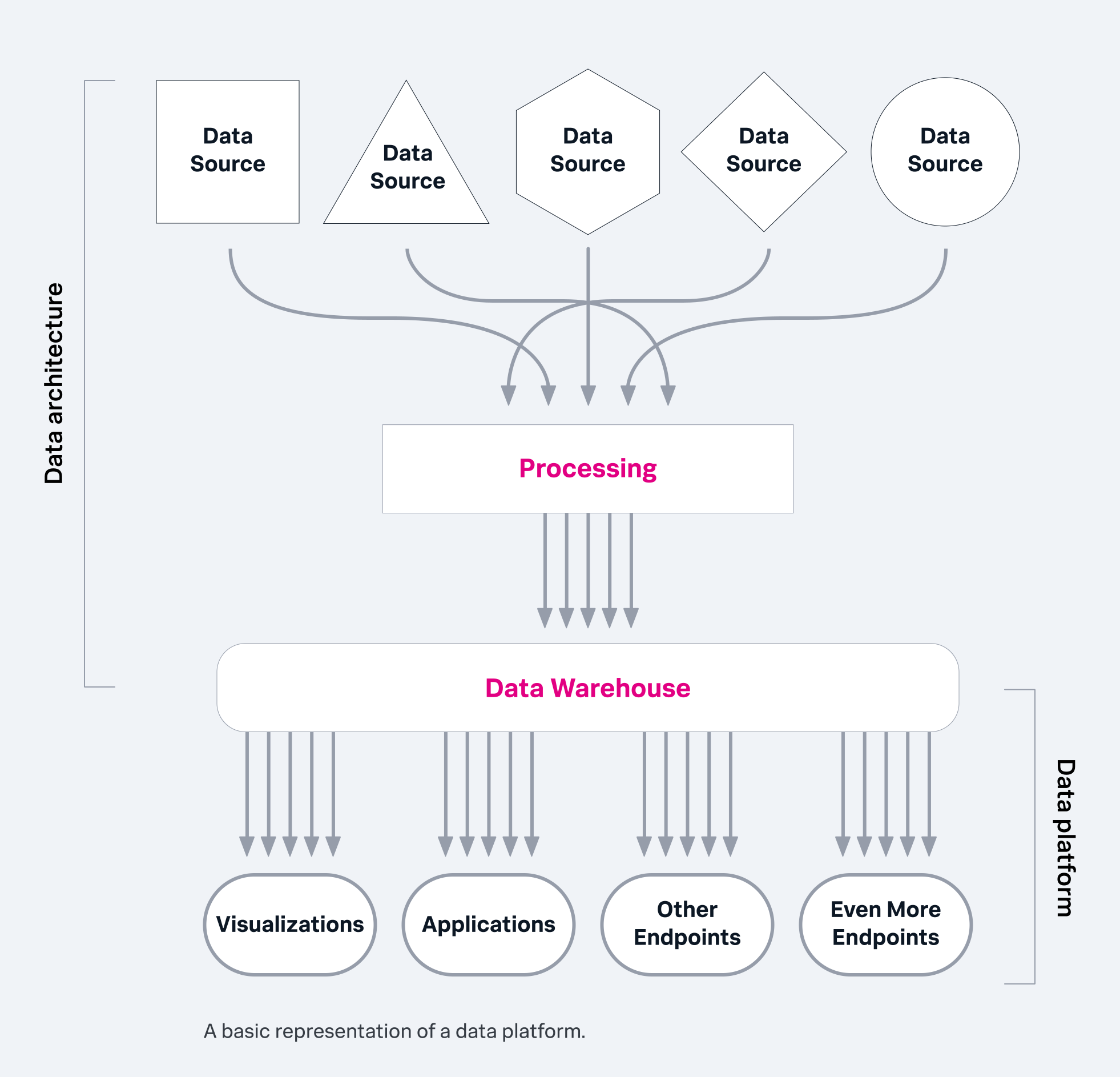
Does your data platform need structured data?
If your data pipeline is built with a data lake, you can take advantage of the flat storage architecture to source data in all formats. A pre-built schema is not required and the data can later be queried by giving it some structure as required — schema-on-read — or using the fixed order of data acquisition. Metadata tags are commonly used during the querying process, which means that a solid metadata management strategy must be in place.
The process of extracting, loading, and transforming data (ETL) should be automated and simplified to meet the scalability needs of the data platform. Since this preprocessing step only takes place when an analytics application queries the data, the data lake can handle workloads with write-heavy and read-heavy schema requirements. This means that the data platform can be flexible, scalable, and cost-effective, given the availability of low-cost cloud storage options.
This pipeline workflow incentivizes organizations to leverage data of all structures and formats while avoiding the resource-intensive schema-on-write process for real-time unstructured data streams that can quickly grow in volume.
The limits of structured data
WIth all that we've covered, you may be wondering why you shouldn't just focus on structured data that complies with the required tooling specifications? Or use a traditional data warehouse system that employs a schema-on-write method to preprocess all data before storage as required?
There's a few things to consider.
Integration and scalability
Data lake technology embodies the idea that data lakes accelerate the data analytics process, turning away no data. Data lakes load all data from source systems directly at the leaf level.
This approach gives analytics teams the freedom to access a growing pool of real-time data streams, processing only the portion of data required by the tooling. (In most cases, that portion is well under 10%.)
Flexibility
Unlike the rigid schema-based model of a data warehouse system, a data lake allows for scalable analytics operations such as:
- Integrating multiple new sources of heterogeneous and real-time data streams.
- Using tools subject to a variety of data structure specifications.
This flexibility is crucial for modern analytics environments where data types and data sources are continually evolving.
Cost and efficiency
Structured and unstructured data assets scale differently, and there may be no consistent approach to modeling heterogeneous data assets with a single schema framework.
Data lakes offer a more cost-effective and efficient solution by storing raw data in its native format, thus reducing the need for extensive preprocessing and transformation.

Practical considerations
An effective data management strategy focuses on the security, auditability, and transparency of structured, unstructured, and semi-structured data assets.
Govern and classify the data to securely manage access between relevant data consumers and data producers. This enables self-service functionality and offers the flexibility to integrate multiple third-party analytics tools. Each with its own set of schema and structure requirements.
It's clear that while structured data offers ease of use and consistency— the flexibility, scalability, and cost-effectiveness of data lakes make them a superior choice for handling diverse data types. Consequently, this approach allows organizations to leverage the strengths of all data structures, ensuring comprehensive and effective data analytics practices.
FAQs about Structured, Unstructured & Semi-Structured Data
Related Articles

What is Data Masking?

The AI Engineer Role in 2026: What Do AI Engineers Do?

What are SaaS, PaaS, & IaaS?

What Is Risk Scoring? How To Score Risk

Call Center Analytics & Metrics for Success

Call Center Optimization: The Complete Guide

Splunk Podcasts

Query Languages: A Simple Introduction