Operationalizing Observability: How To Integrate with IT’s Existing Workflows
Observability Mike SimonKey Takeaways
- Observability must be embedded into IT processes, not added as an afterthought.
- Success depends on integrating observability into workflows and fostering shared ownership. This framework shows you how to do it.
- Continuous, proactive updates are essential to keep observability effective as systems evolve.
Tooling alone is not enough — after all, you stood up the observability tooling. Dashboards are live. Alerts are firing. So why does it still feel like you’re flying blind?
Teams are drowning in noise, new tools keep appearing, and when incidents hit, observability gets blamed. The truth, however, is this isn’t a tooling problem. It’s a process integration problem.
A common anti-pattern: Bolt-on observability
Instead of building observability into how teams plan, ship, and operate, observability is often bolted on after the fact. This is the wrong approach. In that scenario, incidents still surprise people. Leadership expects answers but gets excuses. Assets go stale. What started as a visibility dream becomes an anti-pattern.
Instead, observability must be ingrained into IT processes. Change management, incident response, and release planning should prompt questions like:
- What observability tasks belong here?
- Do we need suppression rules, new telemetry, or dashboard updates?
These aren’t extras, they’re essential.
The cost of stale visibility
When observability is bolted on or doesn’t adapt to change, it breaks. A maintenance window without suppression floods teams with noise, eroding trust. In production, coverage drifts, services shift, dependencies change. Without a feedback loop, blind spots grow…until the next incident exposes them.
That’s when someone asks: “We spent how much on observability, and it didn’t catch this?” Let me show you what this looks like in the workplace.
The real story: The missing piece that took down the portal
In a past role, our team did everything "right." New internal portal, dashboards up, alerts tuned, workflows tested. The launch went smoothly. Confidence was high...until the day it wasn’t.
A month later, a company-wide discount required portal opt-in. Early enrollments were fine. But a surge on the final day choked a backend service. The portal froze.
Synthetic tests missed it. The workflow didn’t exist at launch. In the war room, dashboards were green. Alerts were silent. Tickets piled up. Then came the escalation, straight from the VP of HR who asked: “Why are associates the ones reporting this?”
Fair question, and a damaging answer. Here’s what the postmortem revealed: observability didn’t fail. It was never updated. The business evolved. Our coverage didn’t.
Embedding observability into IT processes: Key integration points
Observability can’t sit on the sidelines. It needs to be embedded into the way your organization thinks, builds, and operates. But how do you achieve that, and where do you get started?
I’ve got you covered: Below are the most common areas where observability can, and should, show up.
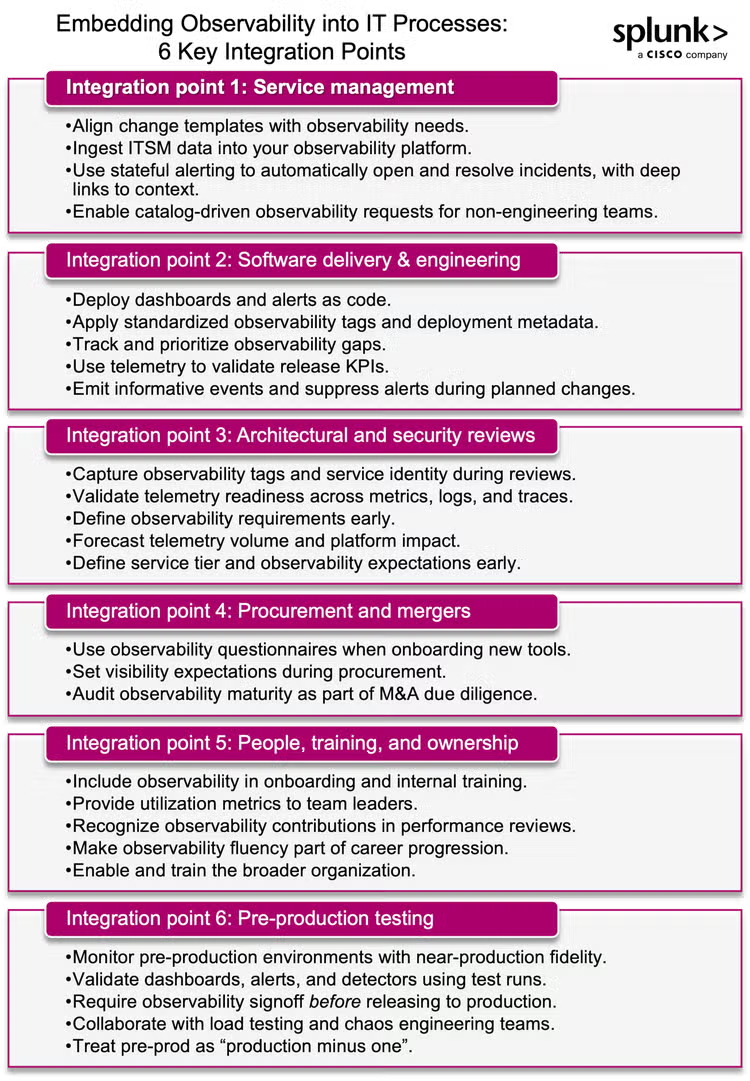
Integration point 1: Service management
Change management, incident management, and problem management are foundational to how IT operates. And observability should be just as embedded. When observability is baked into overall service management, you’ll see better accountability, context, and response quality. This observability transforms dashboards and alerts into actionable insights and valuable operations.
Integration tactics:
- Align change templates with observability needs, including required telemetry updates, validation steps, and suppression planning to prevent alert fatigue during planned activity.
- Ingest ITSM data into your observability platform. This enables correlation between telemetry and incidents, tickets, or call volume trends. Watermarking and analytics unlock rich signal amplification
- Use stateful alerting to automatically open and resolve incidents, with deep links to context. This reinforces accountability through your incident management process. Include deep links to dashboards and root cause views for faster triage
- Enable catalog-driven observability requests for non-engineering teams, just like other IT services. This means less technical teams now have a self-service path to submit form-based requirements that deploy observability as code (OaC).
Why it matters: These integrations reduce alert fatigue, correlate human-reported data with system metrics, and strengthen trust in the signals that observability provides.
Pro tip: Want to connect system behavior with real user impact? Ingest service desk data into your observability platform.
This service desk data (spikes in call volume, incident surges, or ticket classifications) enables earlier detection of issues, validates whether alerts are firing effectively, and strengthens business impact analysis by grounding it in human-reported signals.
Solutions like Splunk ITSI make it easy to bring this data into your observability workflows and correlate it alongside telemetry.
Integration point 2: Software delivery and engineering
Make observability part of the release. New code must be shipped with the visibility to support it. Observability should follow the same rigor, speed, and automation as the rest of your CI/CD pipeline.
Integration tactics:
- Deploy dashboards and alerts as code to ensure consistency and traceability. That’s OaC.
- Apply standardized observability tags and deployment metadata during CI/CD to enrich telemetry with team, service, environment, and version context.
- Track and prioritize observability gaps in team backlogs, treating them like technical debt.
- Use telemetry to validate release KPIs and confirm whether intended outcomes were achieved.
- Emit informative events and suppress alerts during planned changes to reduce noise and improve release awareness.
Why it matters: Integrating into the CI/CD pipeline prevents observability drift and ensures every service is traceable, alertable, and visible in every environment.
Integration point 3: Architectural and security reviews
Design for observability up front. That’s because early observability decisions shape long-term success. Design reviews should include requirements for telemetry, tagging, and alerting readiness — all before go-live.
Integration tactics:
- Capture observability tags and service identity during reviews, including logical service, application, component, and critical user journeys to inform dashboards, alerts, and synthetics.
- Validate telemetry readiness across metrics, logs, and traces, especially for new languages, patterns, or tech stacks that may require new instrumentation or standards.
- Define observability requirements early, including key attributes, technologies in use, planned go-live dates, and responsible stakeholders. Validate that platform capacity and pipelines can support the expected telemetry and observability objectives.
- Forecast telemetry volume and platform impact, including log growth, agent deployments, and licensing requirements for application performance monitoring (APM) or real-user monitoring (RUM). Use established observability KPIs to track and plan ahead.
- Define service tier and observability expectations early, ensuring the planned monitoring aligns with your tiered observability offering before promotion to production.
Why it matters: Observability-ready design avoids retrofitting and helps teams launch with clarity and insight from day one.
Integration point 4: Procurement and mergers
Do not buy blindly. Do not integrate blindly. Rapid procurement and acquisitions often lead to tool sprawl, telemetry gaps, and vendor lock-in. Build observability into both the evaluation and onboarding process to maintain visibility and scale with confidence.
Integration tactics:
- Use observability questionnaires when onboarding new tools. This captures details like telemetry sources (logs, metrics, traces), critical user journeys, health check endpoints, status page availability, and logging architecture.
- Set visibility expectations during procurement, ensuring vendors support your observability stack, provide relevant data, and meet operational transparency standards.
- Audit observability maturity as part of M&A due diligence, identifying how the acquired tech stack fits into your standards and where it introduces gaps. Feed this insight into the Observability Center of Excellence to drive remediation, rationalization, and integration planning, including the alignment of tools with your golden set and deprecation of redundant platforms.
Why it matters: You can reduce tool sprawl, standardize telemetry, and ensure every platform supports your observability objectives.
Integration point 5: People, training, and ownership
Don’t leave observability to the tool admins! Observability success depends on people, not just platforms. Without ownership, enablement, and ongoing engagement, even the best tooling becomes shelfware. From onboarding to performance reviews, visibility must be seen as a shared responsibility.
Integration tactics:
- Include observability in onboarding and internal training, ensuring new hires learn early how to interpret and interact with dashboards, alerts, and telemetry.
- Provide observability utilization metrics to team leaders, such as dashboards created, detectors authored, and tool logins, to help gauge adoption and inform coaching
- Recognize observability contributions in performance reviews, highlighting impact, innovation, and shared accountability
- Make observability fluency part of career progression, with senior and principal technologists expected to demonstrate hands-on, self-service observability skills
- Enable and train the broader organization, extending vendor-provided training resources across teams and working with vendor account managers to distribute product updates and best practices to the right personas.
Why it matters: This builds a culture of observability and spreads ownership beyond the platform team.
Integration point 6: Pre-production testing
Don’t wait for things to break in prod. Pre-production is your dress rehearsal: it’s just as complex as the real world. Pre-production testing environments, where you performance test, QA, and chaos test, are prime spots to surface risks early and validate observability coverage before code reaches customers.
Yet these environments are often under-monitored, leading to missed opportunities and last-minute surprises.
Integration tactics:
- Monitor pre-production environments with near-production fidelity, including logs, metrics, traces, and synthetics.
- Validate dashboards, alerts, and detectors using test runs, ensuring they reflect expected behavior under both normal and degraded conditions.
- Require observability signoff before releasing to production, including verification of telemetry coverage, alert readiness, and tagging completeness.
- Collaborate with load testing and chaos engineering teams to validate end-to-end observability, confirming that telemetry is collected properly, alerts fire, dashboards reflect reality, and synthetics detect issues under pressure.
- Treat pre-prod as “production minus one”, applying observability tiering expectations to enforce consistency and ensure visibility aligns with service criticality.
Why it matters: Proactive testing in pre-production environments reveals gaps early, improving confidence and reducing incident impact.
Pro tip: Let the observability CoE lead the charge. The Observability Center of Excellence (CoE) is your operating model for cross-functional success. Use it to:
- • Drive executive alignment and prioritization.
- • Embed observability into IT and business workflows.
- • Scale standards, automation, and education.
The tooling is just the beginning. Lasting change requires aligning people and processes — that’s the difference between shelfware and strategic impact.
Call to action: Start embedding, not just instrumenting
If you’ve made it this far, one thing should be clear: Observability can’t sit on the sidelines. Observability must be embedded into planning, building, and responding — not added later. Audit your seams. Embed observability where it influences, not just where it reacts.
Don’t wait for the next incident to expose the gap. Make observability proactive.
Explore more: Check out our Building a Winning Observability Strategy series to learn how to establish an Observability Center of Excellence and drive sustainable, scalable practices.
Ready for hands-on work? Start your free 14-day trial of Splunk Observability Cloud right now: it’s easy!
FAQs about Operationalizing and Embedding Observability into IT Workflows
Related Articles
Managing IT Just Got Easier: Introducing the New Splunk App for Content Packs
How to Configure the Opentelemetry Collector to Begin Collecting Metrics