SRE Metrics: Core SRE Components, the Four Golden Signals & SRE KPIs
Learn Chrissy Kidd , Stephen WattsKey Takeaways
- The Four Golden Signals — latency, traffic, errors, and saturation — are core metrics for monitoring and maintaining system health in SRE practices.
- Tracking these signals alongside SLIs, SLOs, and SLAs within a unified framework enables teams to set clear targets for performance and availability.
- Integrating these metrics into an observability platform with alerting and reporting allows for rapid detection, troubleshooting, and continuous improvement of user experience.
SRE (site reliability engineering) is a discipline used by software engineering and IT teams to proactively build and maintain more reliable services. SRE is a functional way to apply software development solutions to IT operations problems.
From IT monitoring to software delivery to incident response, site reliability engineers focus on building and monitoring anything in production that improves service resiliency without harming development speed.
Often used as a highly integrated method for tightening the relationship between developers and IT teams, the biggest roles for SREs is twofold:
- To improve a system's overall resilience.
- To provide visibility to the health and performance of services across all applications and infrastructure.
Site reliability engineers write code to improve service resilience and flexibility. Then, they help spread information across DevOps and business teams, encouraging a blameless culture focused on workflow visibility and collaboration.
How do these teams know they're achieving their goals? In this article, we'll take a look at the core components of SRE, including metrics, the Four Golden Signals of Monitoring, and KPIs to help you track progress.
Brief lookback: origins of Site Reliability Engineering
First, let's start with a little background on how and why SRE has become so important today, starting with ITSM...
The traditional approach to service management
IT service management (ITSM) has existed since the beginning of computers. System administrators (sysadmins) would handle everything from assembling software components to deploying them and responding to incidents. Then, with the introduction of personal computers, IT professionals needed to define universal principles for reliably handling applications and infrastructure.
The growing adoption of technology gave way to the IT service management practice, often harnessing ITIL, a set of defined rules for all IT operations. For a while, defined rules worked well. Software developers wrote the code and gave it to sysadmins who configured and deployed the services. However, this proverbial fence led to a natural division of labor between software developers and sysadmins.
Then, with the birth of the Internet and highly complex, integrated systems, Agile software development practices, and CI/CD became a necessity. In order to keep up with the faster delivery of always-on services, IT service management practices also needed to change.
Enter DevOps
DevOps was adopted in response to the shift in development and release practices. DevOps is a method for:
- Tightening feedback loops.
- Improving collaboration between software developers and IT operations.
A DevOps methodology gets IT teams involved earlier in the software delivery lifecycle (SDLC) while also increasing developer accountability for services in production.
With the faster delivery of more complex applications and cloud infrastructure, teams needed a way to proactively address reliability concerns, leading to the creation of the modern practice of SRE. However, this also came with additional requirements for SRE — to learn Docker and Kubernetes to fit in today's cloud-native environments.
(Related reading: SRE, DevOps, platform engineering, what's the difference? )
The origin of SRE metrics
The discipline of site reliability engineering originates at Google. They used SRE to make a shift towards an IT-centric organization, aligning everyone across the business — from engineering to sales. Google’s then VP of Engineering, Ben Treynor, defined SRE as:
Google started to treat issues that were normally solved manually as software problems — formalizing an SRE team to apply software development expertise to traditional IT operations problems.
With developers focused solely on making operations better, the team can build resilience into their services without harming development speed. They can automate numerous manual tasks and tests. Thus, increasing visibility into system health and improving collaboration across all of IT and engineering.
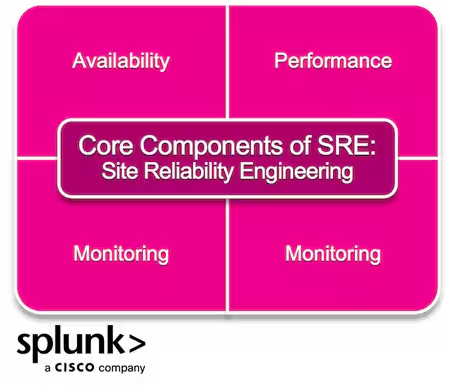
What are the core components of SRE?
Most DevOps and IT professionals constantly focus on improving the development process, while paying less attention on their systems in production. Surprisingly, the vast majority of application and infrastructure costs are incurred after deployment. Thus, development teams need to spend more time supporting current services.
In order to reallocate their time without impeding velocity, SRE teams are forming: dedicating developers to the continuous improvement of the resilience of their production systems.
So, what do they focus on to build resilience? The core responsibilities of SRE teams normally fall into these categories:
Availability
Availability is the term for the amount of time a device, service, or other piece of IT infrastructure is usable.
For any underlying service (an app, an API, a whole network), availability is often associated with both downtime and a variety of service-level metrics, SLOs, SLAs, and SLIs).
- Service level indicators (SLIs) are the actual unit of measurement defining the service level that customers can expect from the system.
- Service level objectives (SLOs) define the desired outputs of the system, drawing on the SLI. In the case of availability, the SLO may be 99.99% availability.
- Service level agreements (SLAs) are based on SLOs and given to customers to communicate the expected reliability of the service they’ll be using and how the team will react if those numbers aren’t met.
SRE teams initially set SLOs, SLAs, and SLIs to answer business questions such as the following:
- What are the expectations of internal teams, customers, and other external stakeholders?
- What’s the overall importance of service to most organizations?
- Is 99.999% availability truly necessary?
Over time, as SRE teams spend more time working in production environments, engineering organizations begin to see more resilient architecture with further failover options and faster rollback capabilities. These companies can then set higher expectations for customers and stakeholders, leading to impressive SLOs, SLAs, and SLIs that drive greater business value. Over time, that begins to look like this:
- The greater development and IT teams maintain a consistent release pipeline.
- The SRE teams maintain the overall availability of those services once they’re in production.
(Learn more about availability management.)
Performance
As teams mature in SRE and thus the availability becomes less erratic, they start focusing on improving service performance metrics like latency, page load speed, and ETL. Questions that can help pinpoint work here include:
- Which services or nodes are frequently failing?
- Are customers consistently experiencing page load or latency lag?
Performance errors may not affect the overall availability. However, customers who frequently encounter performance issues may experience fatigue and consider stopping the use of the service: that may mean fewer sales, fewer repeat customers, and lost revenue.
SRE teams help application support and development teams fix bugs and proactively identify performance issues across the system. As overall service reliability improves, teams will open up more time to identify small performance issues and fix them.
(Related reading: website monitoring & application performance monitoring.)
Monitoring
In order to identify performance errors and maintain service availability, SRE teams need to see what’s going on in their systems. Naturally, the SRE team is assigned the great task of implementing monitoring solutions. Because of the way disparate services measure performance and uptime, deciding what to monitor and how to do so effectively is one of the hardest parts of being a site reliability engineer.
SREs need to think of monitoring as a way to surface a holistic view of a system’s health. Anyone from any department in engineering or IT should be able to look at a single source, like a unified data platform (such as Splunk) to determine the overall performance and availability of the services they support.
Indeed, it was precisely this need — for cross-service, cross-team visibility — that spurred the creation of SRE’s golden signals. (The goldens signals serve as a foundation for actionable DevOps monitoring and alerting, as we'll see in the next section below.)
Preparation
Continuous improvement in several areas — monitoring, incident response, service availability and performance optimization — organically leads to more resilient systems. Ultimately, SRE teams build the foundation for a more prepared engineering and IT team. With the monitoring resources provided by the SRE team, the development and IT team can deploy new services quickly and respond to incidents in seconds.
Integrating site reliability engineers into engineering and IT allows developers to focus on the production environment and helps introduce IT operations earlier in the software development lifecycle. A reactive SRE team responds to issues and fixes them. However, a proactive SRE team puts the system's resilience directly in the hands of individual team members.
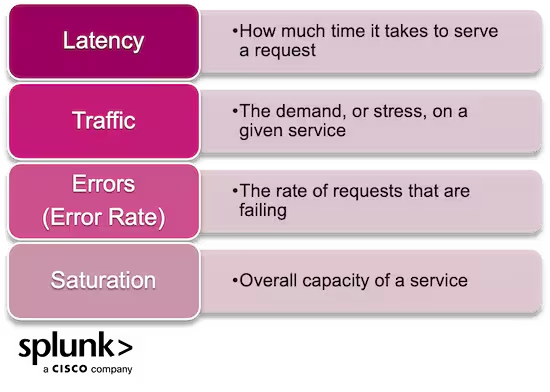
What are the four golden signals of SRE?
Effective implementation of the of SRE metrics requires visibility and transparency across all services and applications within a system. But, it is complex to measure the performance and availability of disparate services on a single scale. So, Google’s SRE team developed the four golden signals as a way to consistently track service health across all applications and infrastructure. SRE’s golden signals define what it means for the system to be “healthy.”
The four golden signals of SRE are:
- Latency
- Traffic
- Errors
- Saturation
While a team can always monitor more metrics or logs across the system, the four golden signals are the basic, essential building blocks for any effective monitoring and observability strategy. Think of these as your get-started, jumping-off point for actionable monitoring.
Tracking the latency, traffic, errors and saturation for all services in near real-time will help all teams identify issues faster and have a clear, immediate, single view into the health of all services. Instead of disparate monitoring across every feature or service, you can roll all monitoring metrics and logs into a single location, like Splunk. Effective monitoring will not only lead to improved incident management but it will improve the entire incident lifecycle over time.
Latency
Latency refers to the time taken to serve a request. Measuring latency for your systems has two core parts:
- Define a benchmark for “good” latency rates.
- Monitor the latency of successful requests against failed requests to keep track of health.
Tracking latency across the entire system helps identify which services are not performing well. It also allows teams to detect incidents faster. The short latency of errors helps improve the speed at which teams identify an incident, allowing faster incident response.
Traffic
Traffic refers to the stress from demand on the system. The more traffic to your systems, the more "stress" those systems carry. Things to consider here include:
- At a given time, how much stress can the system handle from users or transactions running through the service?
- How do you define traffic to your systems and services? Depending on the business, what you define as traffic could be vastly different from another organization.
- Is traffic measured as the number of people coming to the site or as the number of requests happening at a given time?
By monitoring real-user interactions and traffic in the application or service, SRE teams can see exactly how customers experience the product and how the system holds up to changes in demand.
Errors
Errors, or the error rate, defines the rate of requests that are failing. SRE teams need to monitor the rate of errors, both across the entire system and at the individual service level. This includes:
- Errors based on manually defined logic
- Explicit errors such as failed HTTP requests
It’s also important to define which errors are critical and which ones are less dangerous. This can help teams identify a service's true health in the eyes of a customer and take rapid action to fix frequent errors.
You'll also hear about errors in the context of RED: rates, errors, and duration. Known as RED monitoring, these three metrics offer a streamlined approach for monitoring microservices and other request-driven applications.
Saturation
Saturation is defined as the overall capacity of the service. The saturation is a high-level overview of the utilization of the system:
- How much more capacity does the service have?
- When is the service maxed out?
- What level of saturation ensures service performance and availability for customers?
An important consideration here is benchmarking healthy rates. After all, most systems begin to degrade before utilization hits 100%, which is why SRE teams need to determine a benchmark for a “healthy” utilization percentage.
In this video, see how you can use Splunk Real User Monitoring to quick identify client-side errors and latency.
Additional SRE metrics and KPIs
For SRE teams, they need to assess their impact on a business and identify areas of improvement. Some KPIs for measuring the value of SRE practices include:
- Change success rate measures the percentage of changes to production that result in improved service with a high percentage demonstrating the effectiveness of SME services in helping execute change management.
- Mean time to resolution (MTTR) measures the average time taken to resolve incidents. A low MTTR shows SRE teams' effectiveness in helping businesses recover from an issue.
- Mean time between failures (MTBF) measures the average time between service disruptions with a high MTBT, indicating SRE services are effective in preventing a high frequency of incidents.
- Incident reoccurrence rate identifies repeated incidents due to unresolved root causes with a low rate, highlighting the effectiveness of SRE practices in preventing future incidents.
- Resource utilization assesses how well the SRE team can balance ensuring system resilience against cost.
Learn more about which metrics and KPIs can deliver value to your organization:
- DevOps and DORA metrics
- Application monitoring metrics
- Reliability metrics
- Failure metrics
- Incident response metrics
- How to choose the right business metrics
Best practices: FAQs about SRE
To wrap up, let's now turn to some real world situations for SREs.
What happens when SREs are poorly resourced?
SREs with access to adequate resources can take proactive measures to improve system reliability. On the other hand, SREs with insufficient time, tools, or expertise, or teams are understaffed, can only take reactive measures, dealing with incidents as they occur. The lack of adequate automation tools forces SREs to handle repetitive tasks manually, reducing inefficiency. They cannot meet KPIs and the likely indicator here that something is a problem? High MTTR and MTBF.
What's an IDP: Internal developer portal?
An internal developer portal is key for the effective implementation of the above SRE metrics. It simplifies access to internal developer tools in a self-service fashion and ensures site reliability policies and practices are embedded into a product from the outset. Besides, it provides a shared platform where SRE and DevOps teams can work together through collaboration.
Goodhart’s Law in relation to SRE metrics
Yes, Goodhart's Law certainly applies to SRE metrics. So what does it mean here?
SRE's goal is to maintain system reliability. However, when SRE teams focus heavily on optimizing a specific metric, such as latency, it may become their primary measure of success, and they may neglect other metrics. This metric may lose effectiveness as the team adapts to meet its targets. The consequence is compromised performance measurement and, ultimately, ineffective decisions.
This is because the team narrows its focus on meeting a target as opposed to ensuring the holistic health or quality of a system. To balance the use of SRE metrics with the pursuit of overall system health, you need to measure a wide range of metrics that reflect different aspects of the system. Also, you should continuously review them to align with evolving system goals.
Using SRE to facilitate a DevOps mindset
Site reliability engineers expose themselves to many aspects of the system, inherently improving the collaboration between developers and IT operations teams. Facilitating a DevOps mindset through SRE leads to breakthroughs in your team’s productivity and your system’s resilience. When an incident occurs, instead of passing blame between development and IT, SRE opens transparent discussions about how they can improve. SREs are the gatekeepers for efficient, reliable software development practices that don’t force all production responsibilities to IT teams.
Related Articles

Incident Response Plans: The Complete Guide To Creating & Maintaining IRPs

Status Pages: The Ultimate Guide