Defining & Improving Your Security Posture
Learn Shanika WickramasingheThe security posture of any organization is the result of comprehensive security strategies, processes and practices, which enable organizations to be resilient against evolving security threats.
This article describes what we mean by “security posture”, including why it matters, and what comprises it. Importantly, we’ll also understand how to assess and improve the security posture.
What is the Security Posture?
The security posture of an organization measures the overall security status of its systems, networks, and other critical assets. It provides a big picture of the readiness of an organization to face, mitigate, and respond to security attacks that can cripple the business and impact its clients.
Apart from the security policies and procedures in place, there are several factors that determine the security posture of an organization. It depends on understanding:
- All the assets of an organization
- Attack vectors and surfaces
- The strength and quality of existing security controls, incident response plans, etc.
And more, as we’ll see below.
The importance of a strong security posture for organizations
As cyber threats and technologies are becoming more sophisticated, understanding the current security posture of your organization is an essential practice. Here are key reasons why a strong security posture is critical for organizations to survive these cyber threats and technological advancements.
To mitigate cyber threats. Organizations with a strong security posture can protect themselves against various cyber threats, including ransomware, DDOS attacks, and advanced persistent attacks. This protection is essential for safeguarding sensitive data and maintaining the integrity of IT systems.
To preserve customer trust and the business reputation. Assume that a data breach exposes the sensitive information of your customers — or that the security practices of your organization you’re your clients vulnerable to cyberattacks. Either scenario reduces the trust of clients in your business — which can significantly damage the reputation of the business.
To improve your adaptability to evolving threats. The security posture of an organization must dynamically evolve and update—being static here is a major risk. This agility helps the organization adapt to changing cyber threats and tech advancements.
To ensure business continuity. Incident response and recovery plans help organizations quickly overcome security incidents. It enables them to continue business operations, providing uninterrupted service to your clients.
To save unnecessary costs. Security incidents can be costly. For example, ransomware attacks can lead to organizations spending millions of dollars to recover their lost data. And you’re not done yet — this can also involve legal and compliance charges and expenses for damage control. A robust security posture eliminates such unnecessary costs.
(Check out the latest ransomware trends.)
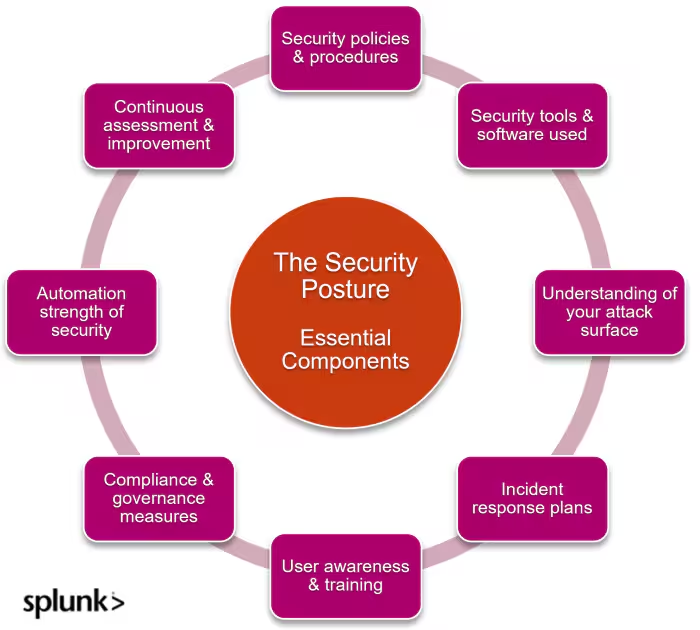
Key components of the security posture
Now we understand the why of a security posture — let’s understand exactly what the posture encompasses. You can measure the security posture of an organization by assessing the following components:
- The security policies and procedures used to manage security risks
- Security tools and software used to monitor, detect, and protect systems and data
- The understanding of the attack surface
- Incident response plans
- Awareness and training of your employees and users
- Compliance and governance measures
- The automation strength of your security measures
- Continuous cyber security assessment and improvement plans
Let's go through each of the above components in detail.
The security policies and procedures
These are security standards and guidelines established to control the security risks within an organization. For example, password policies are enforced to protect user accounts, and access control mechanisms are established to avoid unauthorized data breaches. Moreover, incident response plans are used to effectively manage security incidents while using data encryption standards to protect sensitive data.
The security tools and software used to monitor, detect, and protect systems and data
Installing the necessary security tools and software is a critical part of the security posture. It helps detect and prevent security threats to the organization. A few essential software and tools include:
- Antivirus software
- Intrusion detection systems (IDS)
- Firewalls
- Encryption technologies
The understanding of the organization's attack surface
The attack surface combines the asset inventory of the organization and the attack vectors:
- The asset inventory is a list of all the digital and physical security assets.
- The attack vectors are the methods attackers use to access your networks and systems.
Incident response plans
What are the procedures the organization follows to respond to security incidents promptly? For example, monitoring, alerting, and escalation procedures to reduce system downtimes. Further, what recovery procedures enable organizations to recover business operations with minimal damages?
That’s what your incident response plan will define. Read our complete guide to IRPs.
Employee & user awareness and training
How much effort does the organization put into informing employees and users of security best practices? For instance, some organizations include mandatory training courses for employees to learn about security and privacy protocols. Some of these protocols include the importance of using strong passwords, where to store private and confidential information, etc.
It is essential to keep employees and users regularly updated and aware of security attacks and best practices. It can significantly eliminate the potential for security breaches, increasing your security posture.
Compliance and governance measures
Has your organization established security controls to comply with cybersecurity and data privacy regulations and standards — such as GPDR, HIPAA, SOC, etc.? Further, are there any regular audits to identify vulnerabilities and non-compliance issues?
Compliance and governance measures ensure that organizations adhere to applicable standards and laws, avoiding legal penalties and protecting the reputation of the organization.
(Related reading: GRC, governance, risk & compliance.)
The automation strength of your security measures
Security threats are growing each day with new and innovative attack techniques. As such, maintaining only the necessary security software and tools is insufficient to cope up with evolving security conditions. That’s why the degree of automation — your automation maturity — is important to face these challenges effectively.
For example, leveraging machine learning and artificial intelligence in cybersecurity enables organizations to analyze patterns and predict potential threats. It allows them to adapt to new types of attacks more quickly than manual processes.
Plus, proper automation enables you to deal with the large volume of data generated by network activity, providing proactive and real-time threat detection.
(See how Splunk solutions enable real-time threat detection with all this data.)
Continuous cyber security assessment and improvement plans
Regular assessments of security procedures can help identify any loopholes in them. Penetration testing, for one, helps identify the robustness of your security measures. Other regular assessments include:
- Continuous surveilling of the network and systems.
- Analyzing security incidents to find weaknesses in the existing controls.
- Regularly auditing employee feedback and any improvement plans in place.
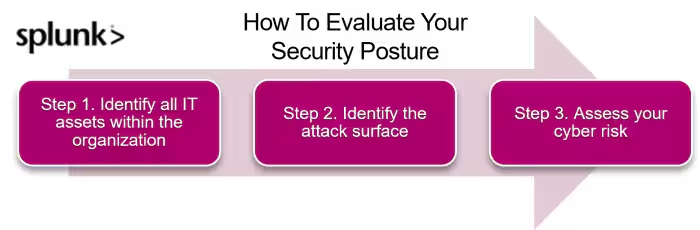
How to evaluate your security posture
To evaluate the security posture of your organization, you need to identify its security assets and their attack vectors. Then, you should perform a cyber security risk analysis.
Step 1. Identifying the IT assets within the organization
The fundamental step of security posture assessment is to accurately identify the IT assets within your organization. These assets are critical for protecting against security threats.
IT assets include all digital and physical assets in your organization, such as desktop computers, laptops, mobile phones, networking routers and switches, cloud infrastructure, user accounts, and third-party software.
Organizations must create an asset inventory cataloging all those assets. Once inventoried, you’ll also need to document detailed information about each asset such as its location, risk profile, business criticality, software and hardware status, linked services, and accounts.
(Related reading: IT infrastructure & CMDBs.)
Step 2. Identifying the attack surface
The attack surface combines the asset inventory of your organization with the attack vectors. (These attack vectors are all the methods and points attackers use to access your networks and systems.)
The attack vectors differ based on the type of cyber threat. For example:
- Ransomware typically spreads through phishing emails or exploiting software vulnerabilities.
- However, a denial-of-service attack (DDOS) targets specific network components.
Mapping these attack vectors helps organizations quickly identify and mitigate cyber incidents.
(Read about attack surface management.)
Step 3. Assessing your cyber risk
The final step of security posture assessment is understanding the cyber risks in the organization. Organizations can use this formula to assess their cyber risks:
Risk = Likelihood x Business Impact
Here, the likelihood is the probability of a specific threat exploiting a vulnerability to damage the organization. On the other hand, the business impact is the potential consequences of the organization from attack.
(Understand the differences: vulnerability, threat & risk.)
How to improve your security posture
The security posture of an organization results from robust security best practices within the organization. There are several ways to improve the security posture of an organization.
- Implement automated, real-time tracking of all your digital and physical assets.
- Prioritize assets based on urgency, risk and security levels, risk tolerance, and compensating controls.
- Establish a hierarchy of risk ownership and assign responsible individuals for each area.
- Assess risk continuously to identify new threats, vulnerabilities, and loopholes in your existing security controls and remediate those gaps.
- Implement a regular software update and patching schedule to keep the system up to date.
- Embrace advanced security technologies and processes such as zero-trust framework, cyber threat intelligence (CTI), and continuous threat exposure management (CTEM) to reduce the risk of evolving cyber threats.
- Backup data regularly to protect critical data and recover from disasters.
- Establish a comprehensive incident response and recovery plan, preparing the organization to handle security breaches effectively.
- Establish clear Service Level Agreement (SLA) targets for incident resolution, evaluating the security controls regularly.
- Conduct regular security awareness training, such as phishing simulations to raise the awareness of employees who fall for such attacks.
Strengthen your security posture
The security posture of an organization is a comprehensive overview of its preparedness to face a wide range of evolving security threats. It mainly comprises the understanding of organizations’ assets, risk surface, employee and user awareness, the effectiveness of security controls, and many other factors described in this article.
Having a robust security posture benefits the organization in many ways. The three-step procedure described above helps you assess your security posture. Furthermore, there are many ways to increase the security posture including regular security assessment, continuous monitoring, a comprehensive incident response and recovery plan, and regular security awareness training.
Related Articles

Shift Left Security Today: Adoption Trends & How To Shift Security Left

Unified Threat Management (UTM): The Complete Guide to Modern Cybersecurity Solutions