Real-Time Analytics: Definition, Examples & Challenges
Learn Austin ChiaBusinesses need to stay agile and make data-driven decisions in real time to outperform their competitors. Real-time analytics is emerging as a game-changer, with 80% of companies showing an increase in revenue due to real-time data analytics as companies can gain valuable insights on the fly.
This blog post will explore the concept of real-time analytics, its examples, and some challenges faced when implementing it. Read on for a detailed explanation of this exciting area in data analytics.
What is real-time analytics?
Real-time analytics is the process of collecting, analyzing, and using data in real time to make informed decisions. It involves capturing data as it is generated, processing it immediately, and presenting actionable insights to users without any delay.
The key aspect of real-time analytics is speed. This allows organizations to respond quickly to changing market conditions, customer behavior, or operational issues. Real-time analytics offers the following benefits:
- Access to data and insights in real-time
- Ability to identify trends and preferences in customer behavior
- Actionable information based on current and historical data
- “Next best offer” analysis in predictive analytics
Wearable devices, like FitBits and heart monitors, are an excellent example of real-time analytics, as they can capture vital data like a person's heartbeat. This data can be used to track a person's health in real time and possibly even predict medical ailments before they arise.
(Related reading: real-time data, data analytics & the data analyst role.)
Real-time vs. traditional analytics
Utilizing massively parallel programming, real-time analytics can process large volumes of data in real-time. In contrast, traditional batch analytics may be more cost-effective and allow for scheduled processing, but it cannot handle live data streams and provide immediate insights.
Traditional analytics involves storing and indexing limited sets of historical data, which is queried when business users require insights. Batch processing is a frequently used method for completing routine jobs, like creating monthly sales reports or calculating the payroll.
For tasks that require immediate insights, however, real-time analytics is the answer. Examples here can include:
- Patient safety monitoring
- Fraud detection
- Emergency response
Technologies that power real-time analytics
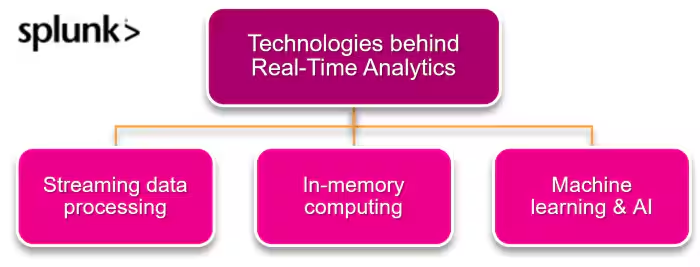
Streaming data processing, in-memory computing, and machine learning and artificial intelligence (AI) are essential technologies for real-time analytics. Combined, these enable businesses to detect patterns, trends, and anomalies in real time and ultimately leading to more rapid and precise decision-making.
Let's have a look at what each of these technologies provide:
Streaming data processing
Streaming data processing is the continual and instantaneous data analysis as it is generated or received. It allows organizations to:
- Improves the timeliness and effectiveness of real-time analytics.
- Analyze live data, generate real-time reports, and perform calculations on the streaming data (versus relying on historical data).
Having a robust system in place is vital for ensuring efficient stream processing. This typically includes components such as:
- A message broker or stream processor
- Batch processing and real-time ETL tools
- Streaming data storage
- Data analytics and processing engines
These components work together to provide continuous analysis of data, enabling real-time insights and decision-making for businesses.
In-memory computing
In-memory computing is a technology that utilizes random access memory (RAM) to store data, resulting in faster processing and analysis when compared to traditional disk-based storage. It minimizes data movement and leverages the speed and efficiency of memory — a crucial facilitator for real-time analytics capabilities.
In addition to its speed advantages, in-memory computing also plays a role in addressing performance issues under high data volumes.
Machine learning & artificial intelligence
Machine learning and AI are domains within computer science that involve developing and using algorithms to process data, identify patterns, and make predictions or decisions. These technologies enable computers to:
- Facilitate more rapid and precise decision-making
- Process data and make predictions, enabling businesses to identify patterns, trends, and irregularities in real time.
Real-time analytics in action: Industry examples
Real-time analytics has numerous applications across various industries. Here are some examples of how real-time analytics can transform them.
Financial services
In financial services, real-time analytics plays a critical role in tasks like fraud detection, risk assessment, trading and investment decisions, and customer personalization.
For example, real-time analytics can help financial institutions to:
- Monitor transactions for signs of fraud and take immediate action to prevent losses.
- Optimize trading strategies by analyzing market data and identifying trends and opportunities in real time.
- Enhance risk monitoring by analyzing vast quantities of market data in real time.
Applying natural language processing (NLP) to complaints helped organizations detect potential operational risk in banks. This improved risk management framework can lead to better decision-making and overall financial stability for businesses.
Retail & e-commerce
Retail and e-commerce businesses can greatly benefit from real-time analytics. Businesses, through analyzing customer data, can gain valuable insights into individual preferences and create customized shopping experiences. Done well, this can lead to:
- Improved customer service
- Personalized experiences
- Optimized inventory management
Healthcare
Real-time analytics has significant potential in the healthcare sector, particularly in patient monitoring, early detection of health issues, and the optimization of treatment plans.
Healthcare providers can make proactive decisions and adjust treatment plans based on individual patient needs by capturing physiological measurements through biosensors and analyzing real-time health metrics. Furthermore, real-time analytics can be utilized to:
- Predict and manage disease outbreaks.
- Analyze large sets of data in real-time, such as disease surveillance data, social media trends, and environmental factors.
- Inform public health interventions and allocate resources efficiently.
Challenges with real-time analytics
Implementing real-time analytics isn’t easy. Let’s explore some possible practical solutions to overcome these hurdles.
Data infrastructure & integration
Integrating data from multiple sources is crucial for effective real-time analytics. To achieve this, robust data integration solutions are required to handle the increasing volume, variety, and velocity of data generated by modern businesses.
Best practices for data integration include:
- Utilizing open-source ETL tools like Apache Storm and Spark Structured Streaming for real-time data analysis.
- Being aware of memory constraints when dealing with real-time data.
Software solutions that can help facilitate seamless data integration in real-time analytics include:
- Apache Storm (stream processing)
- Apache Spark (both stream and batch processing)
- Talend
- Fivetran
- Striim
These solutions ensure that your organization has access to accurate, complete, and timely data from various data sources for informed decision-making. However, having all these integrations and data infrastructure requires some upfront costs to set up. Need to maintain a large volume of live data stream? That’s going to cost even more.
Scalability & performance
Ensuring scalability and performance is essential for real-time analytics systems to handle increasing data volumes and deliver timely insights. To guarantee scalability and performance, businesses can deploy distributed stream processing systems, develop an efficient architecture, and optimize algorithms, data storage, and processing techniques.
By reducing processing times and improving overall system performance, organizations can better harness the power of real-time analytics to drive growth and success. Addressing performance issues under high data volumes can be achieved by utilizing the following techniques:
- Scalable infrastructure
- Robust data processing capabilities
- Distributed computing
- Parallel processing
- Data partitioning
- Data compression
- Caching
- Data filtering
Closing thoughts
Real-time analytics is transforming the way businesses operate, offering valuable insights and enabling rapid, informed decision-making. By leveraging key technologies such as streaming data processing, in-memory computing, and machine learning, and AI, organizations can harness the power of their data to outperform competitors and drive growth.
As businesses face challenges in implementing real-time analytics, a focus on data infrastructure, integration, scalability, and performance is crucial.
Related Articles

Continual Learning in AI: How It Works & Why AI Needs It

Incident Response Plans: The Complete Guide To Creating & Maintaining IRPs