What's Moore's Law? Its Impact in 2026
Key Takeaways
- Moore's Law is the observation that the number of transistors on a microchip doubles approximately every two years, historically driving exponential increases in computing power and significant technological advancements.
- As physical and economic limitations are reached, the pace predicted by Moore's Law is slowing, prompting the tech industry to explore new technologies and computing paradigms.
- To continue improving performance despite slowing transistor scaling, the industry is focusing on architectural and software innovations, such as heterogeneous compute, 3D chip stacking, parallelism, cloud-native microservices, and algorithmic optimizations.
Born in 1929, Gordon Moore profoundly impacted technology and business when he co-founded Intel in 1968, before he was 40 years old. There, he played a key role in the development of microprocessors in the semiconductor industry — and the effects of that continue to reverberate today.
Over time, Moore reflected on the company's journey and the advancements made in technology. He was proud of how far the industry has come, noting the innovations that transformed communication computing along with everyday life. He focused on the importance of investing in research and development in order to drive future breakthroughs.
And he even coined his own so-called law. So, what is Moore's law? The "law" states that a microchip's transistor count doubles in approximately every two years. The observation by Moore has proven to be remarkably accurate over the last several decades years. His law not only changed the future of the semiconductor industry — it revolutionized technology.
To understand the exponential growth in technology, you'll want to know Moore’s law. So, let's discuss how and why Moore’s law continues to shape the future of modern computing and its implications for the future of microprocessors.
(Related reading: Conway's Law & Amdahl's Law.)
What is Moore's law?
Moore's law observes that the count of transistors in a microchip doubles approximately every two years. This emphasizes the growth and efficiency of computing power over time. This trend has guided the semiconductor industry for many years.
Key aspects of Moore's law
The key aspects of Moore's law are:
- Reduction of cost: Increasing manufacturing efficiency lowers the production cost of transistors, increasing the accessibility and affordability of advanced technology.
- Density of transistors: Since the transistor count is increasing, computational capability increases, allowing more complex applications.
- Performance: With rising transistor count, the efficiency and speed of processors increase, thus enhancing the overall system's performance.
- Innovation: Transistor technology's consistent advancement has resulted in innovation in fields like cloud computing, artificial intelligence, and consumer electronics.
Moore's law's implications
For many years, Moore's law held true. Today, however, challenges are arising as the physical limitations of the semiconductor industry are becoming more apparent. By exploring new architectures and materials, the industry must adapt.
Before discussing Moore's law further, let's find out how the count of transistors are doubling.
How can transistor counts be doubling so quickly?
Moore’s observation was attributed to improvements in the chip manufacturing process where Intel was able to produce larger semiconductor components at scale and with fewer defects.
Specifically, the use of optical projection of lithography masks and fine-tuned image rendering on silicon wafers contributed to two-thirds (~67%) of the improvement. The last third is attributed to the optical doping process, which uses controlled light beams instead of applying chemical solutions to the wafer.
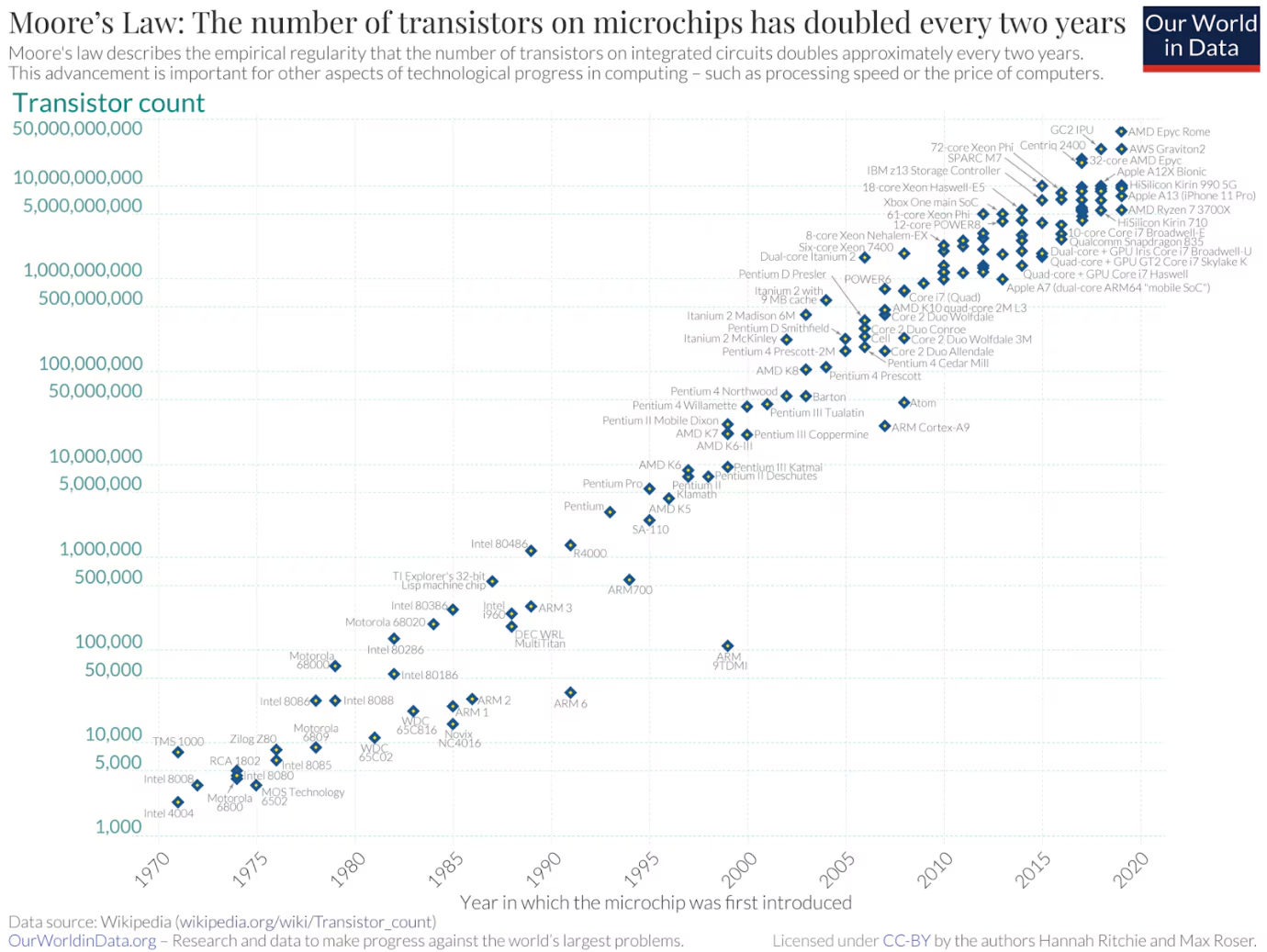
(Image source.)
The accuracy of this prediction as demonstrated by a (logarithmically) linear increase in transistor count has sparked consumer interest and expectations. After all, the exponential growth trend of transistor density means two things:
- Computing chips are getting faster and cheaper.
- The consumer electronics market can experience a state of constant iteration and improvement.
A law of tech, or a self-fulfilling prophecy?
Major advances in manufacturing have made Moore’s law ring true, but will it always be that way?
The nature of Moore's law
Moore’s law is not a fundamental law of physics: it does not describe a natural physical phenomenon. Nor is it a scientific theory. Really, this law is simply an observation of how the semiconductor industry works — or how it worked for a long time. When taking a closer look, it seems that a combination of economic, technological, and even social factors are driving this trend.
ASML challenging smaller transistor design
One of the key players in this advancement is ASML, a Dutch-based semiconductor company. ASML addressed the challenges of smaller transistor design by leading the design of Extreme Ultraviolet (UAV) lithography machines. The machines are the size of a small bus, measuring about 40 feet long, 25 feet wide, and 10 feet high. These machines are important for pushing Moore's law forward and advancing the semiconductor industry.
Economic impact of the semiconductor industry
The global semiconductor industry is worth approximately $600 billion USD today, with projections of hitting $1 trillion by 2030. A significant portion of this sum goes directly into research and development of new semiconductor technologies. The semiconductor industry has kept strong ties with academia, naturally attracting a concentrated effort among researchers around the world working toward improvements in semiconductor technologies. Manufacturing companies are large enterprises that governments incentivize. These governments push for supremacy in the competitive global landscape.
Another perspective of Moore's law views it as a self-reinforcing goal driven by consumer expectations. Although this hypothesis lacks validation, many assume that technology consumers appreciate two key things:
- Regular and exponential improvements in technology performance
- The constant reduction of cost for performance
Some argue that Moore’s law was claimed in an era of rapid technological innovations and advancements and that it may be reaching the end of its days as a “law”. Today, we have already reached a point where most chip manufacturing companies have struggled to improve transistor density from 7nm to 5nm transistor nodes in a highly competitive space.
Philosophical considerations and broader impact
Alongside these factors, there may be a philosophical aspect to Moore’s law. As the observation made decades ago has held true for so long, the semiconductor technology industry, academia, and consumers perceive Moore’s law to be an attainable goal — despite increasingly glaring physical limitations. The collective vision serves as a driving force of motivation. It continues to propel the industry toward this goal. How long this momentum can last, however, remains to be seen.
Whatever the answer, Moore’s Law has rippling effects on businesses across industries. Understanding those effects might just help you stay ahead of the curve.
Let’s dig in.
Moore’s law for the enterprise
The observation gives remarkable insights into the progress of the semiconductors industry, leading to pervasive changes to the technological, economic, and social domains across all industry verticals. Let’s discuss:
Accelerated technology adoption
Technology is evolving at a steady rate.
Following Moore’s law, the semiconductor industry brings exponentially improving processing power to the market every two years. End users expect businesses to leverage these improvements. This means organizations must adopt new digital transformation initiatives. Such initiatives should streamline the digital experience for end users and customers alike.
Improvements in transistor density play an important role here: users expect shorter transition periods between technology updates, but the transition may well be characterized by increased risk. These risks include:
- System performance and dependability issues
- Steep learning curves for complex technologies
- Exposure to security issues such as zero-day exploits.
Edge processing benefits and drawbacks
Over the last few decades, transistor density has increased to the point that a small form factor and low-power IoT device can pack sufficient computer power to enable edge computing. This capability allows business organizations to:
- Embed intelligence into the physical layer via sensor devices.
- Process data directly at the network edge.
Using edge processing instead of transmitting sensitive information over large networks might result in cybersecurity risk or latency delays in data communication. From a business perspective, this presents both opportunity and challenge.
You can create complex, data-driven IoT applications with advanced sensor technologies. To do so, however, requires revamping the existing technology stack. The original stack was designed for centralized data processing and storage. In this setup, front-end devices functioned as “dumb” terminals.
Thriving cloud model and scalability
One of the driving factors for rapid cloud adoption is that the service model enables users to trade high CapEx with affordable OpEx.
Following Moore's Law, the semiconductor industry provides faster computing capabilities. You will achieve this using the same form factor and pricing. Consequently, cloud vendors offer highly scalable computing resources. These resources come with affordable operational expenses. Although Moore's Law doesn't define this economic impact, cloud investment trends are rising exponentially. Business organizations view a positive outlook for cloud investments.
As long as Moore's Law holds, cloud platforms will likely scale with tech improvements.
(Related reading: IT/tech spending trends & cloud cost trends.)
Moore's law's impact on industries
Across multiple sectors, Moore's law is helping to drive efficiency and innovation, thus going beyond computing and reshaping industries like healthcare, transportation, education, and energy production. Let's discuss some examples.
- Healthcare: Siemens Healthineers uses advanced imaging technology, enhanced by advancements per Moore's law. This results in better treatment planning and diagnostics.
- Transportation: Inspired by the hope and promise of Moore's law, Waymo developed autonomous vehicles. These vehicles utilize advanced computing, processing huge amounts of data for safety and navigation.
- Energy production: General Electric is leveraging smart grid technologies and data analytics to improve efficiency and optimize energy distribution.
Moore's law fosters advancement in each of these sectors, helping industries to improve overall productivity and adapt to modern challenges.
Assessing Moore’s law in the future
Moore's Law has profoundly impacted the semiconductor industry. It has driven exponential advancements in technology. This growth shapes many aspects of our lives. Although not a physical law, it has been an accurate observation for over 50 years. It encourages continuous research and development in semiconductor technologies. As transistors shrink, new challenges arise. The industry questions the sustainability of this exponential growth.
As we look ahead, wireless communication, cloud computing, quantum physics, and the Internet of Things (IoT) will converge to drive innovation in computing, enhancing efficiency, connectivity, and processing power. These technologies will facilitate real-time inter-device communication, enhance smarter data processing, and unlock new computational capabilities that were previously not attainable. Obviously, Moore's law will impact their evolution.
Whatever the outcome, remaining adaptive and understanding consumer expectations is critical to remaining competitive.
FAQs about Moore's Law
Related Articles

How to Use LLMs for Log File Analysis: Examples, Workflows, and Best Practices

Beyond Deepfakes: Why Digital Provenance is Critical Now

The Best IT/Tech Conferences & Events of 2026
The Best Artificial Intelligence Conferences & Events of 2026

The Best Blockchain & Crypto Conferences in 2026

Log Analytics: How To Turn Log Data into Actionable Insights

The Best Security Conferences & Events 2026

Top Ransomware Attack Types in 2026 and How to Defend