What is DevOps Automation?
DevOps automation is a key strength of organizations that deliver products faster and more frequently — and with maximum quality. DevOps-focused automated enables organizations to:
- Gain significant operational efficiency in DevOps processes.
- Improve productivity.
- Ultimately boost return on investment (ROI).
This article gives an encompassing view into DevOps automation. We’ll cover its benefits, popular tools and best practices, along with the things that can be automated. So, let’s dig deeper into DevOps automation.
What’s DevOps automation?
First, an overview: DevOps is a set of practices, processes and tools that enable siloed development and operations teams to collaborate and deliver better, higher-quality and more reliable products and services. DevOps involves a set of routine and repetitive tasks like provisioning infrastructure, code integration, software kit deployment, testing and monitoring.
These processes help deliver changes more frequently, adding incremental business value. (Many DevOps proponents also point out that it’s a cultural shift, too. The ways teams work, communicate and choose features and products to develop are approached in new ways.)
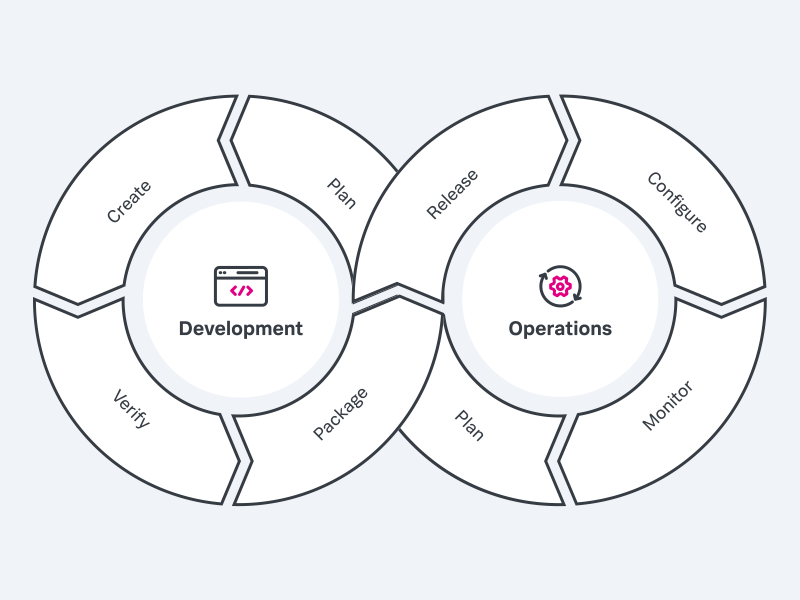
DevOps automation automates the routine tasks performed in the DevOps culture. It uses software tools and technologies to streamline each process rather than manually performing these tasks. Some examples include:
- Automating the process of manually checking code into a git repository.
- Automating production deployment.
- Performing automated testing during the development process.
DevOps automation enables organizations to reduce human errors, make these processes as efficient as possible, and achieve continuous integration and delivery.
(For the latest, check out the State of DevOps and must-attend DevOps conferences & events.)
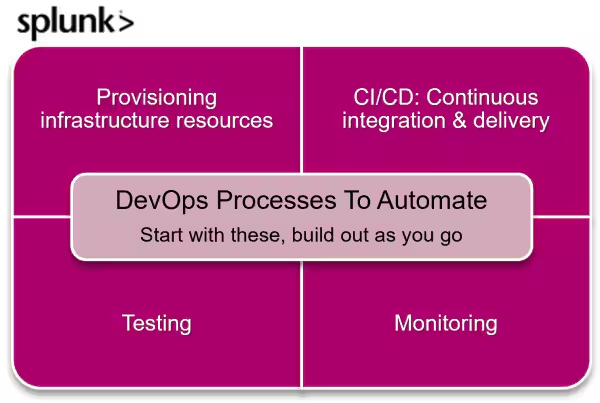
The first DevOps processes you should automate
Not every task in an organization can be automated. Here are the key processes in a DevOps environment that you can — and should — automate with appropriate tools.
Automated provisioning of infrastructure resources
Your application environments require the provisioning of different infrastructures to support various tasks. Manually provisioning servers and other resources, whenever you want, can be complex and time-consuming. It also requires experts to perform these tasks. Another complicating factor is the difficulty in forecasting costs of manual provisioning.
Automated provisioning of resources can be done using:
- Infrastructure as Code (IaC) approaches
- Automated scaling templates
You simply define what you want with applicable conditions. Automated systems like CloudFormation and Auto-Scaling help automatically provision initial resources, resources on-demand or changing requirements according to those specifications — all without human intervention. This capability helps organizations accelerate workflows and build highly available systems.
Automated CI/CD
The central processes in fast-paced agile development environments are continuous integration and delivery (CI/CD). Performing CI/CD tasks like code integration, software kit building and testing can take significant time based on the complexity of the application. Automated CI/CD jobs enable triggering pipelines upon each new code commit, automatically building and deploying the application with the changes.
A fully automated CI/CD pipeline automates manual tasks from building the application, installing dependencies, running the required tests and deploying to the required environment. Automated CI/CD helps avoid human errors, improve product quality and deliver changes more frequently. Additionally, it lets the development teams focus on development work rather than spending time on unnecessary, time-consuming work.
Automated testing
Software development and deployment involve various testing types, like unit testing, UI testing, and integration testing, from the initial stages. Manually performing them is time-consuming and requires more testing resources.
Automated testing can be done with test scripts written using the test automation frameworks. It enables the detection of bugs and issues earlier in the development lifecycle, prior to deployment. For example, you can run an automated Build Verification Testing (BVT) suite before a production release to quickly check the status of the current production environment. Ultimately, automated testing helps to:
- Improve code quality
- Ensure faster production releases
Automated monitoring
Automated monitoring of applications and resources enables rigorous, continuous monitoring and provides deeper insights into their status and performance. In fact, continuous monitoring is sometimes known as DevOps monitoring because they’re tied together so closely.
Such automated monitoring systems help teams troubleshoot production issues and provide faster solutions. Plus, automated monitoring allows for the integration of alerting or notifications to alert whenever there is a performance degradation or error within the system or applications. It enables teams to be aware of issues as they arise and to provide an uninterrupted service to end users.
Benefits of DevOps automation for your organization
DevOps automation provides many benefits. Here is a summary of the benefits your organization can gain through the above automated DevOps tasks:
- Improve DevOps metrics. With automation, you’ll improve key DevOps metrics like deployment frequency, mean time to recovery (MTTR) and lead time for changes and change failure rates.
- Reduce time and resource-intensive tasks. Automation saves developers and other teams from having to do unnecessary tasks. They get enough time to focus on innovation and achieve other organizational goals. It also enables teams to be proactive.
- Improve cross-team collaboration. For example, automated monitoring helps development teams collaborate with SRE teams in troubleshooting incidents.
- Make reliable and highly available systems. Automated monitoring lets teams identify issues in production systems in advance and provide solutions before they affect end users. Thus, it ensures the availability of systems to the end-user.
- Accelerate and simplify the software release process. Automated integration and delivery accelerate software release tasks such as software kit creation, deployment and testing. It also reduces the complexity of software releases and human errors that could have been caused by manually performing them.
- Speed up time-to-market. Frequent releases enable faster delivery of software to the market, offering a competitive advantage over others.
- Increase software quality. with automated tests, frequent small builds help identify bugs and issues earlier. Frequent releases mean frequent delivery, which enable you to establish a feedback loop to improve product quality.
- Improve productivity and operational efficiency. Automation of complex DevOps tasks enables teams to focus on improving the product and helps achieve overall operational efficiency.
Popular DevOps automation tools
With more and more organizations embracing DevOps automation, many software services and tools have been released to automate various DevOps processes easily. The following are some popular automation tools covering all automatable DevOps processes:
- Splunk offers, among many use cases, real-time DevOps monitoring that helps deliver better applications faster. Features for infrastructure monitoring and application performance monitoring (APM) enable you to observe all data instantly and optimize your applications. (FYI: we’re also building resilience across the enterprise.)
- Jenkins is an open-source CI/CD tool that lets you create automated build, test and deploy jobs. It integrates with several plugins to create scripts that let you pull in the code wherever you want, deploy it to your ideal location or trigger the pipeline with the tool of your choice.
- Docker automates the development, deployment and management of containerized applications. This fully open-source DevOps automation tool also integrates with many cloud environments.
- Ansible is a resource provisioning automation tool uses infrastructure as a code technique. It also integrates with other automation tools like Travis CI, Jenkins, GitHub and Team City.
- Git is a popular tool for automated version control and continuous integration and delivery.
- Selenium, an automated testing tool, enables teams to develop test automation suits for UI testing and many more. It supports languages like Java, Python, C#, Ruby and PHP plus multiple browsers.
- Chef is an open-source deployment and configuration management tool lets you provision resources relatively quickly.
- PagerDuty facilitates automated incident management with real-time alerting, automating escalations, providing visibility for critical systems and many more tasks for supporting automated monitoring and faster incident resolution.
- Terraform uses Infrastructure as Code to facilitate automated resource provisioning. It also supports the provisioning of network resources and DNS entries.
DevOps automation best practices
With the what, why and how out of the way, let’s move on to the practices that will set you up for long-term DevOps success.
Choose the right tools
Always choose the right tool carefully, considering your needs. Adopt standard, easy-to-use tools for each automatable DevOps task across teams so that different teams do not have to switch between various tools. Additionally, choose tools with a smaller learning curve that are secure and less complex.
Choosing tools doesn’t stop with deployment. It is also critical to provide the necessary training and teach your teams the best ways to use them.
Adopt Infrastructure as Code (IaC)
IaC allows you to define templates for automated provisioning, configuring and maintaining resources for your applications and environments. It supports creating and deploying serverless applications and related infrastructure.
Define and maintain a standard set of templates to quickly update and scale your underlying infrastructure for changing resource requirements.
Increase automated test coverage
Having only the essential automated tests will not suffice. Automated test coverage should be increased as much as possible to cover every workflow in the system. It ensures each code change is properly tested against every workflow before it is deployed to production.
Leverage shift-left security testing
Security testing prior to the deployment can create unnecessary bottlenecks for deployment pipelines. Shift left security testing insists teams build secure applications and systems in lower environments or at the beginning of the software development lifecycle.
Automating security testing from the beginning of the development cycle enables you to fix issues earlier and makes the entire deployment process smoother.
Integrate logging and monitoring wherever possible
Automated monitoring is critical for every organization that needs to provide uninterrupted customer service. It is important to log important events and integrate monitoring for all key services, systems and applications.
Summarizing automation
DevOps automation is among the most sought-after achievements for organizations due to its proven benefits. Different tools and technologies automate traditional manual DevOps tasks, making them more efficient and error-free. Resource provisioning, software integration, deployment, testing and monitoring are the key DevOps processes that can be automated.
There are many software tools to automate these tasks. However, it is important to follow best practices to get the most out of DevOps automation. Some of these practices include utilizing standard tools across the organization, leveraging IaC, increasing the automated test coverage, implementing shift-left automated security, and integrating logging at every level of your software and systems.
FAQs about DevOps Automation
Related Articles

How to Use LLMs for Log File Analysis: Examples, Workflows, and Best Practices

Beyond Deepfakes: Why Digital Provenance is Critical Now

The Best IT/Tech Conferences & Events of 2026

The Best Artificial Intelligence Conferences & Events of 2026

The Best Blockchain & Crypto Conferences in 2026

Log Analytics: How To Turn Log Data into Actionable Insights

The Best Security Conferences & Events 2026

Top Ransomware Attack Types in 2026 and How to Defend