Customer Experience (CX) Metrics
Learn Joseph NduhiuAs enterprises seek to improve their bottom line, the need to delight their customers is paramount. One major framework used to strategize for business success is the Balanced Scorecard (BSC), which tracks the four perspectives of customer:
- Financial
- Internal
- Innovation
- Learning
To address customer concerns such as time, quality, service performance, and cost, organizations must stay on top of their game — this often means streamlining processes and investing in capability to enhance their products and services delivery.
Customer experience has come to the forefront of determining whether an organization is addressing their needs in a manner that brings joy and keeps the client coming back for more.
In this article, we will consider two categories of customer experience metrics, and the way to optimize them to meet evolving customer needs.
Understanding the customer experience
The ITIL® 4 Drive Stakeholder Value publication defines customer experience (CX) as the sum of the functional interactions and the emotional interactions with a service and the service provider as perceived by a customer.
The impression that a customer has when interacting with any touchpoint can significantly impact whether they are likely to continue to:
- Purchase a product.
- Promote your brand.
Negative experiences — badly prepared pizza, a rude delivery or support person, an inappropriate social media post — can individually or cumulatively lead to the loss of customer confidence and churn. This results in business lost.
Measuring customer experience
Measuring customer experience across all touchpoints of the customer journey is a critical undertaking: this is the way to understand if your goals for serving your customers are being delivered.
This is magnified even more by the fact that the customer voice is heavily magnified thanks to social media — a TikTok video or LinkedIn post can go viral and change the fortunes of a company forever.
According to McKinsey, the four components of CX are:
- Brand
- Product
- Price
- Service
And it is against these components that organizations should carefully select and implement metrics to capture the end-to-end experience.
(See how Splunk helps organizations drive superior customer engagement.)
So, let’s look at two types of CX metrics: “outside-in” and “inside-out”.
“Outside-in” CX metrics
CX metrics that are measured directly from the customer’s interaction with any touchpoint are termed “outside in”. Examples of these direct measures include the following.
Customer satisfaction (CSAT)
Customer Satisfaction (CSAT) is the number one customer experience metric! It is usually measured by asking the customer to provide feedback while interacting with a specific touchpoint, such as a service counter on an online app.
Often, measuring CSAT involves issuing a survey to your customers, and they can provide a rating through sentiment or interactions such as
- Smiley faces (😊 happy or 😒 sad)
- Gestures (👍🏽thumbs up or 👎🏽thumbs down)
- Number of stars (⭐one star being poor experience, ⭐ ⭐ ⭐ ⭐ ⭐ five stars being best)
For example, an app store may configure a rating and review mechanism for users of applications to provide satisfaction measures. A restaurant may provide a QR code on a receipt for customers to leave feedback on their experience with the food and servers. And a service support staff may trigger a CSAT survey when closing a ticket raised by a customer.
Usually, a CSAT metric is designed to capture two items:
- First, the overall experience
- Then, the details about a specific touchpoint
Where possible, the CSAT is designed to include rerouting of negative ratings to get specific details on the reasons behind it, and then forwarding to a specific team for immediate follow up.
Another measure closely related to CSAT is the customer effort score that rates the effort that the customer exerted to get a request fulfilled, issue resolved, or a query answered. This measure is usually related to how smoothly the customer interacts with a product, service portal or agent.
Customer retention
The customer retention metric captures the ratio of customers who come back to a business on a repeat basis for products or services. Where the operational context is not monopolistic, retention indicates that these customers have had a positive experience and are likely to continue to:
- Spend their money on the current offerings.
- Promote them to others.
The advantage of retention is that the company does not need to spend as much money on these customers as compared to new acquisitions where marketing is required. Typically, retention is measured by:
- Renewal or non-cancellation of subscriptions (often related to ARR, for annual recurring revenue)
- Repeat purchases
- Churn
Customer engagement
The engagement metric considers the level of involvement and interaction between customers and the organization’s brand. Engaged customers have more positive experiences, have more loyalty, are likely to spend more, and promote the brand to others.
Engagement is mainly measured by Net Promoter Score (NPS) that asks customers whether they are likely to recommend the brand to colleagues, family, and/or friends on a scale of 1-10. Based on their choice, they are categorized as:
- Promoters (score of 9-10)
- Passives (7-8)
- Detractors (6 and below)
The NPS score is a leading indicator that is computed as the percentage of promoters minus the percentage of detractors, with the score ranging from -100 to 100. The key effort then lies in engaging those who are detractors to identify the reasons for their choice, then put in place measures to address their concerns.
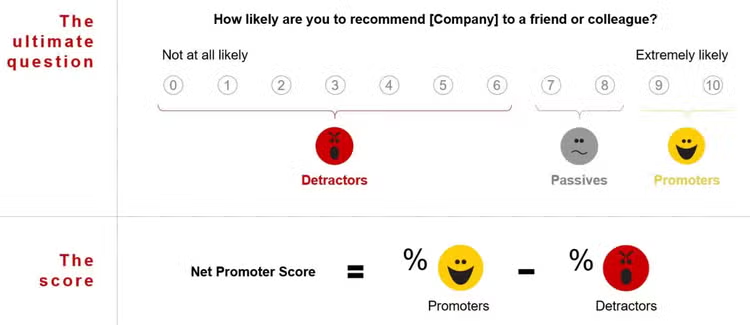
Net Promoter Score (Source)
Other measures for engagement include click through rate, and social media post interaction such as likes, reposts, comments, and sharing.
“Inside-out” customer experience metrics
These metrics measure customer experience indirectly, by considering the perspective of the provider of the products or services being consumed. Examples of inside-out metrics include:
Service quality
When a customer interacts with a service, the customer expects that the functionality and performance should meet their requirements. When a service provider fails to meet these requirements, this results in a poor customer experience. Examples of measures related to service quality include:
- On-time delivery
- Availability
- Responsiveness
In addition, the number of complaints received about service quality can also point to poor experience. Service quality data is usually captured from the provider’s end and used to infer the level of customer experience.
Product quality
Similar to service quality, the customer’s interaction with a product also has a significant impact on their customer experience. David Gavin suggested eight dimensions of product quality that are of strategic importance:
- Performance
- Features
- Reliability
- Conformance
- Durability
- Serviceability
- Aesthetics
- Perceived quality
When these dimensions are measured and compared against competing products or the provider’s own internal targets, and feedback from customers and other stakeholders incorporated, then the service provider can determine the level of customer experience.
Employee satisfaction
The actions or inactions of employees have a significant role to play in impacting customer experience, whether as:
- A direct touchpoint
- Indirectly supporting a product or service
When employees are unhappy, there is a high probability that customer experience will be negatively impacted. Consider overworked and underpaid staff at a retail outlet — expecting them to be polite to customers and go out of their way to assist them is unfair and nearly impossible.
Employee satisfaction covers several dimensions including renumeration, training, work tools, corporate environment, and management interactions.
Companies collect and analyze employee satisfaction through surveys and internal feedback mechanisms, and this is mapped onto customer satisfaction levels.
Optimizing CX metrics
Because customer experience metrics can be collected from different touchpoints and channels, there is a risk of what Gartner calls “measurement anarchy” where each business department or function measures customer experience individually.
This siloed approach can lead to a disjointed perception and negatively impact efforts to improve customer experience.
The voice of the customer (VOC) is one of the approaches organizations can deploy to consolidate feedback from customers gathered from different channels. Presenting a consolidated view of customer experience metrics is crucial in order for organizations to understand where to focus improvements and see the corresponding impact across the entire customer journey.
McKinsey suggests 3 main principles for optimizing customer experience measurement:
- Measure the customer experience at the journey level, rather than at the level of touchpoints or overall satisfaction.
- Invest in hardwired technology that captures feedback on a daily basis from multiple channels, integrating survey results and other data into comprehensive dashboards.
- Cultivate a mindset of continuous improvement at all levels.
Organizations should also be careful not to overwhelm themselves with too many metrics. By selecting a set of curated metrics, and constantly reviewing the data, executives can be in a better position to know what contributes to improved customer experience and make the necessary adjustments.
The collection of experience information sourced directly from customers, which is then correlated with internal quality data, can go a long way in painting the true picture of customer perceptions and attitude. The enterprise is then better informed on how best to address any pain points by improving the customer journey touchpoints, including brand assets and service interaction points.
FAQs about Customer Experience (CX) Metrics
Related Articles

What is Multicloud? An Introduction

Product Analytics 101: Definition, Metrics & Tools