Chief Innovation Officer Role Explained: Responsibilities, Skills & Salary
Key Takeaways
- The Chief Innovation Officer (CINO) leads the organization's innovation strategy, driving digital transformation and fostering a culture of creativity, experimentation, and calculated risk-taking.
- CINOs bridge technology and business goals by building cross-functional teams, breaking down internal silos, and integrating innovation across all areas of the business to promote growth and competitive advantage.
- Success as a CINO requires adaptability, cross-functional collaboration, and the ability to overcome barriers such as cultural resistance and resource constraints while establishing metrics to quantify the return on innovation investments.
Chief innovation officers (CINO) monitor industry trends, evaluate new ideas, and adopt best practices that align with departmental goals. In this role, you combine technological and management skills to innovate and respond to customer needs rapidly.
Compared to other C-suite positions, this is a new role. So, in this article, let’s explore the following:
- The role of Chief innovation officer
- Key responsibilities
- Skills required
- Certifications for getting started
- Salaries you can expect
What is the chief innovation officer role?
A few years back, the CINO role wasn't a thing. However, businesses now recognize the importance of innovation, which is why Botswana was a top country that invested heavily in innovation in 2022.
The chief innovation officer drives a business's innovation strategy — that’s why their duties go beyond creating new products and services. They also do the following:
- Develop novel solutions.
- Improve operational processes.
- Increase operations speed and reduce costs.
- Build strategies to retain the talent.
- Predict how products and technologies will look like in the future.
Chief innovation officer vs. chief technology officer
CINOs predict future trends and shape how products and technologies will evolve. They lean more into the creative and strategic side. But the Chief Technology Officer (CTO) manages technical infrastructure and ensures the company remains profitable while using technology.
(Related reading: CISO vs. CIO vs. CPO.)
Chief innovation officer vs. chief strategy officer
CINO brings in new ideas to improve operational efficiency and reduce costs. Chief Strategy Officer, on the other hand, maps out the company's overall strategy, which includes:
- Assessing risks
- Analyzing market trends
- Allocating resources such as time and money
- Finding and managing partnerships to improve the company's position
Simply put, both roles focus on driving business growth but through different approaches.
How to become a chief innovation officer
If you want to become a chief innovation officer but aren't sure what it takes, follow this path:
- Get a degree: The first step is to get a bachelor's degree in business, marketing, or a related field. If you prefer, you can even study further and get a master's degree or PhD.
- Gain Experience: Once you have the degree, get some experience, too, because you can’t get into a C-suite role without any prior experience. So, make sure you have 5-10 years of experience in leadership or corporate management roles.
- Build a strong portfolio: Recruiters hire candidates with a history of creative and result-driven projects. That's why, while gaining work experience, build a strong portfolio side by side to increase your chances of being promoted to the chief innovation officer role quickly.
Skills needed to become a chief innovation officer
Despite the spark in this role, it comes with one big challenge — since the position is new, many CINOs lack the required skills. To address this challenge, you must possess advanced skills to serve your organization.
Technical background and knowledge in the business area
As a chief innovation officer, you'll lead top technicals and manage daily business operations. That's why you must possess both technical and business skills. Since technical skills allow you to leverage new technologies, here are the most important ones that you must have:
- Data analysis: When you analyze data and trends, you'll have an idea of innovation investment and success.
- Technology knowledge: You must learn different tools to manage projects and stay creative effectively.
- Design thinking: This will help you bring ideas to life using multiple visualization tools.
On the contrary, business skills will allow you to guide teams in managing budgets, promoting products, and providing excellent customer service. But to fulfill your duties responsibly, you must possess the following business skills:
- Time management: When you know how to manage time — you have the key to succeed. That’s why make sure you know how to achieve maximum productivity in minimal time.
- Negotiation: As a CINO, you'll be collaborating with other businesses. So, before stepping into this role, learn to negotiate because it will help you build long-lasting relationships and trust.
- Emotional intelligence: One of the primary reasons companies hire a CINO is because they want someone who can control emotions and manage teams efficiently in uncertain situations. That’s why you'll take risks and manage conflicts in this role.
Team leadership skills
Companies look for chief innovation officers who can learn from past experiences and make the right decisions in uncertain times. That's why it’s so important to have leadership skills — they help you manage risks and have an innovative mindset.
Communication skills
In 2023, 58% of companies prioritized communication skills as the most important soft skill for employees. This means as a chief innovation officer, this skill is even more important for you considering the level of your role.
With good communication skills, you can convey complex ideas simply and participate in public debates to discuss new ideas and technologies.
Identify emerging trends and vulnerabilities
In this role, you have to identify new opportunities and areas of improvement. And to do so, you must learn to analyze large amounts of data quickly. Here's how it can be done:
- Collect data using technological intelligence tools.
- Run different tests to analyze the data.
- Use the results to work on your existing products.
(Related reading: vulnerabilities, risk & threats.)
Certifications to hone your skills
Now you must be thinking, how do I gain these skills? If so, here are three certifications that you can take to get started as a CINO:
Certified Chief Innovation Officer (CCInO): This certificate is excellent for building your foundation and improving your business innovation capabilities. It will help you think creatively by challenging existing norms along with the following:
- Different levels of organizational innovation maturity
- How to lead and shape new markets
- How outcome-driven innovation works
On top of everything, you can choose between self-study and instructor-led learning.
Certified Chief Innovation Officer Training is for CINOs who want to create products in a challenging environment. Also, if you currently work as a manager but aim to be promoted to chief innovation officer, this certificate would be perfect to step up.
Responsibilities of a chief innovation officer
Your responsibilities as a CINO would vary depending on the nature of the business you work for. But I’ve listed the most common tasks that are a must-do regardless of the industry you operate in:
Monitor innovative technology
Since you oversee innovation technology within the organization, your role primarily includes setting clear goals, tackling challenges, and meeting needs. To do so, you will be required to do the following:
- Generate new ideas.
- Improve the quality of ideas.
- Implement ideas efficiently.
- Improve the success rate of new idea implementation.
Analyze competitors
You'll also analyze competitors to stay ahead. But how do you start? Well — online reviews are a great place to gain insights into customer preferences. When you’re analyzing them, look for the answers to the following questions:
- How long have they been in the business?
- What type of products they've launched?
- What are their marketing and sales activities?

Components of competitor analysis. (Source)
Once you have the answers to these questions, you will know where your competitors and your organization stand. This will help you map things and innovate at a high scale.
Share your ideas with various teams
As a chief innovation officer, you don't innovate alone. Instead, you collaborate with different teams who equally contribute their creative ideas. But that's one part of the process — maintaining high levels of coordination is more important. You can do this by:
- Addressing rivalries.
- Providing real-time feedback.
- Ensuring all team members align towards a common goal.
Set clear criteria
In 2023, reducing costs was the top objective Global Business Service (GBS) organizations achieved. The reason it happened was because their primary goal would be to achieve cost reduction. This shows if you want to achieve a certain thing, you should always set clear goals including the budget and time frame to achieve those goals.
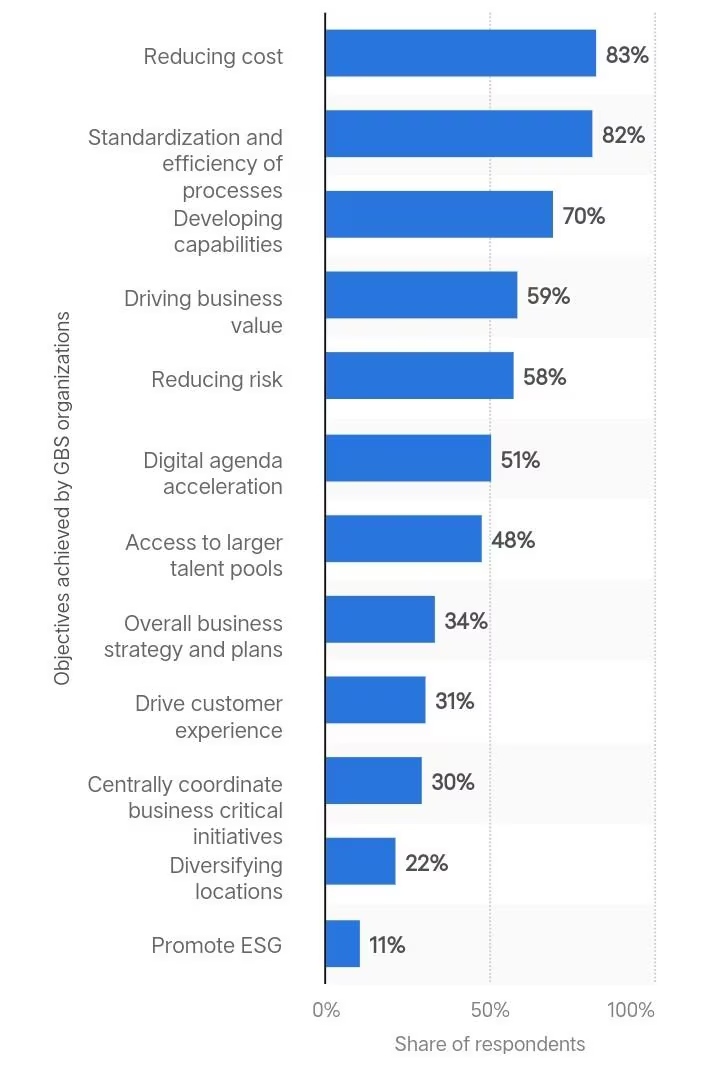
Objectives GBS organizations achieved in 2023. (Source)
So, next time, whenever you have a new idea, ask yourself these questions before directly working on the idea:
- Does it meet your customer needs?
- Can your budget support it?
- Can you implement it within the target timeframe?
(Related reading: the product development lifecycle & the product manager role.)
Provide training
Staff training fuels creativity and the curiosity to do better within teams. You have to provide your employees with targeted training to improve their problem-solving skills and creativity. But training alone isn’t enough. You can also mix things up by:
- Encouraging job rotation because it helps employees learn from one another and gain new perspectives.
- Giving rewards so they participate and continuously share breakthrough ideas.
Salary of a chief innovation officer
The salary of a chief innovation officer varies depending on the company location you're applying for, how big the organization is, the years of experience you have.
However, here are a couple of salary reports from 2024:
- Glassdoor's June 2024 update shows that the average chief innovation officer's salary varies between $317K and $593K annually.
- The latest Ziprecruiter.com 2024 report says that the chief innovation officer makes $151,203 annually.
- Per Salary.com, a chief innovation officer earns an average salary of $398,684 annually.
Note: These salary ranges are subject to change with time.
Summing up
Chief Innovation Officers (CINOs) lead their organization's innovation strategy by blending technical expertise with leadership and communication skills. By doing so, they drive initiatives to enhance efficiency and reduce costs within their organization. If you also want to become one, take the proper certifications to prepare and lead your teams in developing innovative solutions that meet customer needs.
Related Articles

How to Use LLMs for Log File Analysis: Examples, Workflows, and Best Practices

Beyond Deepfakes: Why Digital Provenance is Critical Now

The Best IT/Tech Conferences & Events of 2026

The Best Artificial Intelligence Conferences & Events of 2026

The Best Blockchain & Crypto Conferences in 2026

Log Analytics: How To Turn Log Data into Actionable Insights

The Best Security Conferences & Events 2026

Top Ransomware Attack Types in 2026 and How to Defend