AI Infrastructure Explained: How to Build Scalable LLM and ML Systems
Learn Muhammad Raza , Austin ChiaKey Takeaways
- AI infrastructure combines compute, storage, networking, and software to enable training and deployment of large-scale AI models.
- Observability and monitoring are essential to ensure reliable, high-performing AI systems in production.
- Real-world AI architectures demonstrate the complexity and scale required for modern AI applications, from single-node GPUs to cloud-native LLM clusters.
Artificial Intelligence (AI) has evolved from simple rule-based engines to massive, distributed deep learning systems capable of generating text, images, code, and real-time decisions.
To support this evolution, organizations require AI infrastructure: a combination of integrated hardware, software, networking, and orchestration to power modern machine learning workloads.
In this article, we’ll look at an overview of AI infrastructure, its components, patterns, and what it’s like with observability in AI infrastructure.
What Is AI Infrastructure?
AI infrastructure refers to the combination of physical and virtual components required to build, train, deploy, monitor, and maintain AI models at scale.
The stack of hardware and software typically spans:
- Compute: CPUs, GPUs, TPUs, distributed accelerators
- Storage: Object storage, block storage, memory-optimized stores
- Networking: High-speed interconnects, RDMA, low-latency fabrics
- ML Frameworks: PyTorch, TensorFlow, JAX
- Orchestration: Kubernetes, Ray, Slurm
- Data Pipelines: ETL, feature stores, data lakes
- Deployment Systems: Model serving frameworks, APIs, microservices
- Observability: Logs, metrics, traces, model monitoring
AI infrastructure ensures models can be:
- Trained efficiently on large datasets
- Deployed with high availability
- Scaled elastically
- Monitored for drift and performance issues Integrated with existing data systems
This means that AI infrastructure is the foundation laid in order for models to run effectively and at a large scale.
Core Components of AI Infrastructure
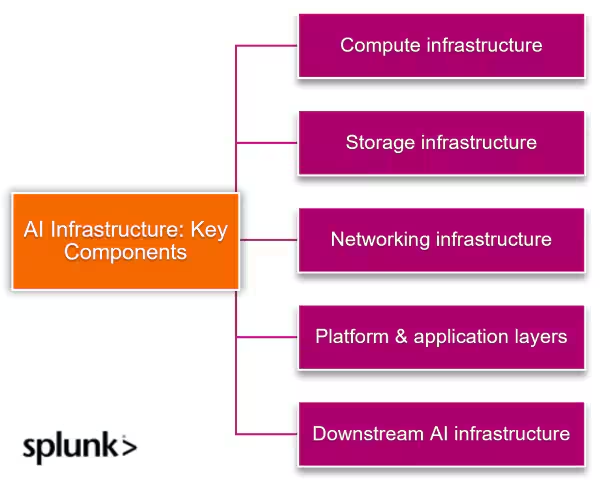
Although the full picture of AI infrastructure comes with many moving parts, there are some core components that cannot be missed. Here are some of them:
1. Compute Layer
AI workloads are compute-intensive, especially during training. The compute layer refers to the hardware and low-level systems used to execute machine learning workloads. It includes:
- GPUs: Primary accelerators for deep learning.
- TPUs: Specialized hardware from Google for large-scale matrix operations.
- Multi-node Clusters: Distributed systems for training large models.
CPUs are useful for inference and preprocessing, particularly for smaller models or batch workloads. For large LLMs, however, inference is typically dominated by GPUs or other specialized accelerators, which handle high-throughput, low-latency demands more efficiently.
Here’s why the compute level matters:
- Determines model training speed
- Controls inference latency
- Influences cost scaling
- Enables distributed training for large models
Computing resources can come in several tiers, such as:
- Training compute: heavy, multi-GPU, distributed
- Inference compute: optimized for low latency + high throughput
- Edge compute: small devices
2. Storage Layer
Storage is where data, model artifacts, checkpoints, and features live. AI is storage-heavy and, therefore, data volume, speed, and reliability matter. AI models rely on large datasets and high-throughput access patterns stored in the storage layer.
The storage layer in AI infrastructure is the part of the system responsible for holding and serving all the data, models, artifacts, and logs that AI workflows depend on. It provides the persistence, scalability, and throughput required for:
- Massive datasets used for training
- Model checkpoints
- Embeddings
- Logs and metrics
Common storage components include:
- Object Storage: S3, Azure Blob, GCS for training data.
- Block Storage: Training job volumes, databases.
- Distributed File Systems: HDFS, Alluxio, Lustre.
Why storage matters:
- High throughput, leading to faster training
- Durable storage, leading to safe checkpoints
- Low-latency access helps retrieval-heavy tasks (though most inference latency is driven by compute)
- Versioning, leading to reproducible ML
3. Networking Layer
Networking is where moving data, gradients, checkpoints, and inference requests have to be done efficiently.
High-performance networking is critical for distributed training. The networking layer in AI infrastructure is the part of the system that connects compute, storage, and serving components so they can efficiently move data, synchronize workloads, and communicate during training and inference. This allows for:
- Multi-GPU and multi-node training
- Fast data loading from storage
- Distributed compute synchronization
- Inference traffic routing
- Scaling across clusters
Networking determines:
- How fast GPUs exchange gradients
- Total training throughput
- Latency-sensitive inference performance
Three layers of networking
- High-Speed Cluster Networking (Training): Used to synchronize gradients across GPUs and is critical for distributed training. It reduces bottlenecks in model parallelism & data parallelism.
- Data Networking: It connects storage to compute and then to clients. It ensures datasets reach cluster nodes quickly. Load balancers also route inference traffic.
- Edge/Internet Networking: The CDN delivery of models with API gateways for LLM inference. This allows for multi-region routing.
4. Machine Learning Frameworks
Machine Learning Frameworks are software libraries (often with high-level APIs) that provide standardized tools for building ML and deep learning models and running computations on CPUs/GPUs/TPUs.
In a typical AI infrastructure stack, ML frameworks sit above the compute layer and below the application/agent layer.
Popular frameworks are:
- PyTorch: flexible, Pythonic, widely used for research
- TensorFlow: scalable, production-friendly
- JAX: high-performance automatic differentiation
These frameworks serve as the interface between model code and hardware accelerators. They can be valuable tools for:
- Tensor operations
- Autograd/automatic differentiation
- Neural network building blocks
- Distributed training
- Data pipelines
- Deployment tooling
AI Infrastructure Architecture Patterns
AI infrastructure can be organized in several architectural patterns depending on workload size, scale, and deployment needs. From single-node GPU setups for experimentation to distributed multi-node clusters for large-scale training, each pattern balances compute, storage, networking, and orchestration to optimize performance, scalability, and reliability.
Pattern 1: Single-Node GPU Workloads
Single-node GPU workloads are the most basic and common pattern in AI infrastructure. They are setups where all AI computation happens on one physical or virtual machine. This machine is equipped with one GPU or multiple GPUs within the same server. It is used for smaller models and prototyping.
Characteristics:
- 1–8 GPUs per node
- Local SSD for datasets
- Docker containers for reproducibility
- Great for fine-tuning LLMs
Pattern 2: Distributed Multi-Node Training Cluster
A Distributed Multi-Node Training Cluster is an AI infrastructure pattern where multiple servers (nodes) are connected together to train a model in parallel.
This pattern is required when a single machine is not powerful enough to train a model due to:
- Insufficient GPU memory
- Insufficient compute power
- Extremely large datasets
- Long training durations
Key components:
- GPU clusters with InfiniBand
- Kubernetes or Slurm for orchestration
- NCCL for GPU communication
- Shared filesystem or object storage
Here is an example workflow:
- Load data from distributed storage
- Run data parallelism or tensor parallelism
- Sync gradients across nodes
- Save checkpoints to durable storage
Pattern 3: AI-Optimized Data Lake Architecture
An AI-Optimized Data Lake Architecture is a data storage and processing pattern designed specifically for AI workloads. For example, it can be used for large-scale data ingestion, feature generation, training data pipelines, embeddings, and retrieval systems.
This is perfect for organizations with large, complex datasets. Features include:
- Raw and processed data layers
- Feature store for model-ready features
- Stream ingestion (Kafka/Kinesis)
- Batch pipelines (Airflow/dbt/Spark)
This supports both offline training and real-time inference.
Pattern 4: Cloud-Native AI Architecture
A Cloud-Native AI Architecture is an AI infrastructure pattern that fully leverages cloud-native principles to build, deploy, and operate AI systems.
They share the same characteristics as cloud architecture:
- Serverless data ingestion
- Cloud-managed GPU clusters
- Native integration with object storage
- Auto-scaling batch and inference systems
Examples of tools: AWS Sagemaker, Azure ML, and Google Vertex AI.
Observability in AI Infrastructure
Observability ensures AI systems behave reliably in production. This gives teams deep visibility into every part of an AI system so they can monitor, debug, optimize, and trust their AI systems.
This means that data pipelines, models, GPUs, distributed training, inference workloads, vector databases, RAG pipelines, and end-user behavior can all be assessed and accounted for.
There are several parts where observability can come in, such as:
- System Observability: CPU/GPU metrics, memory, network
- Pipeline Observability: DAGs, event logs, and retries
- Model Observability: drift, latency, accuracy
There are ready-made observability tools available as well:
- Splunk
- Prometheus + Grafana
- OpenTelemetry
- Kibana / Elastic
Learn more about end-to-end visibility into LLMs with Splunk >
Security in AI Infrastructure
Security considerations are also critical due to sensitive datasets and proprietary models. A single breach could expose company documents, model IP, customer data, and other sensitive information.
Therefore, there must be techniques and controls to protect data, models, pipelines, and inference systems from threats such as unauthorized access, data poisoning, model theft, manipulation, and AI-specific attacks.
Some key practices for ensuring good security are:
- Network segmentation for GPU clusters
- Secret management (Vault, KMS)
- Access control for model endpoints
- Dataset encryption at rest and in transit
- Supply chain security for container images
AI Infrastructure in the real world
Now, let’s look at a specific example of an AI infrastructure. Meta has previously published the details on its generative AI infrastructure that is used to train and run its latest LLM models including Llama 3.
The infrastructure includes two GPU clusters containing 24,576 flagship NVIDIA H100 GPUs. This is an upgrade from its previous AGI infrastructure that contained 16,000 NVIDIA A100 GPUs. The company further plans to extend its computing capacity by deploying 350,000 H100 chips by the end of this year.
These clusters run on two different network fabric systems:
- One network system is designed with RDMA over Converged Ethernet (RoCE).
- The other is based on the Nvidia Quantum2 InfiniBand network fabric.
Both solutions offer a 400Gbps endpoint speed. Meta uses its own AI platform called Grand Teton open sourced as part of its Open Compute Project (OCP) initiative. The platform is based on the Open Rack v3 (ORV3) network system design that has been adopted widely as an industry standard. The ORV3 ecosystem includes cooling capabilities optimized for its AI GPU clusters.
Storage is based on the Meta’s Tectonic filesystem that consolidates multitenant filesystem instances for exabyte-scale distributed data workloads. Other storage deployments include high capacity E1.S SSD storage systems based on the YV3 Sierra Point server platform.
Futureproof your infrastructure for AI
AI infrastructure is the foundation that powers modern AI applications, from LLMs to computer vision systems to embedded analytics. It involves many layers to make it work cohesively. This enables teams to design scalable, reliable, and cost-effective AI systems.
As AI adoption accelerates, organizations must invest not just in models, but in the robust, flexible infrastructure that supports them.
Related Articles

Production Environment Review: The Ultimate Checklist

SQL vs. NoSQL Today: Databases, Differences & When To Use Which