Accelerated Data Science and Deep Learning for a Predictive Testing Strategy
During .conf20 we presented alongside BMW Group the way a predictive testing strategy can enable better process efficiency in automotive manufacturing. We also introduced briefly which machine learning tools and analytical techniques were useful within the given situation. Now, the story continues and we’re excited to share how data science and deep learning tasks can be further accelerated. Before we get started, let’s recap the business challenge.
The Business Challenge
From a business perspective the use of predictive analytics should follow a clear goal. The ability to predict possible issues before they happen in production not only saves time and increases your process efficiency but also decreases cost and unwanted impacts on product quality. In addition, if you are able to provide your production staff with better information before production starts, you can shift from reactive to proactive and potentially even make their task easier.
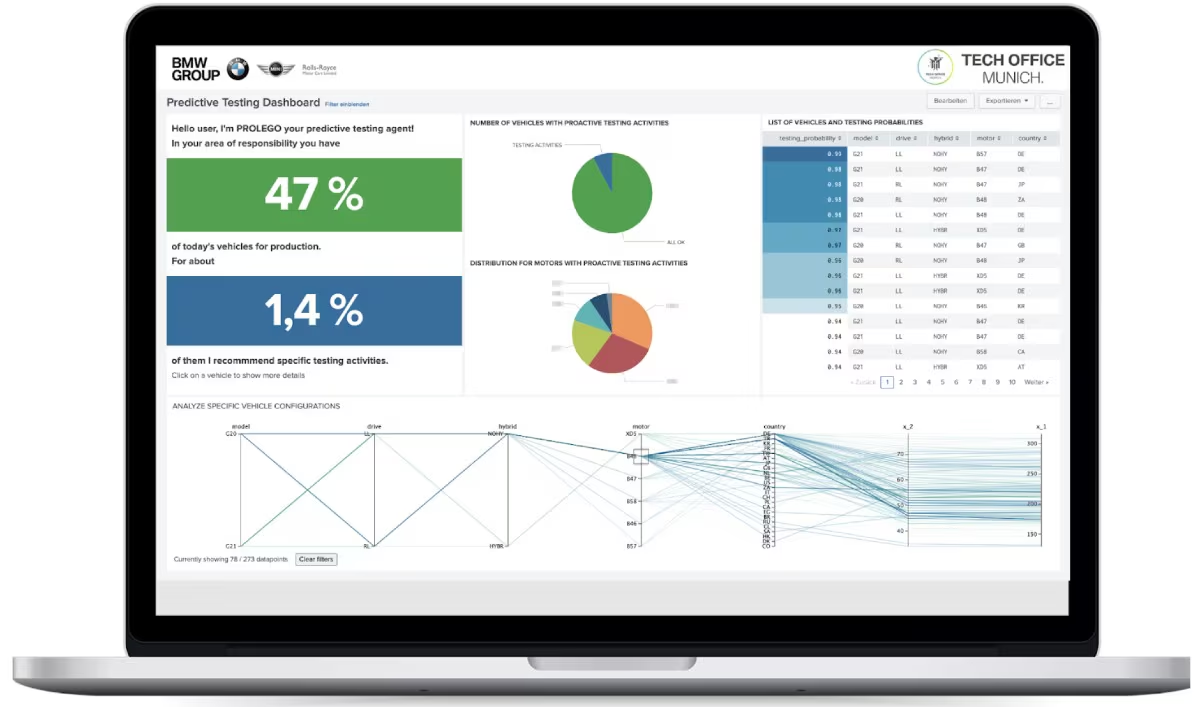
Build your Data Foundation for Machine Learning
The BMW Group’s production and data science teams use Splunk’s Data-to-Everything platform to collect a variety of data sources along the manufacturing process. This provides them with a data foundation that can be used to search for specific issues and analyze what has happened. The same data foundation can also be used to create machine learning models which use the specific product configuration as input to learn the connection between a car’s configuration and possible issues during production.
Accelerate Data Science Tasks with NVIDIA GPUs
Different data science tasks need to be performed in order to create analytics and machine learning models. It’s no secret that it takes time to run various algorithms on data. In some cases, SPL is good enough to extract the desired statistics. In other cases a more complex analytics pipeline is needed and it can easily run for minutes, hours or even longer. This slows down the iterative process of data science and takes more time to produce useful results. Luckily, sometimes computations can be parallelized and benefit from GPU acceleration.
In the example of the BMW Group’s predictive testing the Deep Learning Toolkit for Splunk was run on a NVIDIA DGX Station to accelerate the training of neural network models. This allows for quicker iterations and improvements in model development. For highly specific analytics pipelines, frameworks like RAPIDS were used to further accelerate explorative data science tasks and iterate more quickly.
Learn More at NVIDIA GTC
If you want to learn more about this exciting industry use case and its technical details, you’re invited to join us at NVIDIA GTC 21, the conference for AI innovators, technologists and creatives. Simply register for free and join our presentation on April 14th at 9am CEST. Should you not be able to make it, there will be a recording available after the event.

Last but not least, a big “thank you” to Marc Kamradt, Andreas Schoch and the team of BMW Group’s Tech Office Munich for the great collaboration. It’s a pleasure working with you and I’m looking forward to our presentation at the GTC conference.
Looking forward to seeing you there,
Philipp
Related Articles

How Splunk is Helping Shape the Future of Higher Education IT by Tackling EDUCAUSE 2026 Top Issues

Enhancing Government Resilience: How AI and Automation Empower Public Sector Missions

Solving Manual Mayhem in Telecom with Agentic AI

Upgrading to Splunk Enterprise 10.0 and Splunk Cloud Platform 10.0: Key Resources for Public Sector Customers

Building the Next Generation of Defenders: From the Classroom to the SOC of the Future

Analytics That Work: 3 Approaches for the Future of Contact Centers

Observability + Security: Real-Time Digital Resilience for SLED

Digital Resilience for State and Local Governments (Part Two)